


August
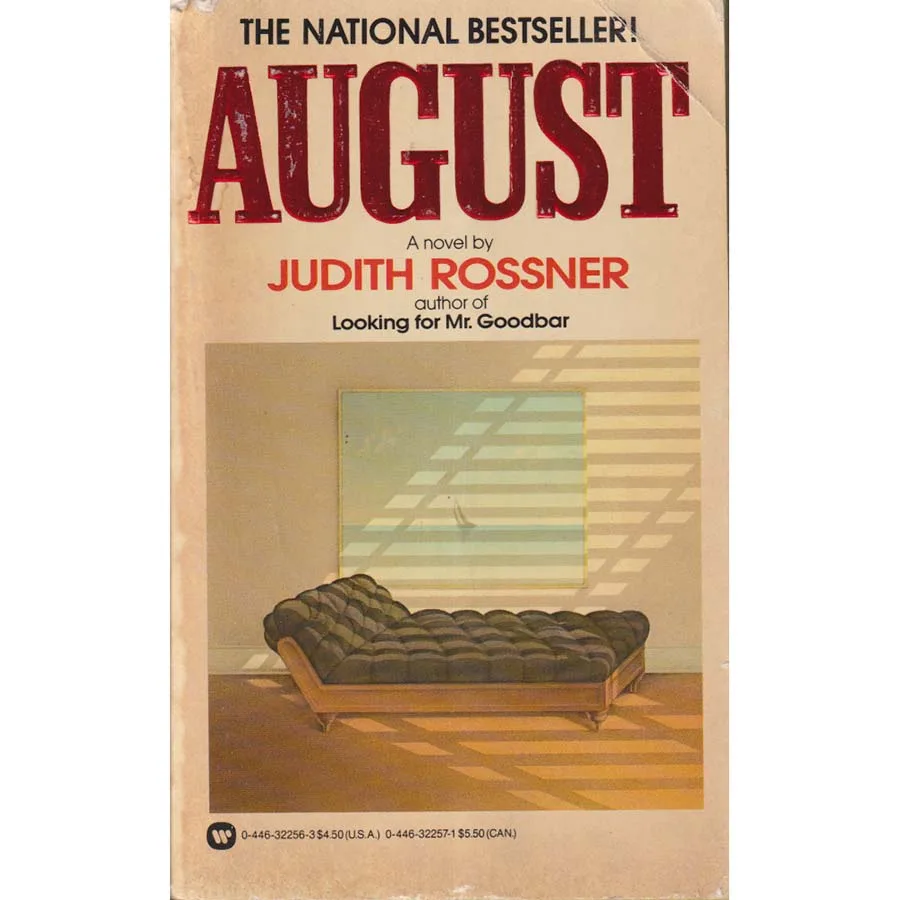
Publisher: Warner
Format: Paperback
ISBN: 070993004507
There are novels with dramatic titles like Storm of Destiny, The Last Empire, or Shadows of Vengeance. Then there is Judith Rossner’s August, a title so understated that it appears to have wandered into the publishing world by mistake. One half expects it to be followed by a subtitle such as "or Possibly September, Depending on Scheduling."
This, however, is no modest little seasonal tale. Published in 1983 by Warner, August is a substantial, intelligent, emotionally intricate novel from the author best known for Looking for Mr Goodbar. Rossner specialised in exploring the complicated machinery of human relationships, and here she turns her attention to one of the richest and most inexhaustible subjects in literature: why people become the way they are, and why understanding that fact often takes far longer than anyone would like.
At the heart of the novel lies a psychoanalyst and her patient, which immediately signals that readers should prepare themselves for a journey into the labyrinth of memory, family, identity, desire, disappointment, and all the other fascinating wreckage that accumulates inside the average human mind. This is not a novel in which people simply have feelings. They examine them, revisit them, reinterpret them, and occasionally spend several hundred pages attempting to understand them.
What makes Rossner’s work so compelling is that she approaches these emotional landscapes with genuine intelligence and compassion. The characters are not tidy literary devices arranged to prove a point. They are messy, contradictory, recognisable human beings who frequently make decisions that seem entirely understandable right up until the moment they prove disastrous.
Reading August today also provides a delightful glimpse into the intellectual atmosphere of the late twentieth century, when psychoanalysis still occupied a larger place in popular culture. There was a time when an astonishing number of novels, films, and conversations operated on the assumption that somewhere, somehow, a therapist would eventually explain everything. Whether this proved true remains open to debate, but it certainly generated some excellent fiction.
The title itself grows more intriguing the longer one considers it. Why August? Is it the month? The mood? The adjective meaning dignified and venerable? Rossner leaves readers to discover the answer for themselves, which is considerably more elegant than calling the book A Detailed Examination of Human Relationships and Personal Development Across Several Decades.
Like many ambitious literary novels of the period, August belongs to a time when publishers were entirely comfortable releasing long, thoughtful books that assumed readers possessed both patience and curiosity. There are no shortcuts here. Rossner expects engagement. Fortunately, she rewards it.
This 1983 Warner edition is also a pleasing artefact from an era when serious fiction and commercial success were not considered mutually exclusive. One can easily imagine this paperback travelling through airports, holiday suitcases, commuter bags, and bedside tables during the Thatcher-Reagan years, quietly encouraging readers to think deeply about the people around them.
Condition-wise, this copy is described as Good. It has clearly survived the intervening decades with admirable resilience and remains perfectly readable. Like many of Rossner’s characters, it may show a little evidence of experience but has emerged all the more interesting for it.
Whether you are interested in psychological fiction, literary family dramas, or simply enjoy novels that take human complexity seriously, August remains a rewarding and absorbing read. Thoughtful, perceptive, and emotionally rich, it demonstrates why Judith Rossner became one of the most respected novelists of her generation.
Exactly the sort of intelligent, slightly intimidating, and unexpectedly engrossing paperback that Crappy Old Books is delighted to rescue from obscurity and return to circulation before it has to spend another forty years explaining itself to the bookshelf.
Keep browsing: See more Fiction books Other books by Judith Rossner
