Trinity
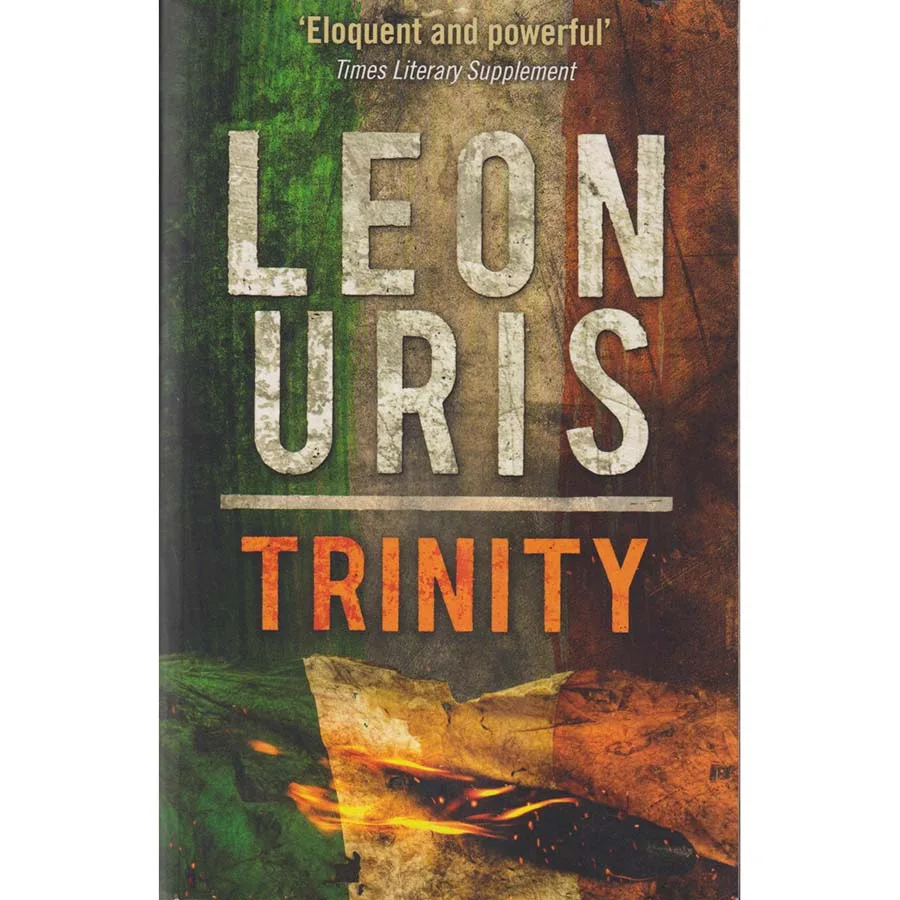
Publisher: Corgi
Format: Paperback
ISBN: 9780552170758
Some novels tell a story. Some novels tell several stories. Trinity by Leon Uris takes one look at such modest ambitions, laughs heartily, and proceeds to tell the story of an entire nation while simultaneously introducing enough characters, political upheavals, family dramas, betrayals, romances, revolutions, and historical grievances to populate a medium-sized county.
Originally published in 1976 and reissued here in a handsome 2015 Corgi edition, Trinity is one of those magnificent historical epics that belongs to a tradition modern publishing seems slightly nervous about. It is large, unapologetic, emotionally earnest, and utterly determined to educate you about Irish history whether you had planned to learn any or not.
The title itself is wonderfully economical. Just Trinity. Not A Brief Tale of Mild Administrative Disagreement in Nineteenth-Century Ireland. Not Some Fairly Important Historical Events Featuring a Number of Strongly Held Opinions. Simply Trinity. The confidence is admirable. It suggests a book entirely aware of the amount of narrative horsepower sitting beneath the cover.
Uris, of course, specialised in the sort of sweeping historical fiction that makes readers feel they have accidentally completed an undergraduate degree while lying on a sofa. He had a gift for taking enormous political and social movements and filtering them through the lives of memorable characters. In Trinity, the focus falls upon Ireland during one of the most turbulent periods in its history, with religious divisions, political tensions, land struggles, national identity, and generational conflict all colliding with remarkable force.
What makes the novel particularly entertaining is its refusal to do anything by halves. The emotions are large. The stakes are large. The historical forces are enormous. People do not merely disagree; they disagree with centuries of accumulated resentment standing behind them. Family arguments seem capable of altering the course of history. Local disputes acquire the weight of ancient prophecy. Even the weather occasionally feels as though it has chosen a political side.
Yet for all its scale, the novel remains intensely readable. Uris understood that history becomes far more compelling when attached to individuals. Readers come for the politics and stay for the people. Or perhaps they come for the people and accidentally acquire a working knowledge of nineteenth-century Irish affairs along the way. Either outcome represents excellent value.
There is also something rather refreshing about the book’s old-fashioned ambition. In an age of trilogies, spin-offs, prequels, sequels, cinematic universes, and twelve-volume fantasy cycles, Trinity simply arrives as a single enormous novel and gets on with the business of being enormous. It is a reminder that a sufficiently determined author can fit an astonishing amount of history between two covers.
The 2015 Corgi edition serves the book well. It retains all the grandeur of the original while being rather easier to carry than some historical monuments. It remains the ideal companion for long train journeys, rainy weekends, and those moments when one feels the need to disappear into another century for several hundred pages.
Condition-wise, this copy is described as Good. It has clearly survived its travels through the literary landscape without significant incident. It may show the gentle signs of having been read, which feels entirely appropriate. Books of this size are not decorative objects. They are expeditions.
For readers who enjoy historical fiction on the grandest possible scale, Trinity remains one of Leon Uris’s most celebrated achievements. Rich, dramatic, passionate, and gloriously ambitious, it offers the chance to become immersed in a pivotal period of Irish history while being thoroughly entertained. Exactly the sort of substantial, intelligent page-turner that Crappy Old Books is delighted to rescue from the shelves of history and send back into active service.
Keep browsing: See more Fiction books Other books by Leon Uris