


Thinking To Some Purpose
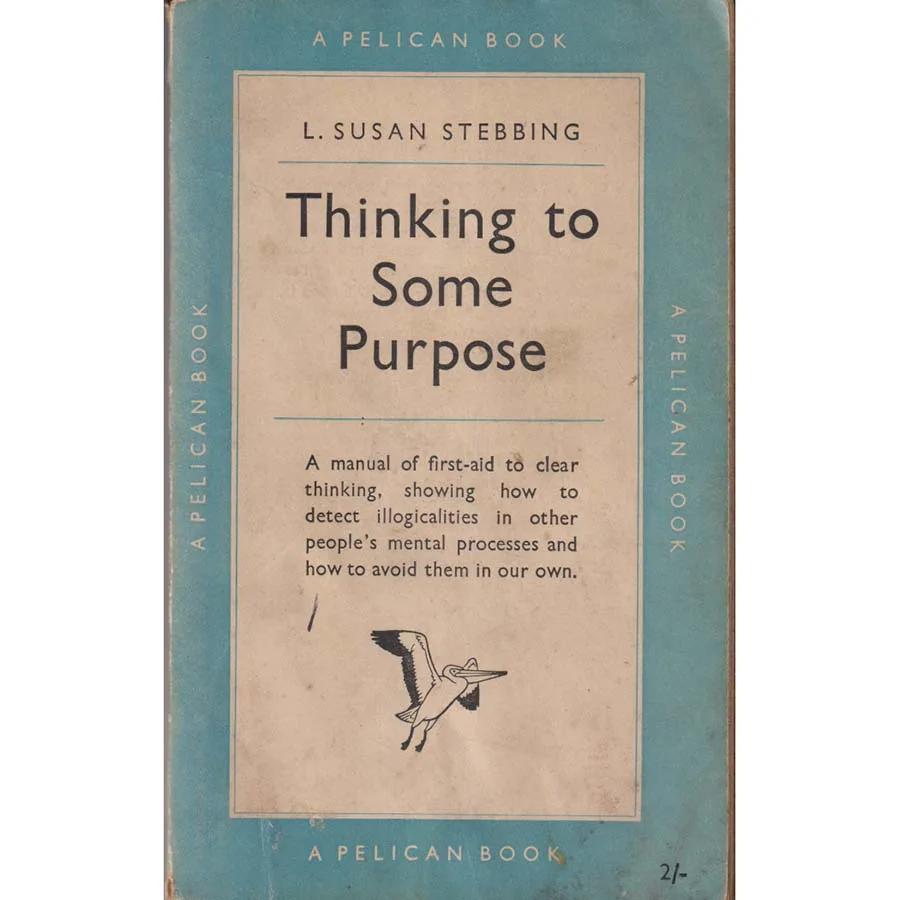
Publisher: Pelican Books
Format: Paperback
ISBN: none
There are books that tell you what to think. Thinking to Some Purpose takes a rather more ambitious approach and attempts to teach you how to think in the first place.
Written by L. Susan Stebbing and published in this 1952 Pelican Books edition, the work has become something of a classic in popular philosophy and critical thinking. First appearing during a period when public debate was becoming increasingly shaped by propaganda, advertising and political persuasion, it remains remarkably relevant in an age where everybody has an opinion and many people have several before breakfast.
Stebbing was one of Britain’s most distinguished philosophers, but one of her greatest achievements was her ability to explain complex ideas without disappearing into academic fog. She recognised that clear thinking was not merely a scholarly pastime. It was a practical skill that ordinary people needed in everyday life.
The book explores logic, reasoning, language and the many ways in which people manage to confuse themselves and each other. Readers quickly discover that human beings possess an astonishing talent for arriving at conclusions first and then searching enthusiastically for reasons afterwards.
There is a wonderful irony at the heart of the subject. Almost everyone believes they are a rational thinker. History, politics, advertising and family arguments provide overwhelming evidence to the contrary. Stebbing gently but firmly invites readers to examine their own assumptions before criticising everybody else’s.
What makes the book particularly fascinating is how modern it feels. Although published in the middle of the twentieth century, many of the problems Stebbing identifies remain stubbornly alive. Misleading arguments, emotional manipulation, vague language and confident nonsense continue to flourish with remarkable vigour.
Readers may occasionally experience moments of mild discomfort as they recognise some of the intellectual traps described in the book. This is entirely normal. One of the side effects of learning about faulty reasoning is discovering how often one has personally engaged in it.
There is also something refreshingly optimistic about Stebbing’s project. She genuinely believed that people could improve the quality of their thinking through practice and attention. In an era increasingly dominated by slogans and soundbites, this faith in reason feels almost heroic.
The Pelican Books imprint was famous for bringing serious ideas to a broad audience, and this volume represents the tradition at its finest. It treats readers as intelligent adults capable of engaging with important questions without requiring a university seminar or a small mountain of footnotes.
Modern readers may be amused to discover that many supposedly new problems of public discourse were already being discussed decades ago. The technology has changed dramatically. Human susceptibility to dubious arguments appears to have remained reassuringly constant.
This 1952 Pelican Books edition remains in good condition and comes from the shelves of Crappy Old Books. It has survived more than seventy years of political campaigns, advertising revolutions, management jargon and internet comment sections, all of which have inadvertently strengthened its case.
An excellent acquisition for philosophers, students, historians of ideas or anyone who occasionally suspects that clear thinking is in shorter supply than it ought to be. Intelligent, accessible and surprisingly entertaining, Thinking to Some Purpose is a reminder that the most useful tool we possess is often the one we forget to maintain.
Keep browsing: See more Academic books Other books by L Susan Stebbing
