


Archaeology Of The New Testiment
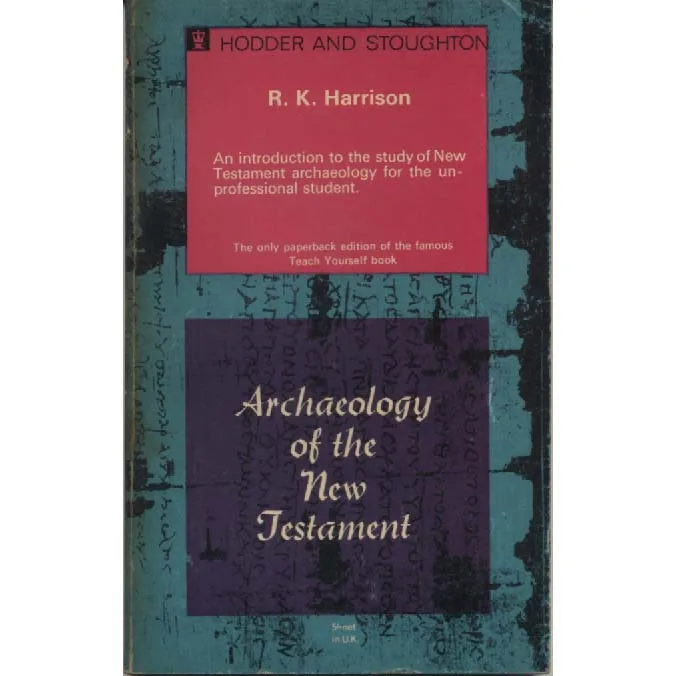
Publisher: Hodder and Stoughton
Format: Paperback
ISBN: none
There are some books that ask big questions about faith, history and civilisation. There are others that involve men in sensible jackets spending years brushing dirt off broken pottery. Archaeology of the New Testament somehow manages to combine both pursuits into a single volume.
Written by R.K. Harrison and published in 1964, this fascinating work explores the physical world behind the New Testament, taking readers beyond the familiar pages of scripture and into the dust, ruins, inscriptions and excavations of the ancient Near East. It is a reminder that history is occasionally discovered not in grand libraries but by someone kneeling in a trench wondering whether the oddly shaped lump they have just unearthed is a priceless artefact or yesterday’s lunch.
The great appeal of archaeology is that it has a habit of turning up uninvited evidence. Empires vanish, cities crumble, documents are lost and entire civilisations disappear beneath the soil. Then, decades or centuries later, someone arrives with a trowel and starts asking awkward questions. Harrison examines how archaeological discoveries illuminate the historical setting of the New Testament, bringing to life the cities, cultures and political realities of the first-century world.
What makes this book particularly charming today is that it comes from a period when archaeology still possessed a certain air of adventure. This was the era when discoveries regularly made newspaper headlines, scholars debated inscriptions with enormous enthusiasm, and every newly uncovered fragment seemed capable of rewriting somebody’s understanding of the ancient world. There is a wonderful optimism running through books of this period, a belief that history still had many secrets left to reveal.
Of course, there is something delightfully ironic about spending hundreds of pages investigating events from two thousand years ago while modern society struggles to remember where it left its car keys. Harrison’s world is one of Roman roads, ancient coins, ruined cities and forgotten inscriptions. It is a world where tiny fragments of stone and pottery become clues in a vast historical puzzle stretching across centuries.
Readers with an interest in biblical history will find plenty to enjoy, but the book also appeals to anyone fascinated by archaeology itself. Even when discussing technical subjects, there is an underlying sense of detective work. Each excavation, inscription or artefact becomes another piece of evidence helping to reconstruct a distant age.
As a physical object, this 1964 edition feels entirely appropriate for its subject matter. It has now become an historical artefact in its own right, a book about ancient history that has itself acquired a respectable amount of history. One suspects that future archaeologists may one day excavate piles of forgotten electronic devices and wonder why their owners abandoned perfectly good books in favour of them.
This copy remains in good condition and is sold by Crappy Old Books. It offers not only an exploration of the archaeological background to the New Testament but also a glimpse into a period when scholarship was presented with confidence, seriousness and the occasional whiff of pipe tobacco.
A thoughtful, engaging and surprisingly readable journey into the ancient world. Less treasure hunting than Hollywood would suggest, perhaps, but considerably more informative and with a far lower risk of being chased by giant rolling boulders.
Keep browsing: See more History books Other books by RK Harrison
