


The Bridge On The River Kwai
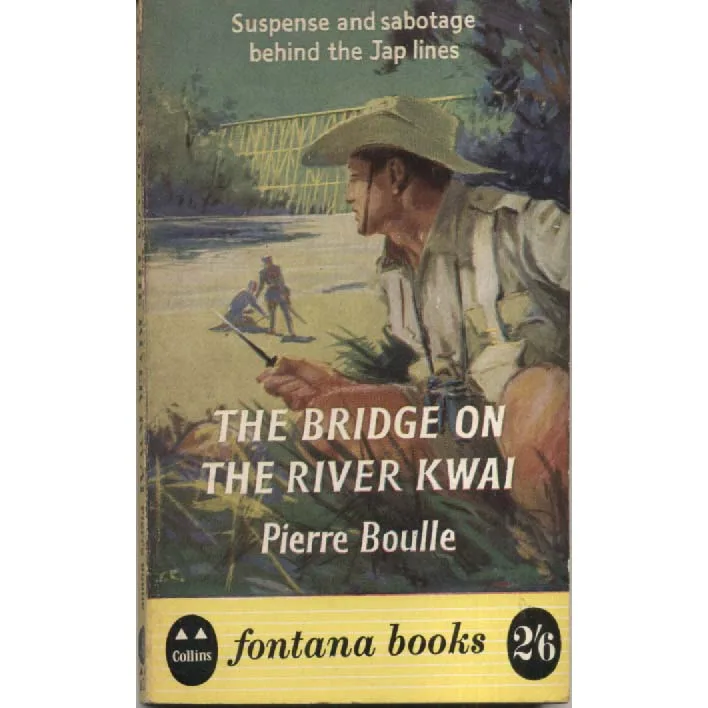
Publisher: Fontana
Format: Paperback
ISBN: none
The Bridge on the River Kwai is one of those novels that arrives carrying enormous historical weight, cinematic legend and just a faint whiff of tropical despair. Pierre Boulle’s classic tale of prisoners of war, impossible pride and railway engineering under catastrophic conditions somehow manages to be tense, philosophical and deeply British despite having been written by a Frenchman. Which feels appropriate somehow.
Published here in a stoically ageing 1959 Fontana edition, this is the sort of paperback that looks as though it should be discovered in a damp railway waiting room beside a thermos flask and unresolved wartime memories.
The story itself is magnificent. British POWs held by the Japanese during the Second World War are ordered to construct a bridge in the Burmese jungle, and what follows becomes less a simple war story than an increasingly bizarre duel of discipline, obsession and national character. Men are starving, exhausted and imprisoned, yet somehow still arguing about proper standards of workmanship.
Which is, in its own way, the most British thing imaginable.
At the centre stands Colonel Nicholson, one of literature’s great examples of professionalism slowly mutating into madness. Presented with forced labour in horrific conditions, his response is essentially: “Very well, but we shall organise it correctly.” Watching military dignity and engineering pride spiral together into something faintly absurd is one of the book’s great pleasures.
The novel has all the ingredients of classic mid-century war fiction: heat, mud, moral ambiguity, existential fatigue and men making catastrophic decisions while remaining impeccably polite. Unlike modern war thrillers full of explosions and cinematic banter, The Bridge on the River Kwai is strangely thoughtful. Everyone spends a great deal of time wrestling with honour, duty and whether competence itself can become dangerous.
And then of course there is the strange irony that many people know the cheerful whistling tune from the film without necessarily remembering that the story itself is about imprisonment, psychological collapse and the complete breakdown of rational priorities in the jungle.
As a 1959 Fontana paperback, this edition almost certainly possesses exactly the right atmosphere. Condition is Good, meaning it has weathered time with the stoic endurance of a retired sergeant-major. Expect softened pages, edge wear and perhaps the faint aroma of attic dust, tobacco and old paperbacks once sold at railway kiosks for people embarking on long journeys involving sandwiches in foil.
There is no ISBN because this book comes from the era before publishing fully surrendered to numerical bureaucracy. Back then a paperback simply existed, often with dramatic cover art and the quiet expectation that readers could locate books without algorithms.
A gripping, intelligent and oddly ironic wartime classic in which courage, stubbornness and engineering enthusiasm collide spectacularly in the jungle. Equal parts adventure story, psychological study and cautionary tale about what happens when competent men become far too emotionally invested in infrastructure projects.
Keep browsing: See more War books Other books by Pierre Boulle
