


Why Do We Quote
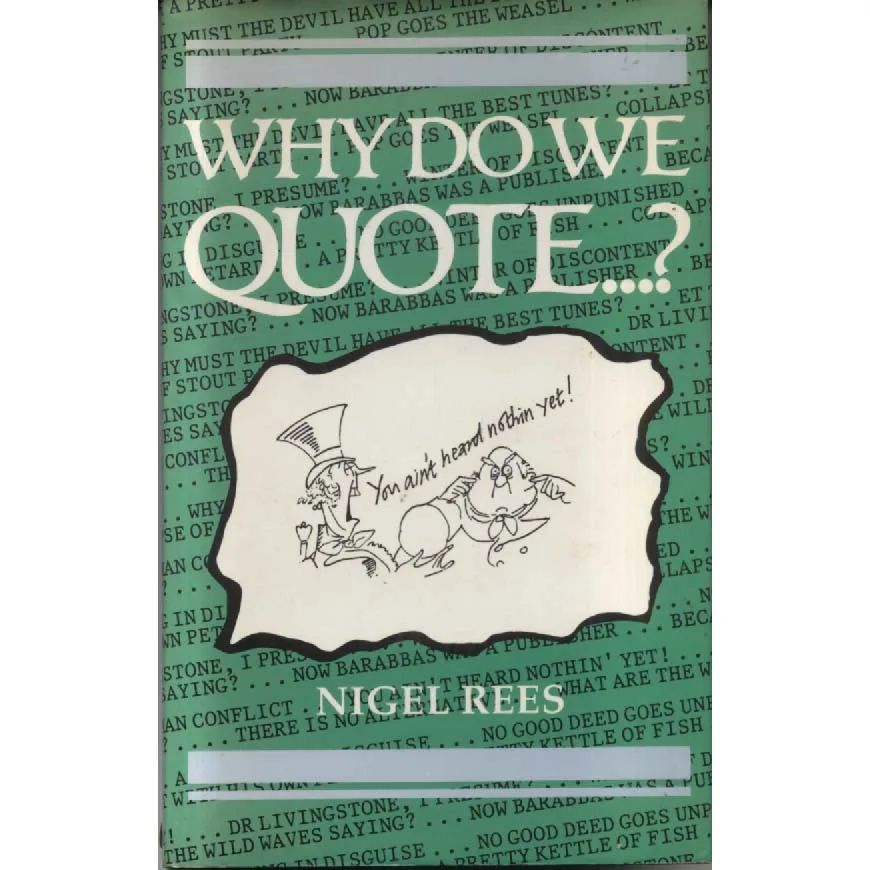
Publisher: Blandford Press
Format: Hardback
ISBN: 9780713721010
Nigel Rees’s Why Do We Quote is a wonderfully British investigation into humanity’s curious habit of endlessly repeating things other people said, usually to sound intelligent, cultured, witty, authoritative, or at the very least slightly less lost during dinner parties. It is, in essence, a book about people borrowing the verbal furniture of dead Romans, playwrights, politicians and comedians in order to survive ordinary conversation.
Rees, best known for his encyclopaedic relationship with quotations and radio panel-show culture, approaches the subject with the enthusiasm of a man who has spent decades noticing that half the things confidently attributed to Oscar Wilde were probably never said by Oscar Wilde at all. The result is part linguistic detective work, part cultural anthropology, and part long-form appreciation of humanity’s determination to repeat the same phrases for centuries while pretending they are fresh observations.
The joy of the book lies in its mixture of scholarship and mild exasperation. Rees clearly loves quotations, but he also seems deeply aware that people use them in faintly ridiculous ways. A quotation can elevate a speech, rescue a dull article, end an argument, impress a date, or disguise the fact that one has absolutely nothing original to contribute. Politicians quote Churchill. Students quote Nietzsche. Office managers quote motivational posters. Everybody quietly hopes nobody checks the source.
Published in 1989, the book also captures a fascinating pre-internet world where tracking down a quotation still required actual effort rather than typing fragments into a search engine at 2am. This was an era when misquotations could circulate for years with a kind of majestic confidence. Libraries mattered. Reference books mattered. Nigel Rees mattered. Somewhere in Britain, a man in corduroy probably bought this specifically to win arguments in pubs.
There is also something gloriously analogue about the whole enterprise. Modern culture bombards us with quotes stripped of context and slapped onto sunsets in aggressively inspirational fonts. Rees belongs to an older tradition where quotations were treated as living cultural artefacts rather than social media wallpaper for people named “Claire x”. He is interested not merely in what was said, but why certain phrases survive while others disappear into the historical void.
Condition is Good, meaning this copy has likely survived years of being consulted by crossword enthusiasts, after-dinner speakers, amateur dramatics societies, and at least one person trying to remember who originally said “Hell is other people.” A thoroughly entertaining literary oddity from Crappy Old Books, where reference works, political memoirs and inexplicable 1980s hardbacks continue their long and dignified campaign against minimalism.
Keep browsing: See more Non-Fiction books Other books by Nigel Rees
