


Rebellions
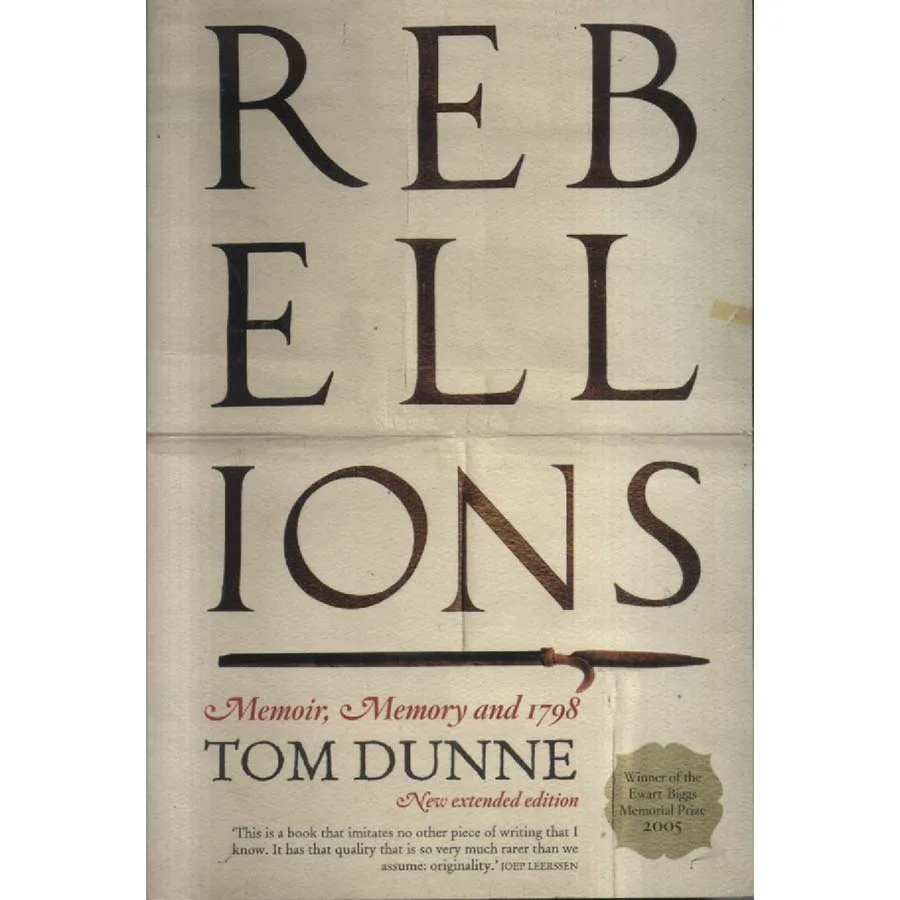
Publisher: The Lilliput Press
Format: Paperback
ISBN: 9781843511885
There are history books that politely summarise political unrest, and then there is Rebellions by Tom Dunne, which dives headlong into the gloriously chaotic Irish tradition of resisting authority with speeches, pamphlets, idealism, secret meetings, doomed optimism, and occasionally farm tools.
Because if there is one thing Irish history has never lacked, it is rebellions.
Large rebellions, small rebellions, planned rebellions, accidental rebellions, rebellions betrayed by informers, rebellions crushed by empires, rebellions romanticised afterwards, and rebellions whose participants almost certainly believed things would go much better than they actually did. Tom Dunne’s book navigates this long and emotionally charged history with intelligence, nuance, and a welcome awareness that national myth and historical reality are not always identical twins.
And that is what makes the book so compelling.
Irish rebellions are often remembered in broad symbolic strokes: brave patriots versus oppressive rule, martyrs versus empire, idealism versus force. Dunne restores texture, contradiction, and humanity to the story. The rebels emerge not as statues in public squares but as real people shaped by religion, politics, local grievances, revolutionary ideas, fear, hope, and occasional catastrophic miscalculation.
There is something wonderfully ironic about revolutionary history in general. Most rebellions fail. Frequently quite badly. Yet failure itself often becomes fuel for future nationalism, mythology, songs, anniversaries, and political identity. History repeatedly demonstrates that losing dramatically can sometimes prove more culturally influential than winning quietly.
The book moves through centuries of upheaval and resistance, revealing how rebellion in Ireland became not just a political act but almost a recurring national language. Generations inherited memories of earlier struggles, reshaping them according to the needs of their own time. Every uprising carried echoes of previous ones.
Tom Dunne writes with the calm authority of a historian who knows these stories are already dramatic enough without theatrical exaggeration. That restraint is one of the book’s strengths. The violence, idealism, repression, and tragedy emerge naturally from the material itself. Readers are trusted to grasp the emotional and political weight without constant heroic framing.
And naturally, because this is Irish history, the cast includes an astonishing mixture of visionaries, radicals, poets, priests, organisers, idealists, pragmatists, and people who probably realised halfway through events that matters had become significantly more dangerous than anticipated.
One of the pleasures of Rebellions is the way it captures the deep interconnectedness of Irish political history. Uprisings are shown not as isolated explosions but as part of a longer continuum shaped by empire, land, religion, class, and identity. The same unresolved tensions keep resurfacing generation after generation in slightly altered forms.
There is also a distinctly modern resonance to the book. It quietly reminds readers how nations are built not just through constitutions and institutions but through memory, storytelling, commemoration, and argument over what past events actually meant. Rebellions never truly end. They simply migrate into speeches, textbooks, murals, anniversaries, and political debates.
Published by The Lilliput Press, this is exactly the sort of thoughtful Irish history book that manages to feel both scholarly and intensely alive. It belongs to that excellent category of works that make readers increasingly aware that beneath every national myth lies a much stranger and more complicated reality.
Condition is listed as Good, meaning this copy has survived the traditional hazards faced by serious Irish history books: emphatic underlining beside revolutionary speeches, readers muttering “it’s more complicated than that actually”, and long pauses while reconsidering entire centuries of Anglo-Irish relations.
An excellent read for students of Irish history, political movements, revolutionary culture, or anyone fascinated by the extraordinary persistence of rebellion as both historical event and national identity.
Keep browsing: See more History books Other books by Tom Dunne
