


Second City
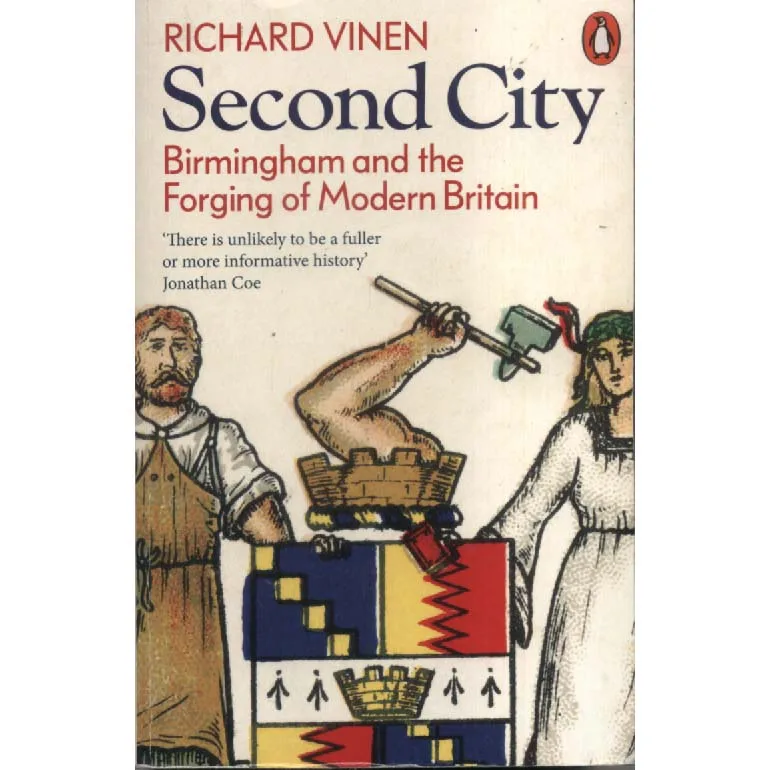
Publisher: Penguin Books
Format: Paperback
ISBN: 9780141993171
There are books about Birmingham, and then there is Second City by Richard Vinen — a work that approaches Britain’s famously complicated “second city” with the fascinated seriousness usually reserved for collapsing empires, ideological experiments, or ancient civilisations built entirely around ring roads.
Birmingham has always occupied a strange place in the British imagination. Too large to ignore, too successful to dismiss entirely, and yet permanently forced into a national role somewhere between industrial powerhouse, municipal punchline, and concrete cautionary tale. Vinen dives directly into this contradiction, tracing the city’s history through manufacturing, migration, politics, class, architecture, ambition, decline, reinvention, and endless arguments about what Birmingham actually is.
And that, really, is the joy of the book. Birmingham refuses to behave like a tidy historical subject.
This is a city that helped build modern Britain while somehow remaining the place Londoners still occasionally speak about as though it were a speculative concept. It produced industry, engineering, radical politics, heavy metal, shopping centres, and enough canals to make Venice quietly uncomfortable, yet continues to carry an odd national insecurity complex. Second City understands this perfectly.
Richard Vinen writes with intelligence, clarity, and a dry awareness of the absurdities of urban history. Birmingham emerges not as a caricature of post-industrial decline nor as a simplistic success story, but as a sprawling, contradictory organism shaped by factories, planners, immigrants, businessmen, idealists, bureaucrats, and motorists with increasingly desperate expressions.
The postwar sections are especially fascinating. Britain spent decades simultaneously rebuilding Birmingham and apologising for it. Entire districts vanished beneath road systems and concrete redevelopment schemes that now feel like ambitious experiments conducted by people who had recently discovered geometry. Somewhere in the twentieth century, city planners collectively concluded that the ideal urban future involved underpasses, shopping precincts, and very determined traffic management.
And yet Birmingham endured.
That endurance gives the book much of its emotional force. Beneath the jokes about accents, ring roads, and impossible navigation lies a city with immense economic, cultural, and demographic importance. Vinen captures the way Birmingham often functions as a kind of unofficial laboratory for modern Britain itself — immigration, deindustrialisation, multiculturalism, suburban growth, consumer culture, and urban reinvention all appearing here in concentrated form.
One of the pleasures of Second City is how it treats Birmingham seriously without becoming solemn. The city’s absurdities remain intact. This is still a place where Victorian civic grandeur collides with 1960s concrete, where canals unexpectedly appear beside financial districts, and where local pride often exists alongside a deeply ingrained habit of self-deprecation.
There is also something wonderfully ironic about the title itself. “Second City” sounds almost defensive, as though Britain permanently insists on ranking urban centres like league tables. Birmingham has spent generations being measured against London while quietly becoming one of the defining cities of modern British history regardless.
This 2023 Penguin edition makes an excellent modern history read: accessible enough for general readers, detailed enough for serious urban-history enthusiasts, and full of the strange social and political textures that make cities endlessly fascinating. It is the sort of book that makes readers look differently at shopping centres, factory districts, suburban estates, and motorway junctions afterwards.
Condition is listed as Good, meaning this copy has survived the usual hazards faced by contemporary history books: commuter bags, bedside reading piles, coffee near important chapters on urban planning, and readers repeatedly stopping to say, “Actually, Birmingham is far more interesting than people think.”
An excellent book for readers of British social history, urban studies, postwar Britain, or anyone fascinated by the endlessly strange story of the city that helped build modern Britain while never quite convincing the country to admit it.
Keep browsing: See more History books Other books by Richard Vinen
