


Nature - 2019 January - Vol 565 No 7740
Publisher: Nature
Format: Paperback
ISBN: 9770028083095
There are magazines that open the year with optimism, productivity tips, or cheerful predictions about the future. Nature – January 2019, Vol. 565 No. 7740 instead begins by reconstructing the geological birth of the Andes Mountains over millions of years while also worrying about humanoid robots and digital periscopes. Which feels far more honest, really.
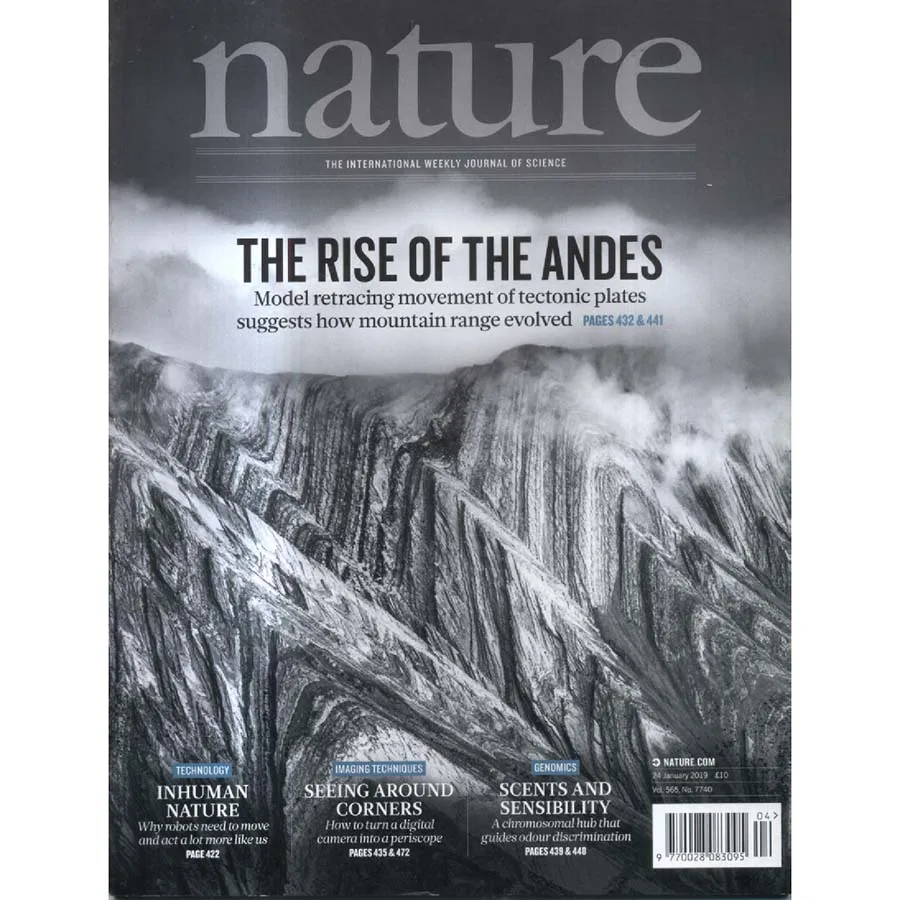
The cover image is magnificent: stark black-and-white ridges of the Andes folding across the page like the exposed circuitry of the planet itself. Beneath the headline “THE RISE OF THE ANDES”, scientists calmly explain they have retraced tectonic plate movements to understand how the mountain range evolved. Humanity, apparently, had reached the point where not only could we map Earth’s geology, we could effectively rewind continents like a slow-motion replay.
There is something deeply reassuring about geology in Nature. Amid all the artificial intelligence, gene editing, and microscopic existential terror elsewhere in science, mountains remain gloriously patient. The Andes did not emerge from a startup culture pivot or a machine-learning model. They were assembled over unimaginable spans of time by crushing tectonic forces with absolutely no concern for quarterly performance targets.
And naturally, because this is Nature, the issue immediately pivots from mountain-building into robots attempting to behave more like humans. The “Inhuman Nature” feature explores why robots need to move and act more naturally, which is precisely the kind of sentence that quietly signals civilisation may be drifting toward a very interesting future.
One can almost feel the unease behind the research. Scientists are carefully refining robot behaviour while humanity collectively hopes they stop just short of becoming emotionally judgemental.
Meanwhile, another article discusses imaging around corners using digital cameras and periscopic reconstruction techniques. Which sounds suspiciously like the early stages of technologies that eventually appear in dystopian police dramas. By 2019, science was steadily entering its “seeing things you technically shouldn’t be able to see” era.
Then there is the genomics feature concerning odour discrimination, because Nature never misses an opportunity to remind readers that even smelling things is vastly more complicated than expected. Somewhere inside these pages are detailed explanations proving your nose is essentially running advanced biochemical pattern-recognition software at all times.
One of the enduring pleasures of Nature is its extraordinary editorial composure. “Model retracing movement of tectonic plates suggests how mountain range evolved,” it says politely, as though reverse-engineering continental history is an entirely routine activity carried out between meetings.
Owning a copy of Nature also projects a very particular intellectual atmosphere. It suggests curiosity, seriousness, and perhaps the occasional desire to casually mention tectonic reconstruction models during conversations. Whether you actually read the geophysics paper or simply admired the dramatic mountain photography while feeling pleasantly overwhelmed is beside the point.
This January 2019 issue now feels like a perfect snapshot of the late-2010s scientific mood — an era balancing deep-time geological perspective against rapidly accelerating technological change. Humanity was simultaneously studying mountains formed over millions of years and teaching robots how to move more convincingly through shopping centres.
Condition is listed as Good, meaning this copy has survived the traditional hazards faced by elite scientific journals: overloaded academic bags, office desks crowded with unread aspirations, coffee perilously near important diagrams, and years spent sitting in carefully curated piles labelled “must properly read later”.
A superb issue for science enthusiasts, geology fans, robotics readers, or anyone who enjoys magazines that casually combine tectonic plate evolution, humanoid movement research, and around-the-corner imaging into one beautifully intimidating package.
Keep browsing: See more Nature Journal books Other books by Nature
