


Nature - 2019 June - Vol 570 No 7759
Publisher: Nature
Format: Paperback
ISBN: 9770028083095
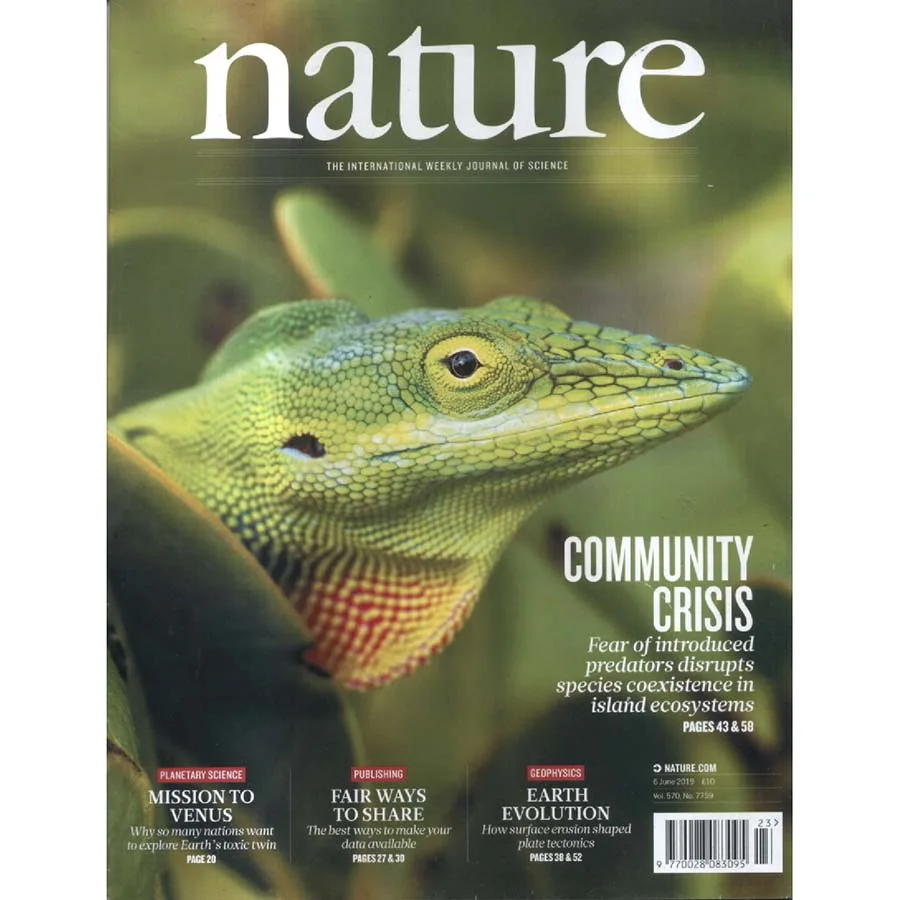
There are magazines that gently encourage readers to reconnect with nature. Nature – June 2019, Vol. 570 No. 7759 instead presents a highly judgemental-looking lizard beneath the headline “COMMUNITY CRISIS” and calmly explains that fear itself can destabilise entire ecosystems. Which, frankly, feels increasingly relatable.
The cover star — a brilliantly green anole perched among leaves — has the expression of a creature that has seen things go badly wrong on its island and would now prefer not to discuss it. According to the featured research, introduced predators do not merely eat species; the fear they create disrupts coexistence throughout island ecosystems. In other words, ecology has officially entered its psychological-thriller phase.
The cover photograph is magnificent. The lizard looks both elegant and deeply suspicious, like a tropical academic who has just discovered humanity has once again interfered with a perfectly functioning system. Somewhere inside this issue, researchers are quantifying fear responses across entire ecological communities while the rest of us are still trying to answer emails without existential fatigue.
And naturally, because this is Nature, the issue immediately expands into several other casually enormous subjects. There are missions to Venus, discussions on open scientific data-sharing, and studies on how Earth’s surface erosion shaped plate tectonics. Few publications can move from anxious island lizards to planetary exploration and geophysics without blinking. Reading Nature often feels like being dragged through the entire operating manual of reality at high speed.
The Venus article is especially delightful because humanity remains incapable of resisting the urge to investigate inhospitable planets. “Earth’s toxic twin” is apparently not enough of a warning. Somewhere in these pages are scientists earnestly planning missions into an atmosphere capable of destroying most machinery while insisting this is a perfectly reasonable career path.
Meanwhile, the “Fair Ways to Share” feature reminds readers that even science itself requires diplomacy. Behind every groundbreaking discovery lurk datasets, arguments over access, and at least one researcher wondering who forgot to upload the correct files.
The geophysics feature quietly carries the classic Nature energy of revealing that Earth itself is involved in processes vastly older and more complicated than human civilisation. Plate tectonics, erosion, ecosystems, climate — everything is interconnected, dynamic, and mildly terrifying if considered for too long.
One of the enduring pleasures of Nature is its extraordinary editorial calmness. “Fear of introduced predators disrupts species coexistence,” it notes politely, as though ecological collapse driven by psychological stress is just another charming feature of island life. The magazine never panics. It simply continues documenting the increasingly complex systems holding existence together.
Owning a copy of Nature also projects a very particular intellectual atmosphere. It suggests someone deeply curious about science, ecosystems, and perhaps the future of Venus exploration. Whether you actually read the ecological modelling article or simply admired the deeply photogenic lizard while feeling spiritually represented is entirely secondary.
This June 2019 issue now feels especially reflective of the late-2010s scientific mood — a period where ecology, planetary science, and systems thinking increasingly merged into one giant interconnected narrative. The more science learned, the more obvious it became that absolutely everything affects everything else.
Condition is listed as Good, meaning this copy has survived the traditional hazards endured by elite scientific journals: backpacks full of unread ambition, desks occupied by over-caffeinated researchers, coffee perilously near important diagrams, and years spent in carefully curated “must read properly” piles.
A superb issue for science enthusiasts, reptile lovers, ecology readers, or anyone who enjoys magazines that casually combine anxious lizards, planetary exploration, and tectonic evolution into one beautifully intimidating package.
Keep browsing: See more Nature Journal books Other books by Nature
