


Nature - 2019 July - Vol 571 No 7763
Publisher: Nature
Format: Paperback
ISBN: 9770028083095
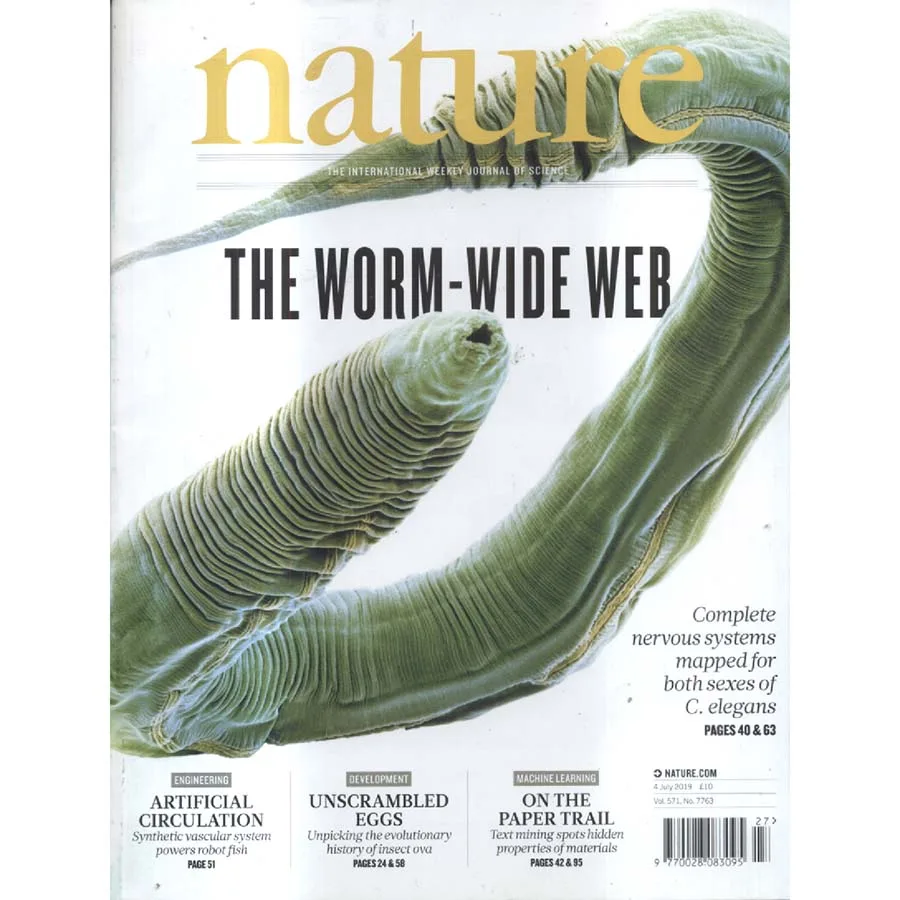
There are magazines that try to reassure readers that science is understandable. Nature – July 2019, Vol. 571 No. 7763 instead places gigantic microscopic worms across the cover beneath the headline “THE WORM-WIDE WEB” and calmly announces that complete nervous systems have been mapped. Humanity, apparently, had reached the point where even worms were now generating neurological infrastructure diagrams.
The cover image is gloriously unsettling. Magnified C. elegans loom across the page like alien noodles from a deeply intellectual nightmare. There is something magnificently ironic about a publication capable of making tiny transparent worms appear both scientifically important and faintly threatening. One suspects these creatures know far more about neural connectivity than most office departments.
The lead feature concerns the complete mapping of nervous systems for both sexes of C. elegans, because modern biology has evolved beyond simply observing life into fully reverse-engineering it. Somewhere inside this issue are scientists tracing every neural connection of organisms smaller than a paperclip while the rest of humanity struggles to untangle headphone cables.
And naturally, because this is Nature, the issue refuses to remain within one scientific discipline for longer than thirty seconds. Elsewhere inside: robot fish powered by synthetic vascular systems, machine learning extracting hidden properties from materials papers, and evolutionary mysteries of insect eggs. Reading Nature is often less like consuming a magazine and more like accidentally overhearing civilisation’s research department during a particularly productive week.
The robot fish feature is especially delightful because humanity appears constitutionally incapable of leaving fish alone. If researchers are not studying their sleep patterns, they are building artificial versions powered by synthetic circulation systems. Somewhere beneath the oceans of the future, there may eventually be schools of biomechanical fish conducting highly important tasks while real fish look on in confusion.
Meanwhile, the machine-learning article quietly hints at the increasingly strange relationship between AI and scientific discovery. By 2019, computers were no longer just helping organise research — they were beginning to uncover hidden patterns in knowledge itself. Nature presents this calmly, as though humanity teaching algorithms to mine the literature for secrets is a perfectly ordinary Tuesday development.
One of the enduring pleasures of Nature is this extraordinary editorial composure. “Complete nervous systems mapped,” it says politely, while readers stare at giant worms and reconsider everything they know about biology. The magazine never oversells its content because it understands that the universe is already absurd enough without additional hype.
Owning a copy of Nature also carries a very specific intellectual atmosphere. It suggests curiosity, seriousness, perhaps even the occasional opinion on nematode neuroanatomy. Whether you actually read the dense connectome article or simply admired the giant worm imagery while feeling academically inadequate is entirely secondary. The aspiration is part of the experience.
This July 2019 issue now feels especially emblematic of the era: biology becoming computational, AI entering scientific workflows, and engineering increasingly imitating nature itself. Every discipline seemed to be merging into one giant interdisciplinary project aimed at decoding reality before the batteries ran out.
Condition is listed as Good, meaning this copy has survived the standard hazards endured by elite scientific journals: backpacks full of unread ambition, academic office desks, coffee perilously close to important diagrams, and years spent waiting patiently in stacks labelled “must properly read later”.
An outstanding issue for science enthusiasts, neuroscience obsessives, AI-curious readers, or anyone who enjoys magazines that casually combine giant worms, robot fish, and machine-learning literature mining into one beautifully surreal package.
Keep browsing: See more Nature Journal books Other books by Nature
