


Nature - 2019 January - Vol 565 No 7739
Publisher: Nature
Format: Paperback
ISBN: 9770028083095
There are magazines that cautiously bridge the gap between past and future. Nature – January 2019, Vol. 565 No. 7739 simply bolts robotic limbs onto prehistoric skeletons and charges directly across the divide with complete confidence.
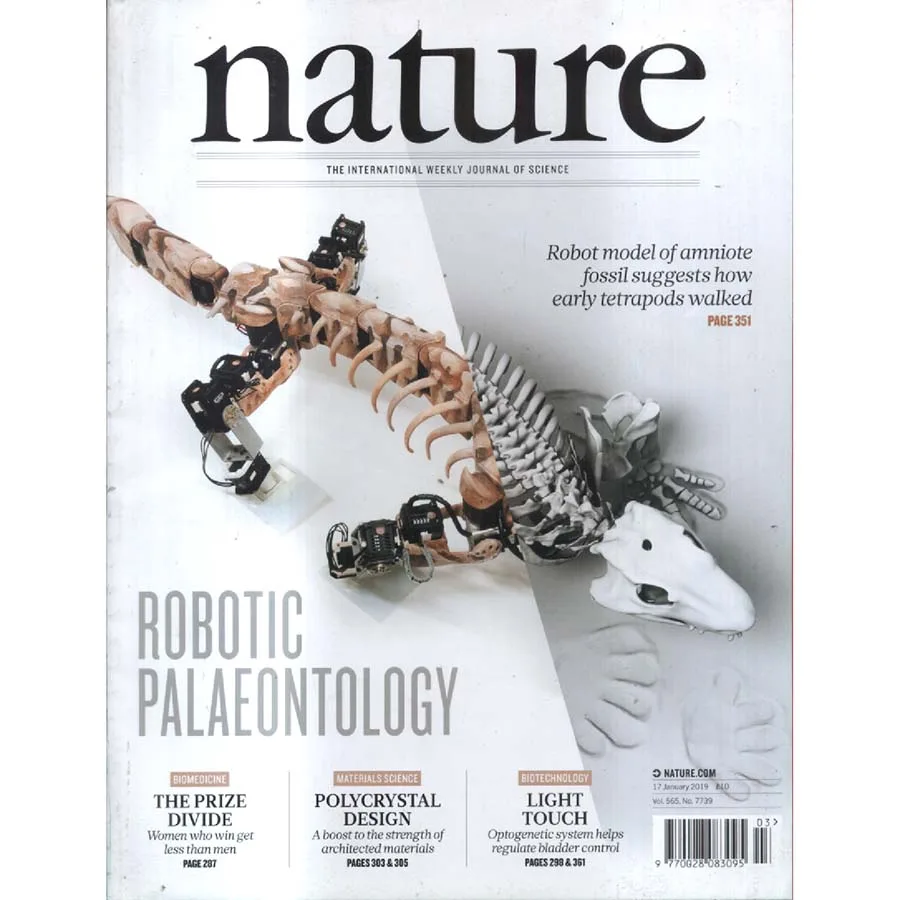
Beneath the magnificent headline “ROBOTIC PALAEONTOLOGY”, this issue documents scientists building a robot model of an ancient amniote fossil to work out how early tetrapods walked. Which is a wonderfully elaborate solution to a question most people did not realise existed. Somewhere in these pages, researchers decided the best way to understand prehistoric locomotion was to construct a semi-mechanical fossil creature and make it wander about like a deeply academic horror film prop.
The cover image is extraordinary. Half fossil, half robot, the reconstructed tetrapod looks like something engineered during a collaboration between a museum, a robotics laboratory, and a particularly ambitious child with access to grants. It radiates the exact sort of energy one expects from modern science: “What if palaeontology, biomechanics, and robotics all became the same discipline for a while?”
And naturally, because this is Nature, the issue immediately expands beyond robotic fossil creatures into a broader survey of humanity attempting to master existence itself. There are articles on gender pay disparities in biomedical research, advanced materials engineering, and optogenetics helping regulate bladder control. One moment readers are studying the gait of ancient tetrapods, the next they are confronting structural inequality and light-controlled organ systems. It is all perfectly normal in the Nature universe.
The “Light Touch” feature is especially delightful because optogenetics continues to sound like a fictional technology from a futuristic medical thriller. By 2019, science had reached the stage where shining light into biological systems to regulate functions no longer counted as science fiction but merely “biotechnology”.
Meanwhile, the materials-science article on strengthening architected materials quietly reminds readers that humanity is redesigning matter itself while simultaneously reverse-engineering how prehistoric creatures shuffled through swampy landscapes hundreds of millions of years ago. Few species multitask quite like Homo sapiens.
One of the enduring pleasures of Nature is the extraordinary composure with which it presents all this. “Robot model suggests how early tetrapods walked,” it says calmly, as though robotic fossil reconstruction is an entirely routine Thursday activity. The magazine never overstates its discoveries because it assumes readers are already appropriately impressed or intimidated.
Owning a copy of Nature also carries a certain aspirational theatre. It suggests someone deeply engaged with the frontiers of science, engineering, and human understanding. Whether you actually read the biomechanics paper or merely admired the magnificent robo-lizard skeleton while feeling pleasantly underqualified is secondary. The magazine functions beautifully as both serious scientific literature and decorative evidence of intellectual ambition.
This January 2019 issue now feels especially emblematic of the era: a period when scientific disciplines increasingly merged together into strange hybrid forms. Robotics met palaeontology, optics met medicine, and computational systems quietly infiltrated every field imaginable. The future was arriving, but it often looked unexpectedly skeletal.
Condition is listed as Good, meaning this copy has survived the usual hazards endured by elite scientific journals: overcrowded office shelves, coffee consumed near highly important diagrams, backpacks full of unread aspirations, and years spent waiting patiently for someone to finally tackle the article on tetrapod locomotion properly.
A superb issue for science enthusiasts, fossil obsessives, robotics fans, or anyone who enjoys magazines that casually combine prehistoric skeletons and modern engineering into one gloriously improbable package.
Keep browsing: See more Nature Journal books Other books by Nature
