


Nature - 2019 March - Vol 567 No 7748
Publisher: Nature
Format: Paperback
ISBN: 9770028083095
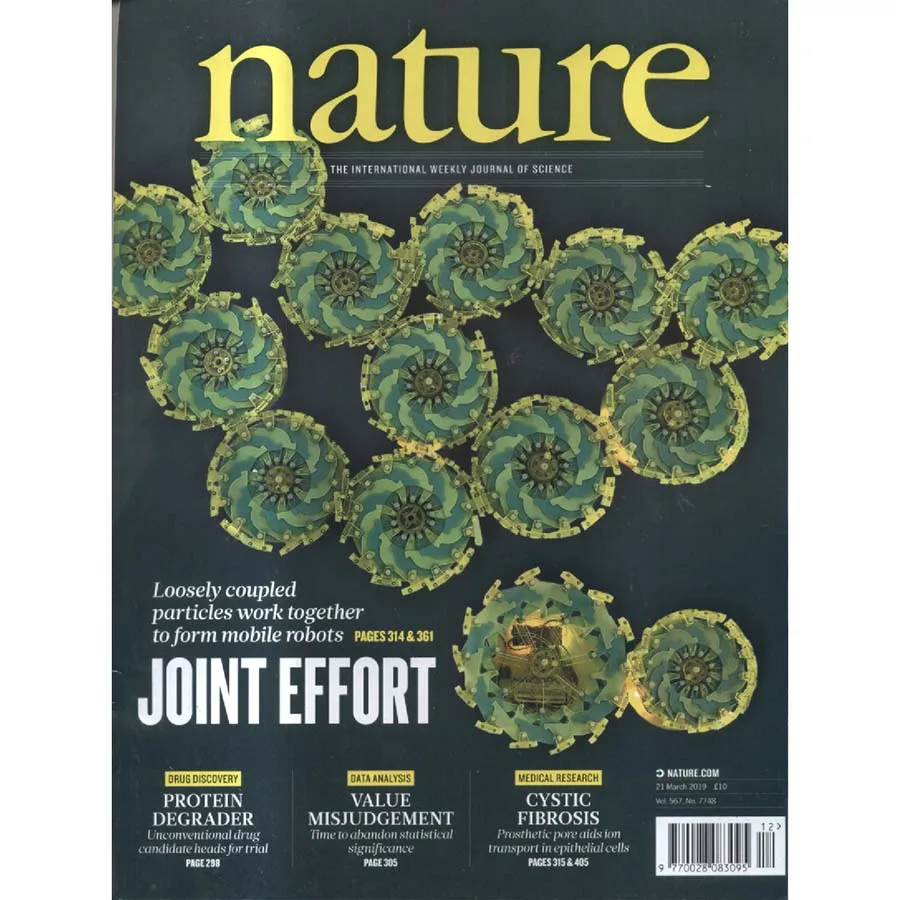
There are magazines that gently suggest the future may eventually arrive. Nature – March 2019, Vol. 567 No. 7748 instead kicks down the door carrying a swarm of tiny coordinated robots beneath the headline “JOINT EFFORT”, calmly informing readers that loosely coupled particles can now work together to form mobile machines. Which is exactly how every respectable robot uprising begins.
The cover artwork is magnificent: clusters of circular mechanical units gathering like futuristic sea creatures or extremely organised biscuits. Somewhere between microscopic engineering and collaborative robotics, humanity apparently decided individual machines were no longer ambitious enough and began teaching swarms of components to cooperate instead. Nothing concerning about that whatsoever.
The lead feature explores how these particles work collectively to form mobile robots, which sounds wonderfully innocent until you realise scientists are essentially studying emergent behaviour in autonomous systems. By 2019, Nature had fully entered its “quietly documenting the early stages of science fiction” era, and this issue is a perfect example.
And naturally, because this is Nature, the issue refuses to limit itself to robotic collectives. Elsewhere inside are discussions on unconventional drug candidates, the dangers of statistical misjudgement, and new approaches to cystic fibrosis treatment. Few magazines can move from swarm robotics to data-analysis philosophy and medical breakthroughs without suffering narrative collapse. Reading Nature often feels like speed-running every discipline in modern civilisation simultaneously.
The “Value Misjudgement” article is especially charming because it acknowledges one of science’s oldest traditions: discovering astonishing things while arguing furiously about whether the statistics are valid. Somewhere beneath every revolutionary breakthrough lies a tense spreadsheet and at least one exhausted researcher muttering about significance thresholds.
Meanwhile, “Protein Reader” sounds suspiciously like either an advanced pharmaceutical tool or an unfortunate machine capable of reviewing gym diets. In reality it concerns drug discovery, proving once again that biomedical science increasingly resembles highly technical wizardry explained through calm academic prose.
One of the enduring delights of Nature is its editorial composure. “Particles work together to form mobile robots,” it says politely, as though this is not the sort of sentence that would have caused public panic fifty years earlier. The magazine never overreacts. It simply continues cataloguing humanity’s increasingly strange achievements with tasteful typography and excellent photography.
Owning a copy of Nature also broadcasts a very particular type of intellectual ambition. It suggests someone deeply engaged with the frontiers of science and technology. Whether you actually read the detailed robotics article or merely admired the futuristic swarm imagery while feeling gently intimidated is beside the point. Nature excels equally as scientific literature and aspirational self-improvement décor.
This March 2019 issue now feels especially fascinating in hindsight. It captures a moment when robotics, AI, biotechnology, and data science were all accelerating simultaneously, creating the peculiar atmosphere that the future was quietly assembling itself behind laboratory doors.
Condition is listed as Good, meaning this copy has survived the traditional hazards faced by elite scientific journals: overloaded backpacks, desks belonging to over-caffeinated researchers, coffee perilously near important diagrams, and years spent in carefully maintained piles of “serious things I absolutely intend to finish reading”.
A superb issue for science enthusiasts, robotics fans, statisticians with unresolved trauma, or anyone who enjoys magazines that casually combine swarm machines, protein discovery, and statistical philosophy into one beautifully intimidating package.
Keep browsing: See more Nature Journal books Other books by Nature
