


Nature - 2019 October - Vol 574 No 7779
Publisher: Nature
Format: Paperback
ISBN: 9770028083095
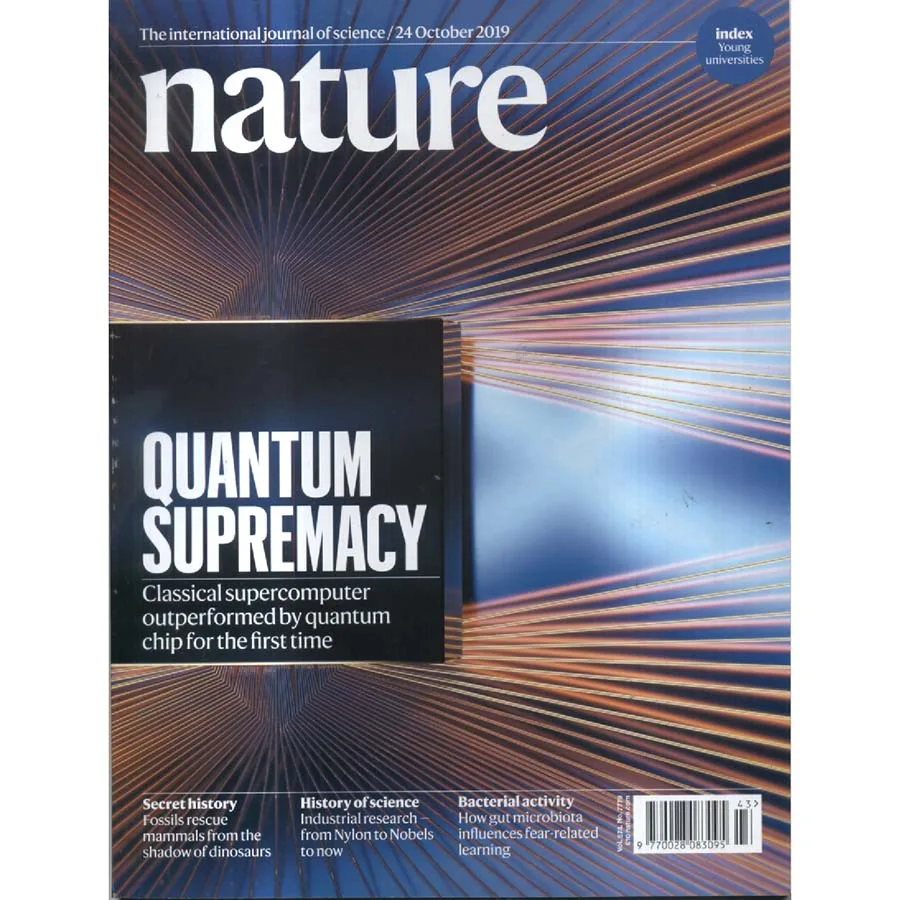
There are magazine covers that age gracefully, and then there are covers like Nature – October 2019, Vol. 574 No. 7779, which practically hum with the energy of humanity accidentally opening the next technological era ahead of schedule. Beneath blazing lines of light sits the wonderfully understated headline “QUANTUM SUPREMACY” — a phrase that sounds either like a landmark computing breakthrough or the title of a deeply expensive synthwave album.
This issue documents the moment a quantum chip reportedly outperformed a classical supercomputer for the first time, which is one of those events that scientists describe calmly while everyone else quietly wonders whether the machines are now legally allowed to become mysterious. Somewhere in these pages are researchers discussing qubits, computational states, and probabilities in ways that make ordinary laptops seem like Victorian adding machines.
The cover artwork is magnificent. A black cube radiates impossible streams of light like a monolith from a near-future civilisation where mathematics has become architecture. It feels less like a science journal and more like a warning delivered through exceptionally tasteful graphic design.
And because this is Nature, the issue immediately expands beyond quantum computing into an entire buffet of intellectual ambition. There are fossil discoveries revealing the hidden history of early mammals, reflections on industrial research from nylon to Nobel prizes, and articles about gut microbiota influencing fear-related learning. Few magazines can move from prehistoric mammals to bacteria affecting emotions without missing a beat. By page twenty, readers are left with the uneasy suspicion that literally everything in the universe is interconnected and slightly stranger than previously advertised.
The microbiota article is especially delightful because it continues the modern scientific tradition of discovering that the tiny organisms living inside us are quietly involved in practically every aspect of existence. At this point, one suspects future Nature issues may reveal that gut bacteria are also responsible for tax returns and poor parking decisions.
Meanwhile, the “history of science” feature reminds readers that behind every modern breakthrough lies decades of industrial laboratories, obscure experiments, and exhausted researchers trying to convince funding committees that their bizarre idea might eventually change civilisation. Occasionally, astonishingly, they turn out to be right.
One of the enduring joys of Nature is the extraordinary restraint of its tone. “Classical supercomputer outperformed by quantum chip for the first time,” it says calmly, as though humanity has not just crossed into a realm previously reserved for speculative fiction. The magazine never panics. It simply documents the future arriving in weekly instalments.
Owning a copy of Nature also projects a particular kind of intellectual aspiration. It suggests someone who casually follows advances in quantum computation over breakfast. Whether you actually understood the quantum-supremacy article or simply stared at the glowing cover while feeling pleasantly overwhelmed is largely irrelevant. The magazine works equally well as advanced scientific literature and evidence that you once had ambitious reading plans.
This October 2019 issue now feels especially historic — a snapshot from the exact moment quantum computing shifted from theoretical promise into something frighteningly tangible. Reading it today carries the same atmosphere as looking at early space-race headlines or first-generation internet coverage: the sense that a technological threshold has quietly been crossed.
Condition is listed as Good, meaning this copy has survived the standard hazards faced by elite scientific journals: backpacks overloaded with unread ambition, office desks occupied by stressed researchers, coffee consumed too close to important diagrams, and years spent waiting patiently in stacks labelled “must properly read later”.
An outstanding issue for science enthusiasts, futurists, computing obsessives, or anyone who enjoys magazines that casually announce the beginning of the quantum age while also discussing dinosaur-era mammals and emotionally influential bacteria.
Keep browsing: See more Nature Journal books Other books by Nature
