


Nature - 2019 April - Vol 568 No 7753
Publisher: Nature
Format: Paperback
ISBN: 9770028083095
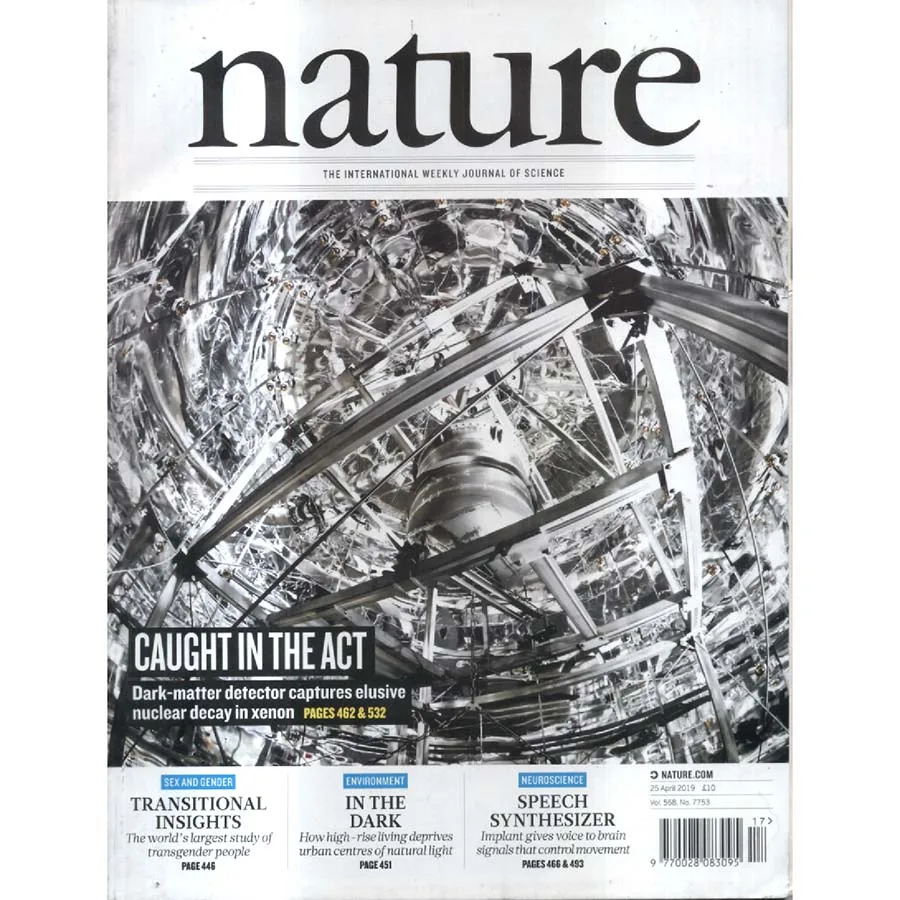
There are magazines that promise escapism, and then there is Nature – April 2019, Vol. 568 No. 7753, which opens by informing readers that scientists may have finally caught elusive nuclear decay events inside a dark-matter detector. In other words, while most of humanity was worrying about emails and parking tickets, physicists were deep underground attempting to trap fragments of the universe behaving suspiciously.
The cover image is gloriously intimidating: an enormous gleaming metallic chamber resembling either an advanced dark-matter experiment or the engine room of a starship moments before catastrophe. Beneath the headline “CAUGHT IN THE ACT”, the issue radiates the very particular energy of scientists spending billions to detect something that may or may not fundamentally redefine reality.
And that is part of the enduring joy of Nature. It treats the potential unraveling of the cosmos with complete editorial composure. “Dark-matter detector captures elusive nuclear decay in xenon,” it says politely, as though this were no more dramatic than observing an unusually large pigeon. Somewhere inside are people who genuinely understand xenon decay signatures. The rest of us are simply grateful they appear confident.
Naturally, the issue does not stop at potentially universe-altering physics. Elsewhere inside, neuroscientists are building speech synthesizers linked directly to brain signals, environmental researchers are studying how artificial light affects urban trees, and one of the world’s largest studies of transgender people offers new social and medical insights. It is the classic Nature experience: civilisation sprinting simultaneously toward deeper understanding of matter, consciousness, identity, and the environment, all before page fifty.
The brain-linked speech synthesizer feature is especially wonderful because it sounds exactly like technology from a near-future science-fiction film, except it is real and peer-reviewed. By 2019, science had reached the stage where reading Nature often felt like accidentally glimpsing tomorrow several years ahead of schedule.
Meanwhile, the urban-lighting article quietly reveals that even trees are now involved in complicated interactions with human infrastructure. At this point, virtually every issue of Nature contains at least one feature gently reminding readers that absolutely nothing in the natural world is simple anymore.
There is also something beautifully ironic about the magazine’s overall tone. Humanity may be probing dark matter, rewiring communication through neural implants, and studying societal transformation at unprecedented scales, yet Nature continues presenting it all with the calm layout discipline of a very serious railway timetable.
Owning a copy of Nature projects a specific kind of intellectual aspiration. It suggests someone deeply engaged with frontier science, possibly capable of discussing xenon decay over coffee. Whether you actually read the dense physics article or simply admired the astonishing machinery on the cover while feeling pleasantly inadequate is secondary. The magazine excels equally as scientific literature and aspirational décor.
This April 2019 issue now feels like a perfect snapshot of late-2010s scientific culture — an era of accelerating discovery where physics, neuroscience, social science, and environmental research all seemed to be advancing at once. Every page carries the faint sense that humanity was collectively opening doors it might not yet fully understand.
Condition is listed as Good, meaning this copy has survived the standard hazards faced by elite scientific journals: backpacks stuffed with unread ambition, academic office desks, coffee placed perilously close to important diagrams, and years spent in carefully curated piles labelled “must properly read later”.
A superb issue for science enthusiasts, physics lovers, futurists, neuroscience readers, or anyone who enjoys magazines that casually combine dark matter, brain-machine interfaces, and urban tree stress into one beautifully intimidating package.
Keep browsing: See more Nature Journal books Other books by Nature
