


Nature - 2019 January - Vol 566 No 7744
Publisher: Nature
Format: Paperback
ISBN: 9770028083095
Technically, Nature – Vol. 566 No. 7744 is a science journal. Spiritually, however, it is a beautifully designed weekly reminder that humanity has organised itself into increasingly complicated groups of people studying increasingly strange things beneath the ocean of existence.
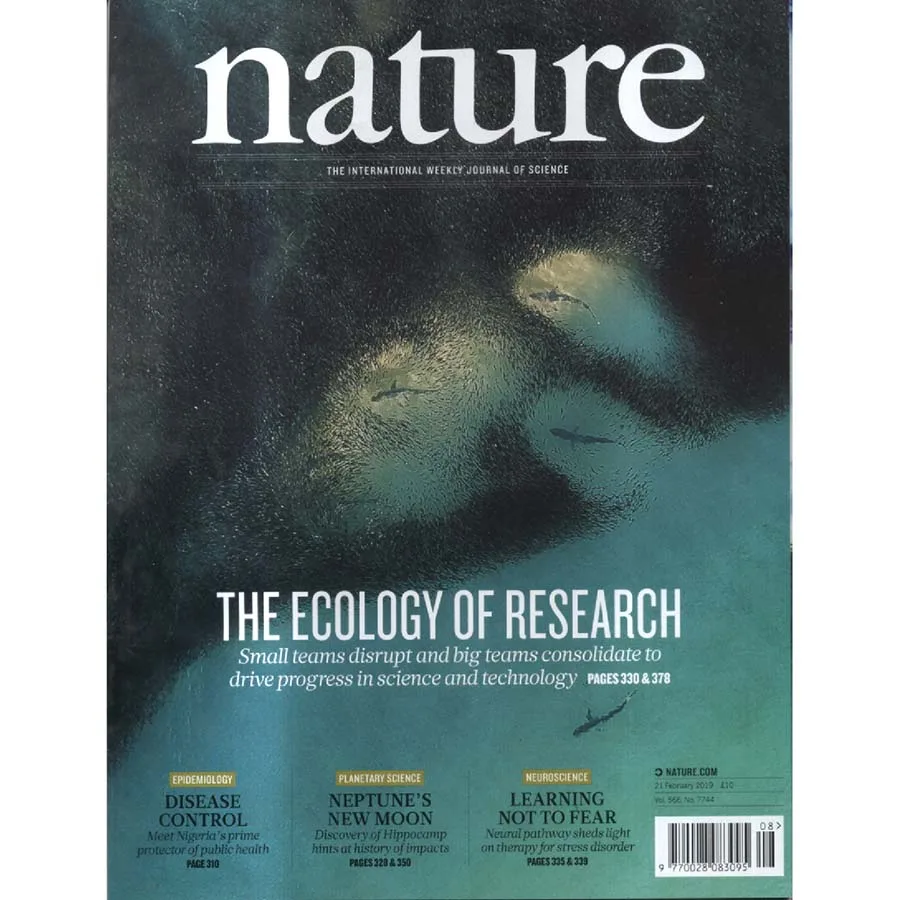
This February 2019 issue arrives beneath the hauntingly philosophical headline “THE ECOLOGY OF RESEARCH”, accompanied by an abstract underwater swarm scene that looks less like academic collaboration and more like bioluminescent fish attending a highly competitive management seminar. According to the featured article, small research teams disrupt while large teams consolidate — which is a wonderfully elegant scientific way of saying that breakthroughs often begin with a few sleep-deprived obsessives before giant institutions arrive carrying PowerPoint presentations.
The cover itself is superbly atmospheric. Tiny illuminated clusters drift through dark waters like ideas forming in the depths of human knowledge. It is strangely calming while simultaneously implying that science itself may behave like a deep-sea ecosystem populated by grant applications and caffeinated postgraduates.
And naturally, because this is Nature, the issue refuses to limit itself to merely examining the sociology of science. Elsewhere inside, there is epidemiology in Nigeria, discoveries about Neptune’s moon Hippocamp, and neuroscience approaches to fear and stress disorders. Few magazines can leap from research-team dynamics to distant moons and psychological trauma without missing a beat. Reading Nature often feels like humanity attempting to speedrun the entire universe before lunch.
The Hippocamp feature is particularly delightful because astronomers continue their long tradition of discovering objects in deep space and immediately assigning them names that sound either mythological or faintly medicinal. Somewhere in this issue are scientists calmly analysing the impact history of a tiny moon orbiting Neptune while most of the population struggles to remember where they left their charger cables.
Meanwhile, “Learning Not to Fear” explores neural pathways and stress therapy, which means that even anxiety has now become a highly technical interdisciplinary project. One gets the sense that modern science will eventually reduce every aspect of human existence into beautifully formatted diagrams and extremely expensive imaging scans.
One of the enduring charms of Nature is its extraordinary composure. “Disease control”, “planetary science”, “stress disorder therapy” — all are presented with the same quiet confidence and understated typography. The magazine never screams for attention because it knows it contains discussions about the literal structure of reality. There is no need.
Owning a copy of Nature also carries a particular social symbolism. It suggests intellectual curiosity, scientific literacy, and perhaps the ability to casually mention Neptune’s moons in conversation. Whether you actually absorbed the detailed analysis of research ecosystems or simply admired the eerie aquatic cover while feeling academically inadequate is irrelevant. The magazine excels at making readers feel simultaneously inspired and underqualified.
This early-2019 issue now feels especially reflective of the scientific mood of the time: increasing awareness that discovery itself is a system — messy, collaborative, political, competitive, and deeply human — even while the subjects being studied ranged from planetary collisions to public health infrastructure.
Condition is listed as Good, meaning this copy has survived the traditional hazards faced by elite scientific journals: overcrowded bookshelves, university offices, backpacks full of unread ambition, and prolonged exposure to coffee consumed during late-night attempts to understand neuroscience properly.
An excellent issue for science enthusiasts, academics, overworked PhD students, or anyone who enjoys magazines that calmly compare research culture to an ecosystem while simultaneously discussing Neptune and fear itself.
Keep browsing: See more Nature Journal books Other books by Nature
