


Nature - 2019 June - Vol 570 No 7761
Publisher: Nature
Format: Paperback
ISBN: 9770028083095
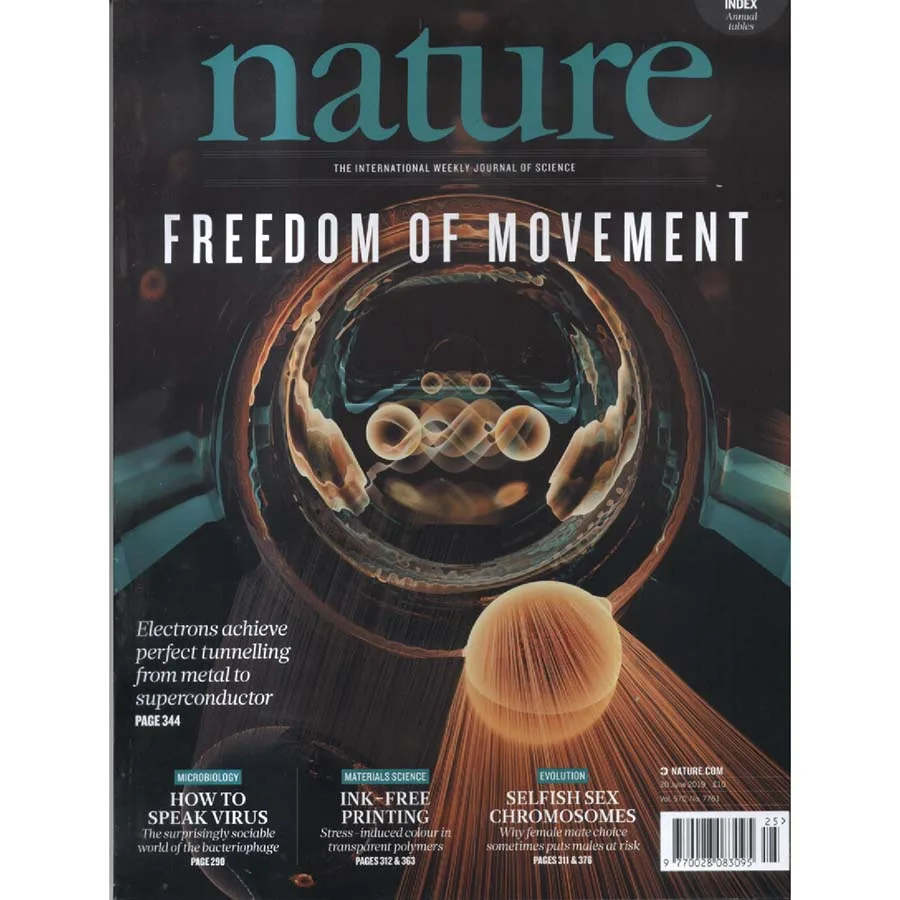
There are certain magazines that attempt to simplify science for the general public. Nature – June 2019, Vol. 570 No. 7761 is not one of them. This issue arrives beneath the headline “FREEDOM OF MOVEMENT”, accompanied by glowing abstract electron tunnels that look less like physics and more like the opening scene of a very expensive science-fiction film in which humanity accidentally invents a portal to another dimension.
The lead article concerns electrons achieving “perfect tunnelling from metal to superconductor”, which is exactly the sort of sentence that makes physicists visibly excited and everyone else quietly reach for a biscuit. Somewhere inside this issue are people who genuinely understand quantum transport phenomena, while the rest of us nod respectfully and pretend we absolutely know what “perfect tunnelling” entails beyond sounding faintly illegal.
The cover art is superbly dramatic. Rings, glowing particles, impossible depths — it resembles a futuristic engine core moments before either revolutionising civilisation or vaporising a research facility. One of Nature’s greatest talents has always been making incomprehensibly advanced science appear aesthetically magnificent while never fully clarifying whether mankind should be thrilled or deeply concerned.
And naturally, because one field of advanced science is never enough, the issue also includes articles about sociable viruses, ink-free printing, and selfish sex chromosomes. Few publications can move from superconducting electrons to manipulative chromosomes without pausing for breath. By page twenty, you begin to realise that biology, physics, and materials science are all quietly becoming stranger than fiction while most of humanity remains distracted by supermarket loyalty cards.
The microbiology feature — “How to Speak Virus” — is particularly wonderful in its phrasing. It sounds less like a peer-reviewed paper and more like a self-help language guide for negotiating with microscopic organisms. Somewhere, bacteriophages are apparently engaging in social interactions sophisticated enough to deserve their own diplomatic summit.
Then there is “ink-free printing”, which casually hints at a future where even printers might stop being terrible. Frankly, that alone may be the most optimistic scientific prediction in the entire issue.
As always, Nature maintains its signature editorial tone: calm, measured, quietly revolutionary. “Selfish sex chromosomes” are discussed with the same composure one might use to describe weather patterns. There is no sensationalism here — merely a weekly publication documenting humanity steadily uncovering how bizarre the universe actually is.
Owning a copy of Nature also carries a particular cultural prestige. It implies intellectual seriousness and an active interest in frontier science. Whether you actually read the superconductivity article or simply admired the glowing cover while feeling academically inadequate is beside the point. The aspiration itself is part of the charm.
This June 2019 issue now feels like a fascinating relic from a period when scientific advancement seemed to accelerate monthly. Quantum materials, synthetic biology, molecular communication — all were rapidly evolving into things that sounded increasingly futuristic and slightly suspicious. It was the era when tomorrow quietly began arriving ahead of schedule.
Condition is listed as Good, meaning this copy has survived the traditional hazards endured by elite science journals: overfilled backpacks, desks belonging to exhausted researchers, coffee stains narrowly avoided, and prolonged residence in “important things I really should read properly” piles.
A brilliant issue for physics enthusiasts, science collectors, aspiring polymaths, or anyone who enjoys magazines that casually combine quantum tunnelling, manipulative chromosomes, and sociable viruses into one gloriously intimidating package.
Keep browsing: See more Nature Journal books Other books by Nature
