


Nature - 2018 December - Vol 564 No 7734
Publisher: Nature
Format: Paperback
ISBN: 9770028083095
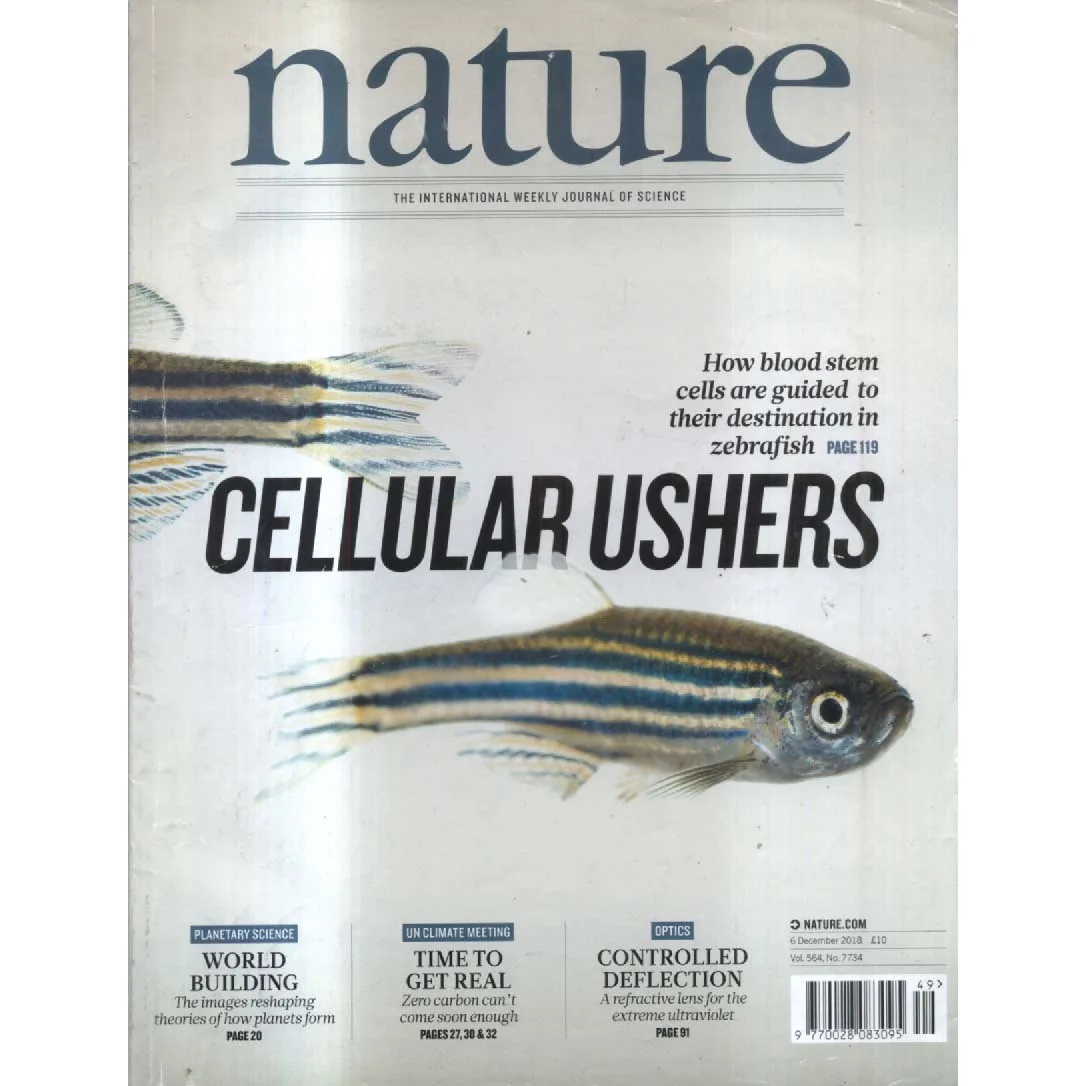
There is something deeply reassuring about Nature choosing zebrafish for the cover of an issue devoted to cutting-edge biomedical science. Not dramatic galaxies. Not terrifying AI renderings. Just two mildly startled stripy fish quietly carrying the burden of humanity’s scientific future on their tiny aquatic shoulders.
Nature – December 2018, Vol. 564 No. 7734 arrives under the gloriously bureaucratic headline “CELLULAR USHERS”, which sounds either like a forgotten indie band from 2007 or a deeply niche airport management role. In reality, it concerns how blood stem cells are guided to their destination in zebrafish — because modern science has discovered that if you want to understand the secrets of life, medicine, and cellular development, the answer is apparently “look closely at small fish”.
The cover is wonderfully understated. Two zebrafish drift calmly across a stark white background while inside the journal researchers unravel staggeringly complicated biological mechanisms. Somewhere in these pages are scientists performing molecular detective work of extraordinary sophistication, while the fish themselves look as though they have absolutely no idea they are central to major medical breakthroughs.
And naturally, because this is Nature, the issue casually broadens out into several entirely different existential topics without warning. Planetary scientists are revising theories about how planets form, climate experts are warning that “zero carbon can’t come soon enough”, and optical physicists are creating refractive lenses for extreme ultraviolet light. One moment you are contemplating fish stem cells, the next you are considering planetary formation and climate urgency before finishing with optics technology that sounds suspiciously like equipment from a classified space programme.
This is really the classic Nature experience: a relentless parade of human ingenuity presented with complete editorial calm. “World-building,” one article announces politely, as though reconstructing the formation of planets is a perfectly normal thing to discuss between emails. Meanwhile the climate section quietly suggests civilisation may need to hurry up considerably. The magazine never panics. It simply continues publishing the future every week.
There is also a particular irony in owning copies of Nature. They radiate tremendous intellectual seriousness while simultaneously serving as monuments to unread ambition. People place them on desks intending to absorb frontier-level science and instead end up reading three paragraphs before thinking, “I should probably lie down for a bit.” This is not failure. It is tradition.
This December 2018 issue now feels like a fascinating snapshot from just before the world accelerated into the strange 2020s. Climate anxiety was rising, biomedical science was rapidly advancing, and researchers were steadily uncovering mechanisms within life itself that sounded increasingly precise and faintly magical. There is an optimism here — dense, technical, cautiously hopeful optimism — that remains oddly compelling.
Condition is listed as Good, meaning this copy has survived the normal hazards faced by elite scientific journals: overstuffed academic bags, coffee perilously near important diagrams, bedside piles of “serious reading”, and years of respectful neglect by people who absolutely intended to finish the article on ultraviolet optics someday.
An excellent issue for science enthusiasts, biology nerds, climate readers, aquarium owners with intellectual aspirations, or anyone who enjoys magazines that can make tiny fish seem quietly responsible for the future of medicine.
Keep browsing: See more Nature Journal books Other books by Nature
