


Nature - 2019 April - Vol 568 No 7751
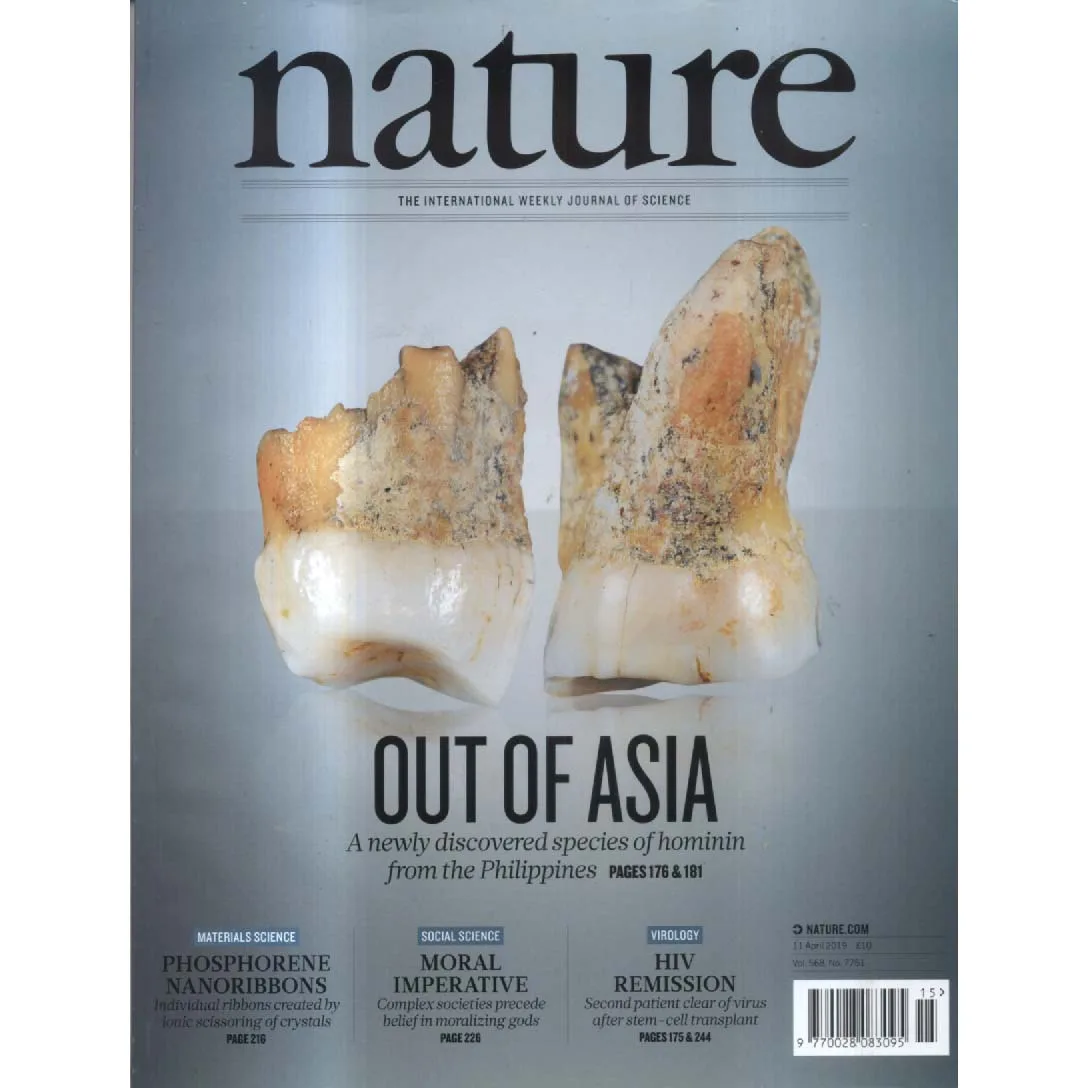
Publisher: Nature
Format: Paperback
ISBN: 9770028083095
There are few things more wonderfully unsettling than a prestigious scientific journal placing two ancient teeth on the cover and calmly announcing that humanity may once again need to rethink its own origins. Nature – April 2019, Vol. 568 No. 7751 does exactly that with the gloriously understated headline “OUT OF ASIA”, proving once more that some of the most dramatic discoveries in human history arrive looking suspiciously like objects your dentist might remove with mild concern.
The featured discovery — a newly identified species of hominin from the Philippines — is the sort of news that causes anthropologists to become wildly excited while the rest of humanity slowly realises that the human family tree resembles less a tree and more a hedge that has been attacked with gardening equipment. Every few years scientists uncover another ancient relative and quietly rewrite what everyone thought they knew about migration, evolution, and why early humans apparently refused to stay where textbooks had placed them.
The cover itself is magnificently minimalist. Two fossil teeth float against a pale background like sacred relics from an ancient civilisation or perhaps evidence in the world’s most academically rigorous police investigation. Somewhere inside this issue are researchers explaining, in exquisite technical detail, that these fragments may alter our understanding of human evolution. Meanwhile most readers are still trying to emotionally process the fact that a tooth can become international scientific news.
And because this is Nature, the issue refuses to stop there. Elsewhere inside: phosphorene nanoribbons, moralising gods, and HIV remission after stem-cell transplant treatment. It is the classic Nature reading experience — one minute pondering prehistoric hominins, the next discovering that materials science sounds increasingly like wizardry, while social scientists calmly discuss the evolution of morality itself. By page twenty you begin to suspect the entire human experience is simply one long interdisciplinary project.
There is also something deeply charming about Nature’s editorial restraint. Lesser publications might scream “HUMAN HISTORY CHANGED FOREVER!” across the cover in flaming letters. Nature instead presents a couple of fossil teeth with elegant typography and trusts readers to appreciate the existential implications themselves. It is intellectual confidence bordering on aristocratic aloofness.
Naturally, owning a copy of Nature confers immediate accidental prestige. It suggests the sort of person who casually keeps up with palaeoanthropology over breakfast. Guests may assume you have strong opinions on hominin dispersal patterns in Southeast Asia. In reality, like many owners, you may simply think the cover looked interesting and now feel mildly intimidated every time you pick it up. This is perfectly normal. It is part of the Nature ecosystem.
This April 2019 issue also captures a fascinating cultural moment in science — a period when discoveries about ancient humanity were arriving with startling regularity, each one gently dismantling older certainties. The more scientists discovered, the messier and more interesting human history became. Rather fitting, really.
Condition is listed as Good, meaning this copy has survived the usual hazards faced by serious scientific periodicals: overcrowded bookshelves, coffee-adjacent study sessions, postgraduate despair, and several years of someone insisting they were definitely going to finish the article on phosphorene nanoribbons “soon”.
An excellent issue for science enthusiasts, archaeology fans, evolutionary history obsessives, or anyone who enjoys magazines that can make two ancient teeth feel more dramatic than most modern thrillers.
Keep browsing: See more Nature Journal books Other books by Nature
