


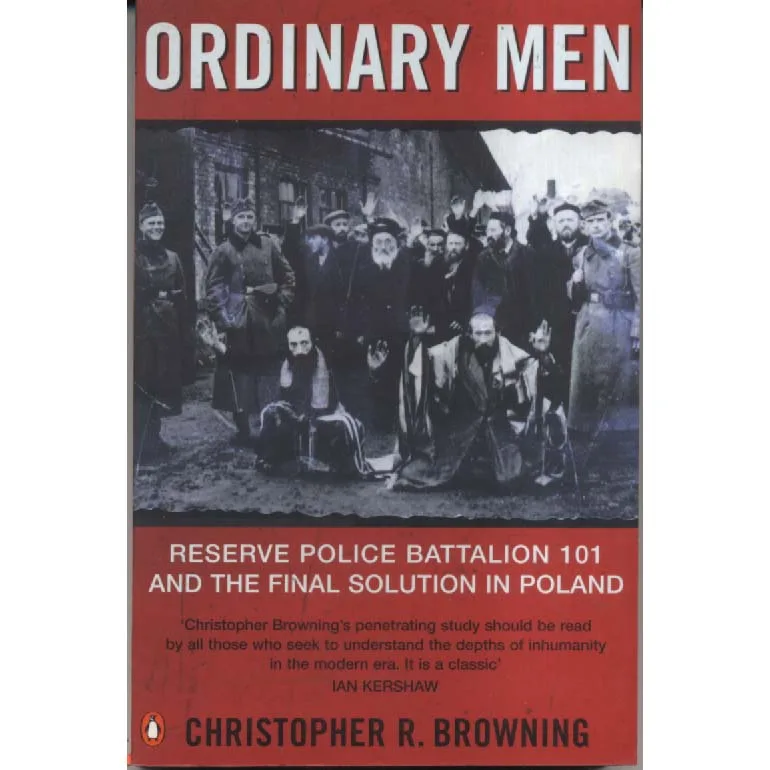
Ordinary Men
Publisher: Penguin Books
Format: Paperback
ISBN: 9780141000428
Christopher Browning’s Ordinary Men is one of those rare historical works that quietly dismantles comforting illusions with devastating calm. There are no grand monsters twirling metaphorical moustaches here, no easy cinematic distance between “them” and “us”. Instead Browning examines Reserve Police Battalion 101, a unit composed largely of middle-aged, working-class German men who, before the Second World War, had mostly been leading painfully ordinary lives. Salesmen, clerks, labourers, fathers. The sort of people history prefers to imagine standing safely outside atrocity.
The deeply unsettling argument of the book is contained in the title itself.
Browning traces how these very ordinary individuals became participants in mass murder during the Holocaust, carrying out shootings, deportations and extermination operations in occupied Poland. What makes the book so powerful is not sensationalism but restraint. Browning writes with clinical precision, allowing the horrifying banality of the process to emerge gradually through testimony, records and reconstructed events. The result is far more disturbing than melodrama could ever manage.
There is an awful irony at the heart of the story. The battalion members were not generally fanatical ideological zealots selected from some mythical reservoir of pure evil. Many were older reservists, not elite SS fanatics. Some were uncomfortable, some drank heavily to cope, some avoided direct participation when they could — and yet the machinery continued functioning. Browning forces readers to confront the uncomfortable possibility that human beings do not necessarily require monstrous personalities to commit monstrous acts. Often they require bureaucracy, conformity, authority, routine and the gradual erosion of moral resistance.
The book became enormously influential precisely because it attacked the reassuring fiction that historical atrocities are always committed by obviously different people. Browning instead explores peer pressure, obedience, careerism, fear of standing apart and the strange adaptability of human behaviour under institutional systems. It is history written not merely to document events, but to examine human nature itself.
And this is where the title becomes almost painfully ironic. “Ordinary men” sounds harmless, even comforting. The phrase evokes commuters, neighbours, tired workers returning home at the end of the day. Browning reveals how terrifyingly fragile civilisation can become when ordinary people stop asking moral questions and begin treating horror as administrative routine.
The writing is sober, rigorous and deeply humane. Browning never sensationalises suffering or indulges in rhetorical theatrics. That restraint gives the book extraordinary force. One finishes it less with a sense of historical closure than with lingering unease about obedience, systems and the frightening elasticity of normality.
It is not an easy read, nor should it be. But it remains one of the most important and influential studies of the Holocaust ever written, precisely because it refuses simplistic explanations and forces readers to confront difficult truths about responsibility and human behaviour.
An essential work for readers of Holocaust history, twentieth-century Europe, moral philosophy, political violence and the disturbing mechanics by which ordinary societies can descend into organised brutality.
Condition: Good. Sold by Crappy Old Books, where difficult history, uncomfortable truths and humanity’s less flattering case studies remain permanently available for inspection.
Keep browsing: See more War books Other books by Christopher R Browning
