Nature - 2019 November - Vol 575 No 7782
Publisher: Nature
Format: Paperback
ISBN: 9770028083095
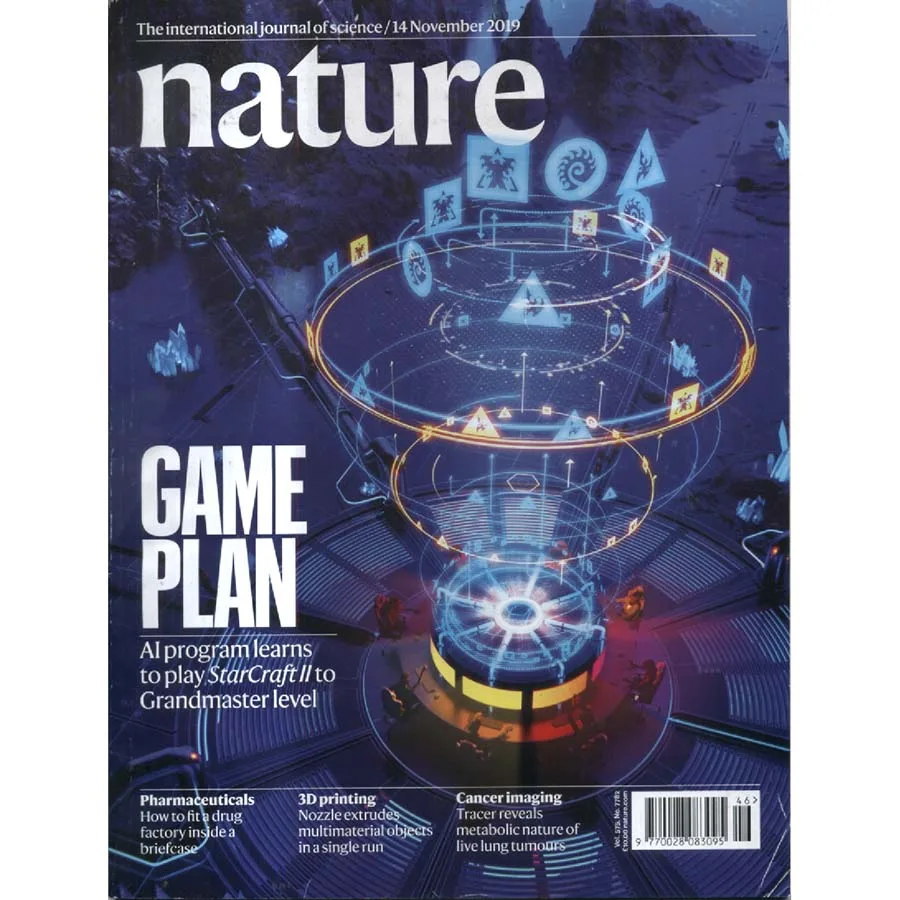
There are moments when humanity quietly realises it may have crossed into the future without properly noticing, and Nature – November 2019, Vol. 575 No. 7782 captures precisely that atmosphere. The cover headline announces:
GAME PLAN
AI program learns to play StarCraft II to Grandmaster level
which is either an extraordinary scientific breakthrough or the opening paragraph of history’s most politely peer-reviewed science-fiction novel.
The cover art is magnificent. Glowing tactical interfaces spiral upward through a dark futuristic arena while tiny symbols orbit like some impossible fusion of esports tournament, alien command centre and advanced civilisation preparing to optimise humanity out of existence. One half expects the magazine itself to begin calculating strategic weaknesses in the reader.
And this, importantly, was 2019 — back when AI defeating humans at complex games still felt charmingly impressive rather than faintly existential.
The issue documents DeepMind’s AI systems mastering StarCraft II, a notoriously difficult real-time strategy game requiring:
-
planning,
-
adaptation,
-
incomplete information,
-
resource management,
-
and tactical decision-making under pressure.
In other words, precisely the sort of complex human behaviour civilisation had once confidently assumed separated us from machines. Scientists, meanwhile, quietly continued removing those assumptions one by one while the public remained distracted by phone notifications.
Naturally, Nature approaches all this with complete academic calm. There is no dramatic screaming about robot uprisings. Just careful scientific reporting explaining that artificial intelligence has become alarmingly competent at strategic thinking in highly dynamic environments. Completely normal magazine content. Nothing unsettling there whatsoever.
Elsewhere in the issue:
-
pharmaceutical manufacturing becomes increasingly portable,
-
3D printing evolves toward multi-material production,
-
and cancer imaging reveals metabolic signatures inside living tumours,
which together create the overwhelming impression that modern science is advancing simultaneously in every direction at once. Medicine, computing, manufacturing and biology all hurtle forward while ordinary humans struggle to update software without emotional exhaustion.
The irony of revisiting this issue now is extraordinary. In late 2019, AI mastery of StarCraft II still felt futuristic and slightly abstract. Today, after the explosion of generative AI, language models and machine-learning systems entering everyday life, the issue reads almost like an early dispatch from the opening stages of a technological transformation everyone underestimated.
And yet the magazine remains beautifully composed throughout. Scientific journals possess a uniquely reassuring tone even when describing developments that would absolutely terrify previous generations. Somewhere in a Victorian laboratory, a scientist learns that machines now teach themselves advanced strategy games and immediately faints into a cabinet of chemicals.
The visual culture of Nature deserves admiration too. Modern scientific publishing increasingly resembles conceptual cyberpunk art because advanced technology naturally produces imagery that looks impossibly cinematic. The glowing tactical spirals on this cover feel less like a magazine illustration and more like a classified briefing from the near future.
Physically, this issue radiates high-level intellectual seriousness. One imagines it originally appearing on:
-
university desks,
-
AI research labs,
-
technology institutes,
-
or beside untouched salads in Silicon Valley offices full of people quietly reinventing civilisation.
Yet now it survives as a fascinating cultural artefact from the exact moment AI began moving decisively from theoretical achievement toward visible public transformation.
Condition-wise, this copy is listed as Good, meaning it has survived admirably despite likely exposure to caffeinated researchers, intense late-night reading and perhaps at least one owner who bought the issue expecting interesting game theory and accidentally encountered the future.
Today, Nature – November 2019, Vol. 575 No. 7782 stands as both scientific journal and historical milestone: a snapshot of humanity teaching machines increasingly sophisticated forms of thought while still believing this was all happening at a safe and comfortable distance.
An excellent acquisition for science enthusiasts, AI historians, technology collectors, gamers with intellectual ambitions or anyone who enjoys magazines capable of making them feel simultaneously excited about the future and slightly nervous about what, exactly, the computers are learning next.
Keep browsing: See more Nature Journal books Other books by Nature