


Midt I En Klunketid
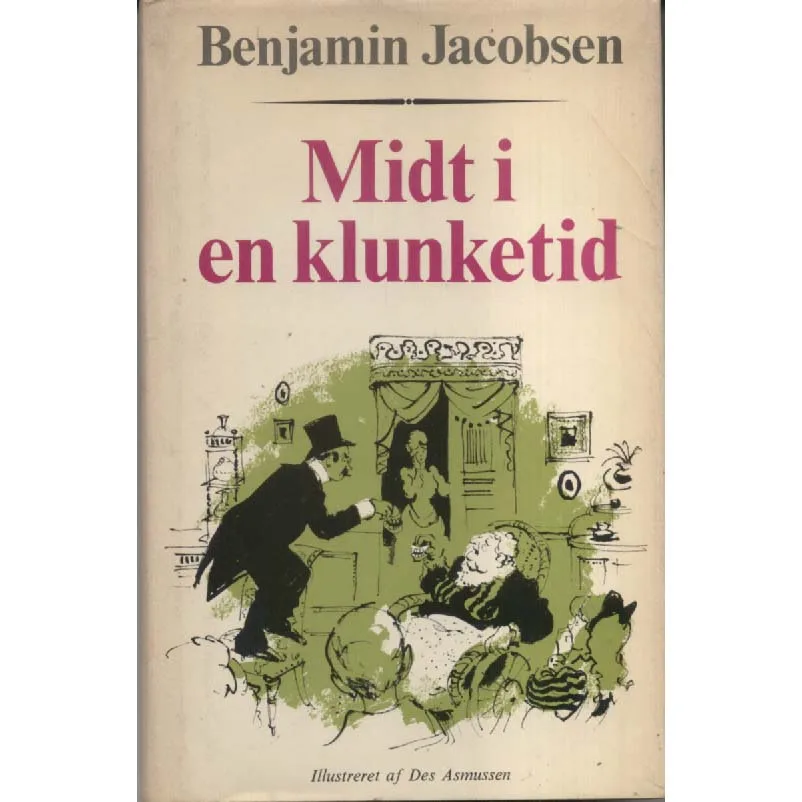
Publisher: Lademann
Format: Hardback
ISBN: none
There are history books that politely summarise the past, and then there are wonderfully specific Scandinavian cultural works that plunge headfirst into an entire vanished social atmosphere with the confidence of people who assume readers already understand what a “Klunketid” is. Midt i en Klunketid (“In the Midst of the Klunk Era”) by Benjamin Jacobsen belongs magnificently to the latter category.
Now, for the uninitiated, the Danish “Klunketid” refers roughly to the heavily ornamented late-19th-century bourgeois period — an age of overfurnished interiors, velvet curtains, decorative excess and enough tassels, drapery and dark wood to emotionally suffocate a small horse. Imagine Victorian respectability colliding violently with Scandinavian decorative enthusiasm and you are somewhere in the vicinity.
And honestly, humanity may never have fully recovered from it.
Benjamin Jacobsen’s book appears to dive directly into this fascinating era: its social habits, aesthetics, domestic life and cultural atmosphere. Which means readers are treated to a glorious parade of middle-class anxieties, overdecorated rooms and carefully maintained respectability beneath layers of fabric thick enough to stop artillery fire.
The title itself is wonderful. In the Midst of the Klunk Era. It sounds faintly as though the reader is about to become trapped inside an aggressively upholstered drawing room while somebody’s aunt discusses morality beside an enormous ceramic lamp.
Naturally, books like this become more charming with time. What may once have been straightforward cultural history now reads partly as anthropology from another civilisation entirely. Modern minimalism has trained people to believe homes should contain approximately three objects and a distressed houseplant. The Klunk Era, by contrast, believed every available surface should display:
-
ornaments,
-
framed photographs,
-
embroidered cloth,
-
porcelain dogs,
-
or enough carved mahogany to intimidate visitors psychologically.
Scandinavian culture often presents itself internationally as sleek, minimalist and emotionally restrained, which makes books about the overstuffed decorative chaos of the late 19th century especially delightful. Somewhere beneath all that modern Nordic design lies a historical memory of rooms dense enough with furniture to absorb sound completely.
The irony deepens further because this 1972 edition emerges from another fascinating design period altogether. By the early 1970s, Scandinavian modernism was already internationally fashionable: clean lines, simplicity, functionality. So this book effectively becomes one historical aesthetic looking back at another historical aesthetic with mild cultural bewilderment.
One suspects the pages are filled with:
-
social observations,
-
historical photographs,
-
decorative detail,
-
and descriptions of bourgeois life conducted with just enough distance to remain respectable while quietly acknowledging the absurdity of it all.
And that, really, is where books like this become irresistible. They preserve not only facts, but atmospheres. Entire emotional climates survive inside them: how rooms looked, how people behaved, what they valued and how societies imagined respectability should appear physically in space.
Condition-wise, this copy is listed as Good, meaning it has survived admirably despite decades of probable ownership by history enthusiasts, interior design obsessives and perhaps one Danish relative who sincerely believed Victorian furniture should never entirely go out of fashion.
Today, Midt i en Klunketid stands as both cultural history and accidental design time machine. It offers entry into a vanished world of decorative ambition and bourgeois performance so elaborate it now feels almost surreal — a civilisation permanently one velvet curtain away from complete collapse beneath its own upholstery.
An excellent acquisition for lovers of Scandinavian history, design, decorative arts or anyone who occasionally suspects modern interiors could perhaps benefit from slightly more carved walnut and dramatically fewer empty white walls.
Keep browsing: See more Danish books Other books by Benjamin Jacobsen
