


Statuer Og Skulpturer I Odense
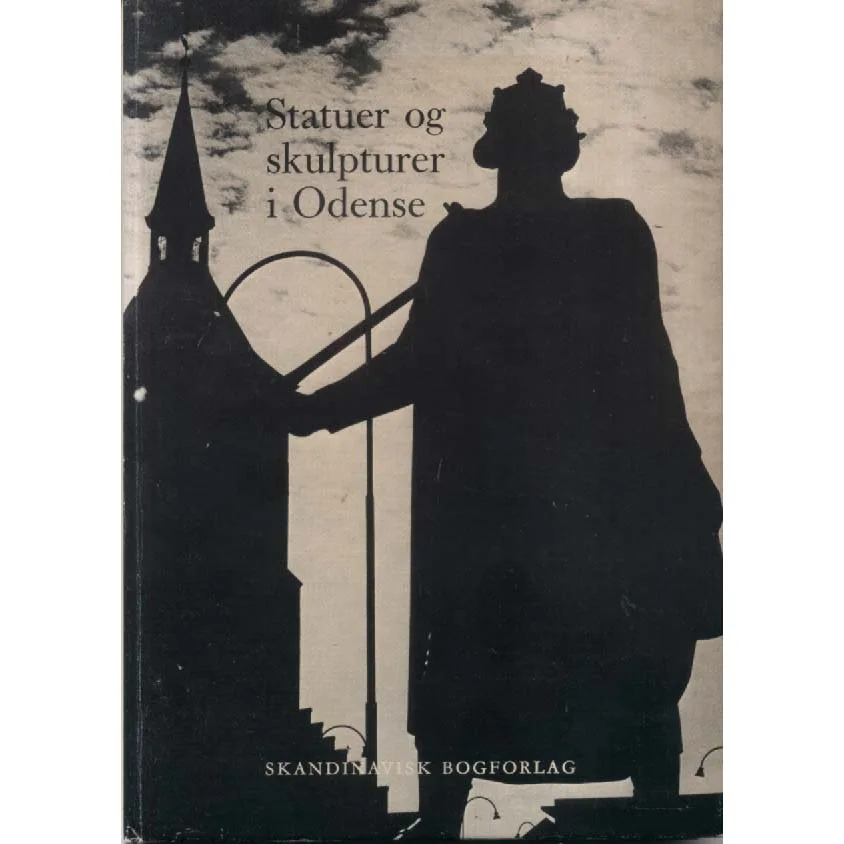
Publisher: Skaninavisk Bogforlag
Format: Hardback
ISBN: 8775010305
There is a very particular type of Scandinavian book that appears, at first glance, to concern an almost comically specific subject, only to reveal itself as an unexpectedly charming portal into an entire civilisation. Statuer og Skulpturer i Odense (“Statues and Sculptures in Odense”) by H.H. Jacobsen is precisely that kind of treasure: a lovingly serious 1971 guide to the public art of one Danish city, produced with the calm confidence of a society that genuinely believed people might enjoy spending afternoons contemplating bronze figures in municipal spaces.
And honestly, perhaps they were right.
Odense, of course, is best known internationally as the birthplace of Hans Christian Andersen, but like many old European cities it is also filled with statues, memorials, civic sculpture and artistic curiosities quietly occupying squares, parks and corners while modern life rushes past largely unaware. This book steps in heroically to insist that somebody really ought to stop and look at them properly.
The title itself is gloriously straightforward. Statues and Sculptures in Odense. No dramatic subtitle. No “Hidden Secrets of Denmark’s Forgotten Artworks!” Just a calm declaration that here is a book about statues, and if you possess even the slightest cultural seriousness you will naturally wish to read it.
One cannot help admiring that confidence.
Published in 1971 by Skandinavisk Bogforlag, the book belongs to a wonderful era of European publishing when local culture, public art and civic identity were still considered worthy of dedicated books rather than quick phone photos followed by immediate distraction. Somewhere in Denmark, committees and librarians quietly agreed that documenting sculptures around Odense was not merely acceptable but actively important.
And in fairness, books like this become far more fascinating with age.
What may once have functioned as a practical cultural guide now survives as accidental time travel. Public spaces change, sculptures disappear, cities modernise and suddenly an earnest catalogue of statues becomes a historical document preserving an older urban landscape. Even the existence of the book tells you something about Scandinavian society: organised, cultured, slightly understated and deeply committed to the idea that public spaces should contain meaningful art rather than merely parking restrictions.
There is also something deeply funny about humanity’s relationship with statues in general. Entire generations commission enormous bronze figures believing future societies will gaze upon them with reverence forever, only for later visitors to use them primarily as meeting points, pigeon habitats or landmarks near coffee shops. Yet books like this quietly restore dignity to these civic artworks by taking them seriously again.
Physically, one imagines this volume carrying all the restrained charm of Scandinavian design from the early 1970s: practical layouts, thoughtful typography and black-and-white photographs capturing sculptures with almost archaeological sincerity. Modern publishing would probably insist on drone photography and glossy lifestyle aesthetics. This simply trusts readers to appreciate sculpture because sculpture exists.
The irony, naturally, is magnificent. Once intended for tourists, students and culturally ambitious residents wandering around Odense with intellectual purpose, the book now itself becomes an object of nostalgia — a relic from a slower Europe where people still bought specialised books about public monuments without irony. Or at least without too much irony.
Condition-wise, this copy is listed as Good, meaning it has survived admirably despite decades of probable ownership by librarians, architecture enthusiasts, local historians and perhaps one extremely determined Danish uncle who genuinely cared about municipal sculpture placement.
Today, Statuer og Skulpturer i Odense stands as both art guide and cultural artefact: part local history, part urban archaeology and part reminder that civilisations occasionally express themselves through beautifully specific books no algorithm would ever think to produce.
An excellent acquisition for lovers of Scandinavian culture, public art, local history, obscure European books or anyone who has ever looked at a statue in a town square and wondered whether somebody, somewhere, had written an entire book about it.
Keep browsing: See more Danish books Other books by HH Jacobsen
