


Common English Proverbs
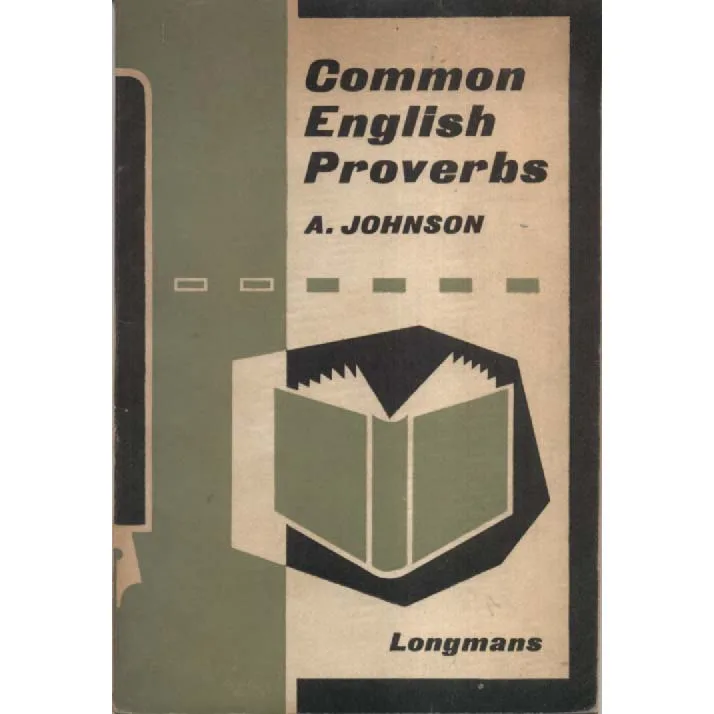
Publisher: Longmans
Format: Paperback
ISBN: none
There is something deeply reassuring about old proverb books. They emerge from a world absolutely convinced that nearly every human problem — war, heartbreak, bad neighbours, laziness, excessive optimism, suspicious geese — could ultimately be explained through a short sentence involving hay, horses or birds in bushes. Common English Proverbs by A. Johnson is a splendid survivor from that tradition: a compact 1954 volume preserving centuries of accumulated British wisdom, caution and passive-aggressive observation.
Before motivational influencers began shouting about “mindsets” and “manifesting abundance” into ring lights, humanity relied upon proverbs. Entire generations navigated life using little more than phrases like “A stitch in time saves nine” and “Too many cooks spoil the broth.” Nobody entirely knew what the numbers referred to or why the broth situation had escalated so catastrophically, but society carried on regardless.
This book gathers together those durable nuggets of folk wisdom that somehow survived hundreds of years of plagues, wars, economic collapse and British weather. And that survival alone is impressive. Proverbs are essentially the original social media posts: short, memorable, endlessly repeated and often delivered with enormous confidence despite varying levels of actual usefulness.
Naturally, many of them contradict each other completely. “Many hands make light work,” insists one proverb cheerfully, while another warns that “Too many cooks spoil the broth.” Which is it, England? Should more people help or not? The answer, apparently, depends entirely upon the broth.
That is part of the joy of old collections like this. They reveal not only language, but the strange accumulated psychology of a culture. English proverbs are full of rain, caution, livestock, patience and vague disappointment. They suggest a civilisation permanently expecting mild inconvenience and preparing accordingly with turnips and stoicism.
The 1954 publication date only adds to the charm. This was still an era when books like this were considered genuinely educational and respectable household reading. One imagines it sitting proudly beside dictionaries, atlases and practical guides to household management in a semi-detached home where tea was strong and nobody trusted continental plumbing.
Physically, old Longmans editions possess a lovely scholarly sturdiness about them. They were made for use rather than decoration, intended to survive school bags, public libraries and decades of being consulted by puzzled readers wondering precisely why one should never count chickens before they hatch. This particular copy being listed as Good suggests it has weathered seventy years of proverb-related contemplation remarkably well.
There is also something wonderfully ironic about proverb collections surviving into the modern digital age. Humanity now possesses instant global communication, artificial intelligence and smartphones capable of answering almost any factual question ever conceived, yet people still casually rely on medieval agricultural sayings to explain life decisions. Deep down, we remain a species comforted by advice involving carts, apples and suspiciously active birds.
Modern readers may also discover that proverbs occupy a curious territory between wisdom and comedy. Some are genuinely insightful. Others sound faintly threatening. A few appear to have been invented by exhausted farmers attempting to stop people doing obviously stupid things near wells.
In the end, Common English Proverbs is more than a language book. It is a portable museum of everyday thought, preserving the accumulated mutterings of generations who believed life could mostly be understood through common sense, observation and the occasional deeply confusing metaphor involving horses.
An ideal acquisition for lovers of language, folklore, vintage reference books or anyone who occasionally suspects that humanity peaked intellectually somewhere around “Don’t put all your eggs in one basket.”
Keep browsing: See more Academic books Other books by A Johnson
