Pygmalion
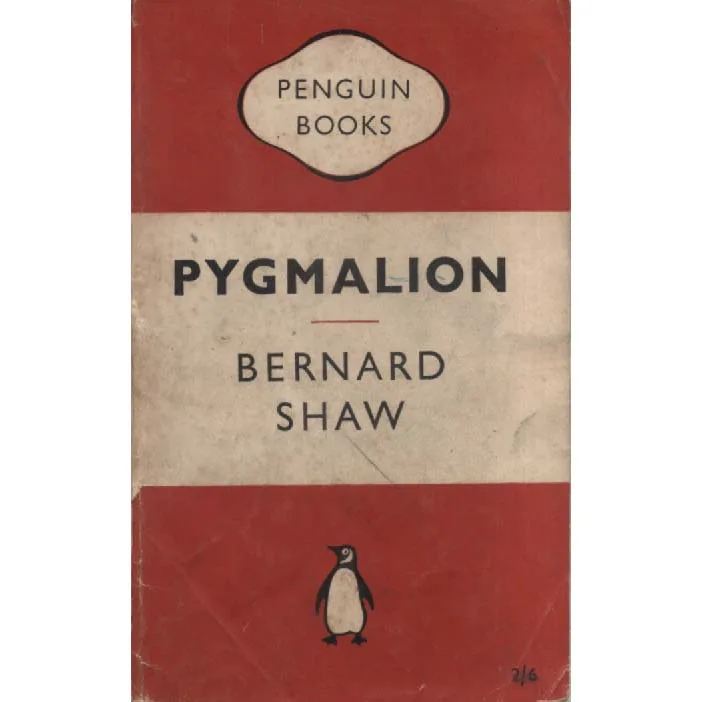
Publisher: Penguin Books
Format: Paperback
ISBN: none
There are plays that transform their characters, and then there are plays that transform their books as well, occasionally requiring a little assistance along the way. Pygmalion (1956) by Bernard Shaw, published by Penguin Books, is very much about change—linguistic, social, and otherwise—and this particular copy has taken that theme to heart, having undergone a modest but entirely practical repair to keep it in circulation.
Shaw’s play, for those who have managed to avoid it thus far, revolves around the ambitious idea that speech can be refined, accents adjusted, and identities, at least to some extent, reshaped through careful instruction. What begins as a seemingly straightforward experiment in phonetics gradually becomes something rather more pointed, exploring class, perception, and the curious tendency of people to judge one another based on how words are delivered rather than what is actually being said. It is witty, sharp, and quietly observant, with just enough humour to ensure that the underlying critique does not go entirely unnoticed.
The text itself, presented here in a 1956 Penguin edition, has the familiar, unassuming design of the period—practical, portable, and built for use rather than display. This particular copy is listed as Good, which in Crappy Old Books terms indicates that it has seen some life and, at one point, required a little attention. The spine has been carefully repaired with a small patch of brown paper and glue, a solution that is both effective and entirely in keeping with the book’s unpretentious character. The cover may show some wear, the pages may have softened, and there is a faint sense that the book has been kept going through a combination of necessity and mild determination.
It is not the sort of play that demands to be read in a single sitting, though it can be, given its manageable length. More often, it will be picked up, read through with a degree of enjoyment, and perhaps revisited later, particularly if one finds oneself paying closer attention to accents and speech than previously intended. Whether you approach it as a piece of theatre, a social commentary, or simply a well-regarded text that has managed to endure, it offers a reading experience that is both engaging and quietly thought-provoking.
A neatly observed, enduring play that explores transformation in more ways than one, and a perfectly respectable way to suggest that your reading habits include works that have not only stood the test of time, but, when necessary, been gently encouraged to do so.
Keep browsing: See more Poetry books Other books by Bernard Shaw