


Marat
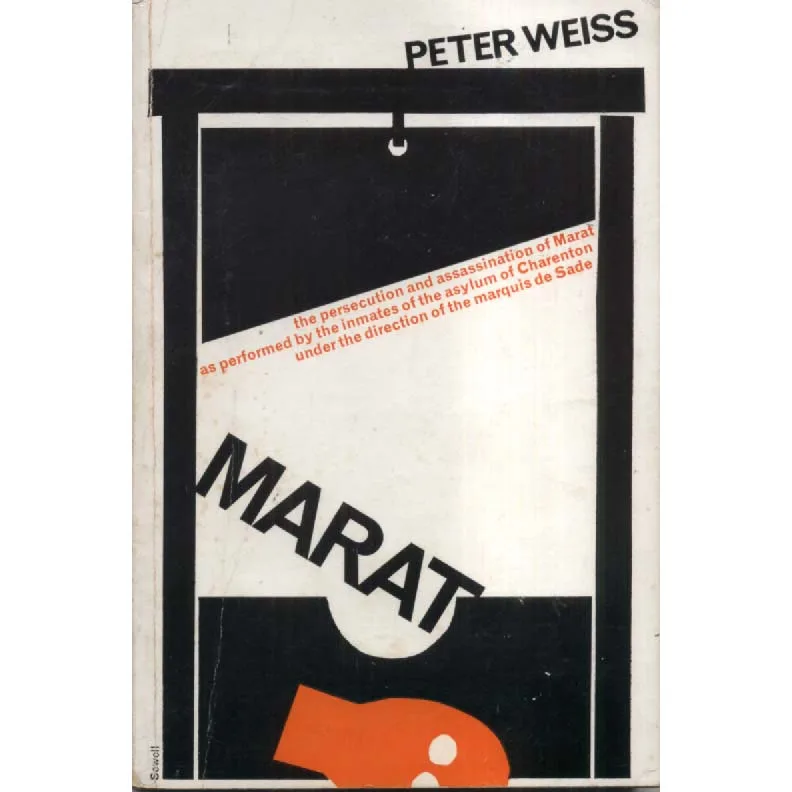
Publisher: John Calder
Format: Paperback
ISBN: none
There are plays that present a story, and then there are plays that stage an argument, invite you to watch it, and quietly imply that you might be part of it whether you like it or not. Marat (1969) by Peter Weiss, published by John Calder, belongs firmly in the latter category: a work that takes the French Revolution, places it inside an asylum, and proceeds to blur the line between performance, politics, and something that feels suspiciously like commentary.
The premise, for those who like to know where they stand, involves a group of asylum inmates performing a play about the assassination of Jean-Paul Marat under the direction of the Marquis de Sade. From there, things unfold with a deliberate complexity that resists straightforward interpretation. The historical event becomes a framework for exploring ideas about revolution, authority, suffering, and the curious ways in which ideals behave when confronted with reality. It is, in short, not simply a play about what happened, but a play about what it might mean.
Weiss’s writing moves between sharp exchanges, moments of theatrical spectacle, and passages that feel almost unsettlingly direct. Characters speak, argue, and occasionally collide, while the structure itself seems to question the stability of what is being presented. The result is a work that feels both controlled and unpredictable, as though it is aware of its own construction and is not entirely convinced it should be trusted.
Published in 1969, this John Calder edition carries the slightly austere, practical design typical of serious theatre publications of the period. It looks like a book that expects to be read with attention, though it does not insist on making the process easy. This particular copy is listed as Good, which in Crappy Old Books terms suggests it has been handled, read, and perhaps considered with a degree of concentration. The cover may show some wear, the spine may have softened, and the pages may bear the faint traces of previous readers who may have paused at certain lines, wondering exactly how they were meant to be delivered.
It is not a play that sits quietly in the background. More likely, it will provoke, puzzle, and occasionally unsettle, offering moments that feel as relevant now as they might have been when it was first performed. Whether you approach it as a piece of theatre, a reflection on history, or simply a book you feel you ought to have encountered at some point, it provides an experience that is less about resolution and more about engagement.
A challenging, deliberately layered work that refuses to simplify its concerns, and a perfectly respectable way to suggest that your reading habits extend into territory where drama is not merely entertainment, but a means of asking questions that do not always have comfortable answers.
Keep browsing: See more Poetry books Other books by Peter Weiss
