


Sonnets To Orpheus
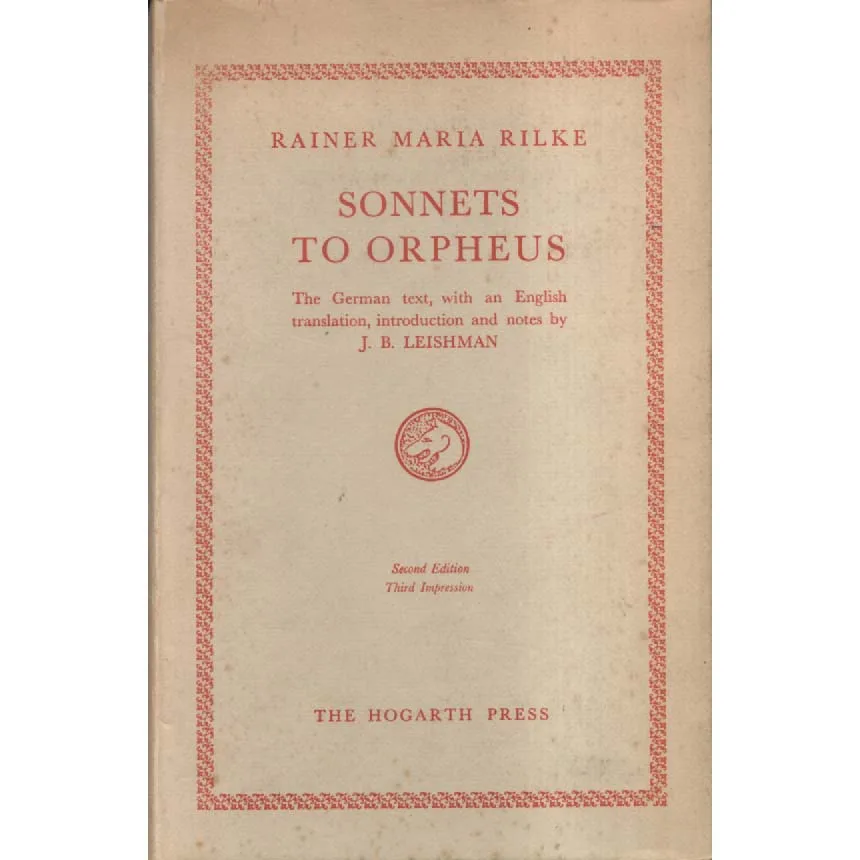
Publisher: The Hogarth Press
Format: Hardback
ISBN: none
There are poetry collections that invite you in, and then there are poetry collections that appear to have been written somewhere slightly beyond ordinary reach, leaving you to decide how far you’re willing to follow. Sonnets to Orpheus (1967), by Rainer Maria Rilke and published by The Hogarth Press, belongs comfortably in the latter category: a slim but quietly formidable volume that carries the suggestion that poetry might be doing something rather more ambitious than simply arranging words attractively on a page.
Rilke’s sonnets, originally composed in a remarkable burst of creative intensity, are addressed—loosely, evocatively—to Orpheus, the mythic figure associated with music, transformation, and the occasional descent into the underworld. From this starting point, the poems move with a kind of fluid confidence, touching on themes of life, death, art, and the curious space in which all three seem to overlap. It is not always clear where one idea ends and another begins, but that appears to be part of the design.
What distinguishes these poems is less their subject matter than their atmosphere. They do not so much present arguments as create conditions—moments in which something might be understood, if only briefly, before slipping away again. Lines can feel both precise and elusive, as though meaning is being offered and withdrawn in equal measure. It’s the sort of reading experience that encourages pauses, re-readings, and the occasional quiet suspicion that the poem may know more than it is prepared to explain.
This 1967 Hogarth Press edition carries with it a certain understated elegance, presenting the text without unnecessary distraction. It looks like a book that expects to be taken seriously, though it makes no particular effort to insist upon it. This particular copy is listed as Good, which in Crappy Old Books terms suggests it has been opened, handled, and perhaps approached with a mixture of curiosity and determination. The cover may show some wear, the spine may have softened, and the pages may bear the faint signs of previous readers who paused, reconsidered, and perhaps returned at a later date with renewed resolve.
It is not a collection to be rushed, nor one that yields its contents on demand. More likely, it will sit within reach, occasionally consulted, occasionally set aside, offering moments of clarity that arrive without warning and depart just as quietly. Whether you come to it with a background in poetry or simply a sense that Rilke is someone you ought to have encountered by now, it provides exactly the sort of experience that justifies that expectation.
A thoughtful, elusive collection that treats poetry as something closer to an art of transformation than a form of explanation, and a perfectly respectable way to suggest that your reading habits extend into territory where meaning is not always obliged to make itself immediately available.
Keep browsing: See more Poetry books Other books by Rainer Maria Rilke
