


Hitler 1936-1945 Nemesis
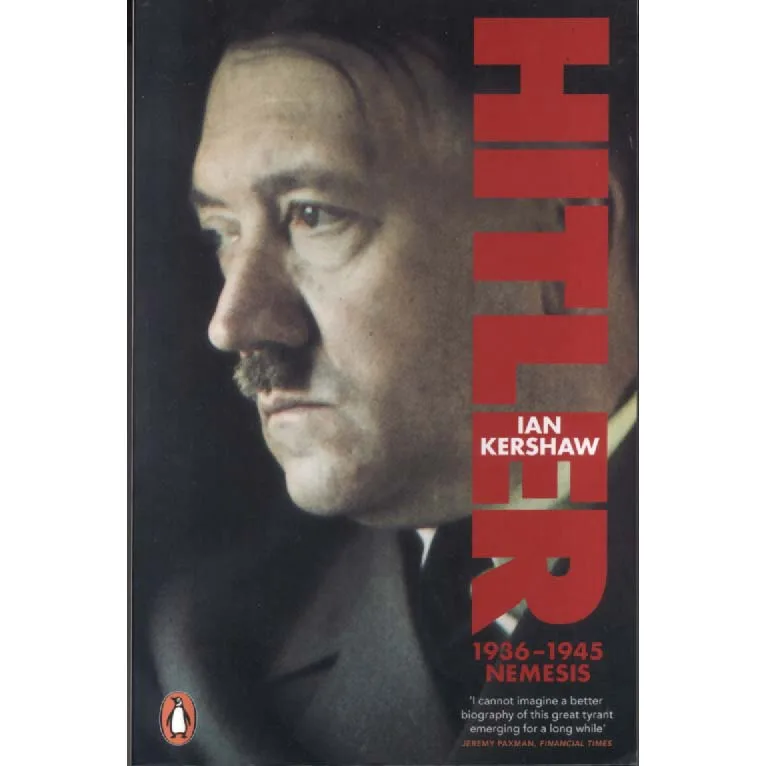
Publisher: Penguin Books
Format: Paperback
ISBN: 9780140272390
Hitler 1936–1945: Nemesis (2000) is not, let us be clear, one of those jaunty popular histories in which great events trot briskly past in neat little summaries while the reader is invited to feel vaguely informed by teatime. This is Ian Kershaw, and Kershaw has turned up to do the job properly. Which means depth, seriousness, immense scholarship, and the gradual but unmistakable impression that one is in the hands of someone determined to explain not only what happened, but how on earth it was allowed to happen at all.
This is the second volume of Kershaw’s monumental life of Hitler, which is rather like saying the second half of a tidal wave is slightly damp. By this point the story has moved well beyond fringe politics, theatrical rallies, and the sinister gathering of momentum. We are now in the years of dictatorship, war, radicalisation, catastrophe, and collapse: the period in which ideology, power, bureaucracy, fanaticism, opportunism, and mass murder fuse into one of the bleakest and most consequential chapters in modern history.
And this is where Kershaw is so formidable. He does not treat Hitler as some gothic aberration floating mysteriously above events, as though history were driven by one madman glaring at maps. Instead, he places him at the centre of a system—fed by institutions, followers, enablers, careerists, true believers, and a state increasingly shaped around his will. It is, in its way, the opposite of comforting. One would rather evil came with simpler mechanics. Kershaw, grimly but usefully, explains that it usually does not.
The subtitle, Nemesis, is perfect: grand, classical, fatalistic, and entirely earned. There is something almost unbearable in watching the logic of the regime work itself out—step by step, policy by policy, crime by crime—until the end arrives not as an abrupt shock but as the terrible culmination of what was always latent in the project. This is history without sentimentality, and all the more powerful for it.
Yet for all the scale and horror of the subject, the achievement of the book is its control. Kershaw never succumbs to melodrama, which is perhaps the greatest compliment one can pay a historian of such material. He has no need to inflate; the facts are already enough. Instead, he writes with clarity, precision, and the kind of intellectual steadiness that makes the reader feel, paradoxically, more rather than less the weight of events. It is the calm tone of someone carrying an immense and dreadful load without dropping it.
Published by Penguin, this is the sort of paperback that can sit innocently enough on a shelf while quietly containing several hundred pages of devastating intelligence. It is not decorative history. It is not a dip-in-and-out affair for the easily distracted. It is the real thing: a serious, major work by a historian who has done the reading, the thinking, and the explaining on your behalf, though not, mercifully, the simplifying.
Condition: Good. Which feels apt for a book that has likely already spent time in the company of a reader determined to understand the 20th century without illusions.
An essential volume for readers of modern history, biography, political catastrophe, and the darker mechanics of power. Not light, not cheerful, and not designed to leave anyone feeling better about human institutions—but superb.
Keep browsing: See more Biography books Other books by Ian Kershaw
