


Junior Handwork - The Teaching Aids Series 10
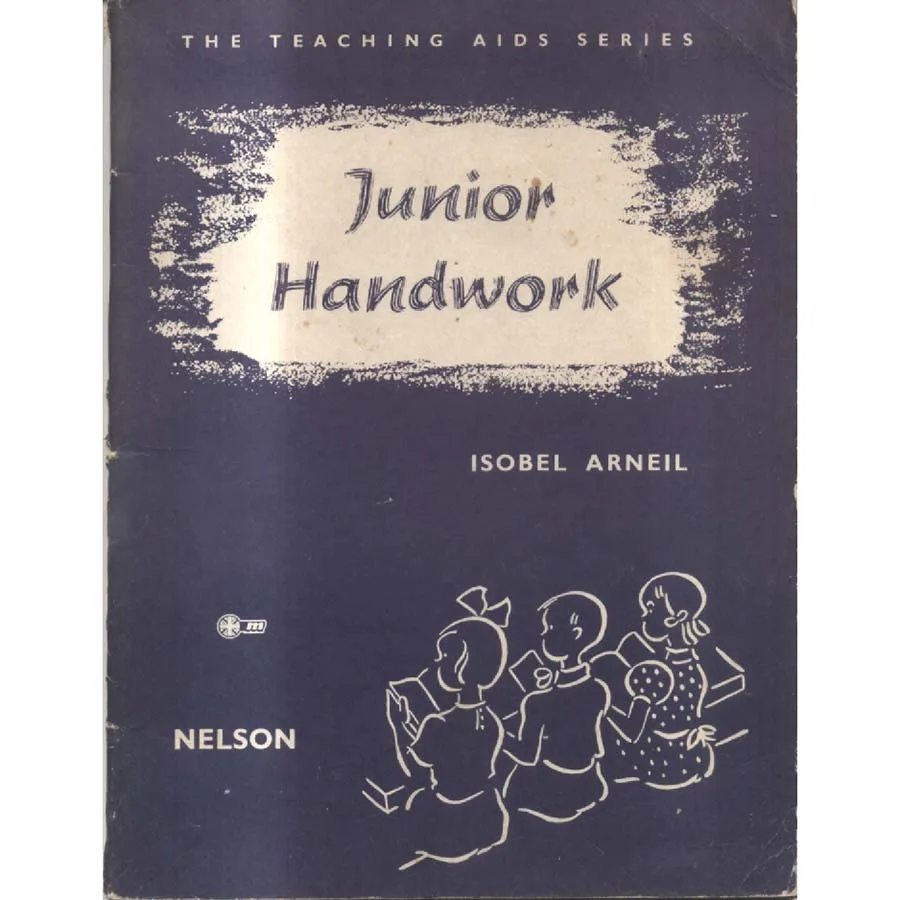
Publisher: Thomas Nelson and Sons
Format: Paperback
ISBN: 174233299
Some books arrive trailing prestige, controversy or literary thunder. Junior Handwork – The Teaching Aids Series 10 arrives with the far more formidable authority of practical educational purpose. Which is to say: this is a book that was not produced to dazzle you, but to ensure that children somewhere were efficiently introduced to glue, card, scissors and the disciplined manufacture of worthy things.
Written by Isobel Arneil and published in 1971 by Thomas Nelson and Sons, this is a fine specimen from that admirable age when teaching aids were exactly that: aids to teaching, not glossy lifestyle objects pretending to be creative revolutions. The title alone is magnificently direct. Junior Handwork. No fuss, no branding, no nonsense about unlocking your inner maker. Just handwork, for juniors, presumably before they cut through the tablecloth or paste felt to a radiator.
And what a glorious phrase “handwork” is. It carries with it a whole world of schoolrooms, practical tables, careful demonstrations and the vaguely solemn belief that children should learn by doing something constructive with their hands, preferably under supervision and with materials bought in bulk. This was the age of useful making. Not content creation. Not personal expression at any cost. Proper little projects, likely involving coloured paper, string, perhaps raffia if the school was feeling ambitious, and the ever-present possibility of PVA glue setting permanently where it ought not.
That is the charm of a book like this. It opens a door into a very particular educational world: one of patient instruction, manageable mess, and quietly heroic teachers trying to turn a room full of energetic children into a temporary workforce of compliant crafters. One imagines neat examples held up at the front, mild panic over missing scissors, and a strong underlying hope that the finished results might be fit to send home without alarming the parents. Educational publishing has rarely been more honest about its aims.
There is also something wonderfully ironic in the survival of such a book. Once, this would have been a practical tool, perhaps living in a staff room, teacher-training college or the more orderly corner of a primary school cupboard. It existed to help adults teach children how to make things that were probably considered both developmental and character-building. Now it reappears as a second-hand curiosity, a gentle relic of an era when schools believed civilisation could be upheld through paper folding and careful threading.
And let us not underestimate that ambition. Handwork, properly understood, was never just about keeping children busy. It was about coordination, patience, observation, neatness and the faintly radical notion that young people should know how to manipulate actual objects in physical space. In an age before everything was tapped, swiped, streamed or algorithmically personalised, there was enormous faith in the educational value of making a thing with your own slightly sticky fingers. This book stands as a monument to that faith.
As sold by Crappy Old Books, this copy is in Good condition, which feels wholly appropriate. A handwork manual should not look too pristine. It ought to carry just a hint of having been useful, even if only in spirit. Good suggests a respectable survivor: tidy, sound, and still entirely ready to advise on the constructive occupation of children. One likes to imagine it once sat beside piles of sugar paper and a tin of blunt pencils, radiating calm while chaos unfolded nearby.
For collectors of vintage education books, nostalgic school ephemera, craft manuals, or the quietly peculiar corners of twentieth-century British publishing, this is a delight. It has that lovely specialist sincerity that makes old teaching books so appealing. Nobody involved was trying to be trendy. They were trying to help. There is something almost moving about that. The diagrams were probably clear, the instructions sensible, and the expectations of children refreshingly robust. You can practically hear the phrase “Now then, everyone” echoing from the pages.
So this is more than just an old schoolbook. It is a compact cultural artefact from a time when learning by making was taken seriously, when classrooms were full of materials with texture, and when “teaching aids” did not need a marketing department or an app. It is practical, modest, faintly stern and unexpectedly evocative. A little handbook of order, creativity and controlled classroom optimism.
Junior Handwork – The Teaching Aids Series 10 is the sort of book that reminds you education once involved cardboard with a mission. And frankly, perhaps it still should.
Condition: Good. Ready to inspire, instruct, or simply sit on a shelf looking quietly superior to modern craft trends. Sold by Crappy Old Books.
Keep browsing: See more Academic books Other books by Isobel Arneil
