


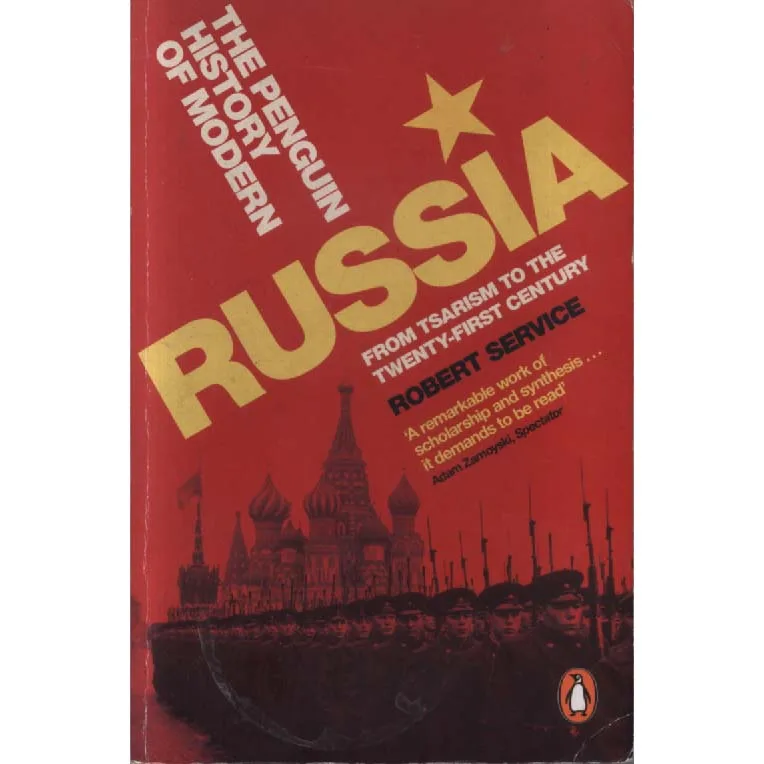
The Penguin History Of Modern Russia - From Tsarism To The Twenty-first Century
Publisher: Penguin Books
Format: Paperback
ISBN: 9780141992051
Russia, as this book makes abundantly clear, has never really believed in doing things by halves. If other countries occasionally flirt with upheaval, Russia tends to marry it, move it into the house, and then write several competing ideologies about it before winter. Tsars, revolutionaries, party bosses, oligarchs, reformers, strongmen, secret police, collapsing systems and grand promises of renewal: modern Russian history has a habit of treating moderation as a regrettable foreign custom.
The Penguin History of Modern Russia – From Tsarism to the Twenty-first Century (2020) by Robert Service is a sweeping, substantial guide to a country that has repeatedly reinvented itself in ways that are dramatic, consequential and not always especially restful for the people involved. This is a history of empire, collapse, revolution, dictatorship, war, reconstruction, stagnation, reform, disintegration and post-Soviet improvisation. In other words, not a dull patch in sight.
Service begins with late tsarist Russia, that vast and uneasy empire which managed to be both formidable and fragile at the same time. It had grandeur, hierarchy, repression, ambition and chronic structural problems, which is usually a sign that events will not remain calm forever. Sure enough, the old order buckles. Revolution arrives not once but twice, because in Russia even regime change occasionally requires a sequel. Out goes the Romanovs, in comes Lenin, and from there the twentieth century gathers speed with all the reassuring gentleness of an armoured train.
What follows is the rise of the Soviet state in all its contradictory force: ideological fervour, brutal coercion, industrial transformation, terror, war, sacrifice, pride and ruin. Stalin looms, naturally, as he must, turning politics into a mechanism of fear while building a system whose achievements and atrocities remain entangled in grim historical partnership. Then come the later decades: Khrushchev’s jolts, Brezhnev’s stagnation, the strange late-Soviet feeling that an enormous superpower could appear both immovable and vaguely exhausted at the same time.
And then, with the sort of abruptness history enjoys inflicting on experts, the Soviet Union collapses. The final sections move into the turbulent post-1991 world of market shock, state weakness, oligarchic opportunism, wounded national identity and the reassertion of central power. The title’s promise of the twenty-first century is therefore not decorative. This is not simply a Soviet history with a modern appendix stapled on. It follows Russia into the newer age, where the old questions of authority, empire, security and identity continue to reappear wearing different suits.
The pleasure of a book like this lies partly in its refusal to reduce Russia to a single story. It is not just tyranny, or just revolution, or just suffering, or just endurance. It is all of those things, plus culture, ambition, resilience, bureaucracy, myth-making and repeated attempts to drag an enormous state into some workable relationship with modernity. The irony, perhaps, is that every era arrives announcing a new beginning, only to discover that Russia has an extraordinary talent for carrying its past forward into the next upheaval.
Robert Service writes with the confidence of someone who knows the territory and is not easily dazzled by slogans. This is serious history, but highly readable serious history: the kind that can carry you from the last years of tsarism to the twenty-first century without losing sight of either the broad sweep or the sharp human cost. It is ideal for readers who want more than a narrow episode and less than a lifetime commitment to specialist monographs in footnote formation.
For readers of Crappy Old Books, this is an excellent slab of history: weighty, intelligent and faintly forbidding in the best possible way. It says that you enjoy understanding how the modern world got itself into such predicaments, and that you do not object if this understanding arrives via several revolutions, a world war, a superpower and a good deal of snow.
Condition: Good, which is more than can be said for several Russian regimes. A solid, readable and deeply informative history of a nation that has spent two centuries lurching magnificently between autocracy, ideology and reinvention, rarely pausing long enough for anyone to get comfortable.
Keep browsing: See more History books Other books by Robert Service
