


Railwaymen, Politics And Money - Great Age Of Railways In Britain
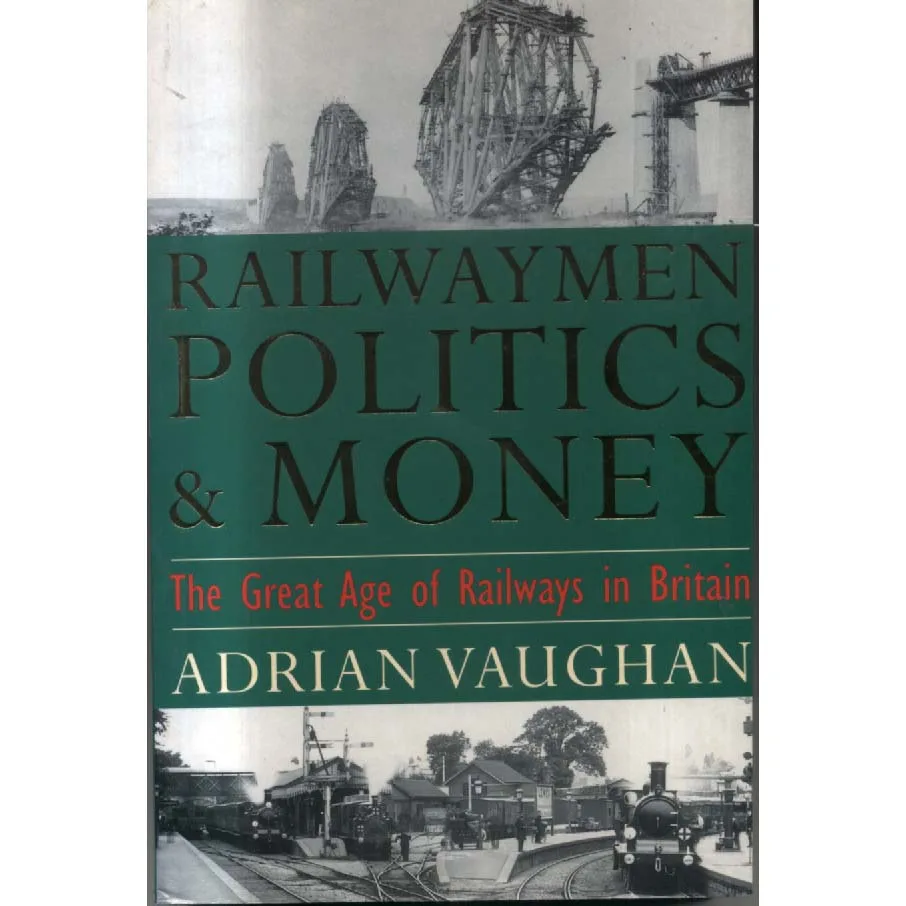
Publisher: John Murray
Format: Paperback
ISBN: 9780719557460
There is a particular kind of nostalgia reserved for the British railway: steam drifting romantically across the countryside, polished brass, punctuality (allegedly), and men in caps who appear to know exactly what they’re doing. It is all very reassuring—right up to the point where someone mentions money, politics, and the small matter of how any of it actually worked.
Railwaymen, Politics and Money – The Great Age of Railways in Britain (1997) by Adrian Vaughan is here to gently, and sometimes not so gently, dismantle the comforting myth that the railway age was a seamless triumph of engineering and national purpose. Instead, what you get is something far more recognisable: a sprawling, ambitious, occasionally chaotic enterprise powered by human effort, political manoeuvring, financial risk, and a great deal of argument.
Because, as it turns out, the railways were never just about trains. They were about people—railwaymen in all their varieties, from engineers and managers to the workers who kept the whole vast system moving. They were about politicians, who discovered that railways were extremely useful things to support, oppose, regulate, or interfere with depending on the mood of the moment. And, inevitably, they were about money—vast quantities of it, raised, spent, lost, misdirected, and occasionally justified.
Vaughan’s book lifts the lid on this world with a kind of practical scepticism. The “great age” of railways was indeed great, but not in the tidy, commemorative-plaque sense. It was great in the way large human systems tend to be: dynamic, messy, innovative, inefficient, and constantly under pressure. Expansion required capital. Capital required confidence. Confidence required persuasion. And persuasion, as ever, tended to involve optimism shading into fantasy. Investors, politicians and railway companies all played their parts in a drama that could swing from visionary progress to financial overreach with impressive speed.
There is also a quiet irony running through the narrative. The railways transformed Britain—shrinking distances, accelerating commerce, reshaping towns and industries—yet the very scale of that success made them harder to manage, more expensive to sustain, and increasingly entangled with government oversight. Freedom gave way to regulation, private ambition to public interest, and somewhere along the line the simple idea of “running trains” became an intricate balancing act between competing priorities.
And then there are the railwaymen themselves, without whom none of it functions. Behind every timetable and policy debate is the daily reality of operating a complex network: maintaining track, managing traffic, dealing with breakdowns, handling passengers, and doing so in all weathers with varying degrees of appreciation. Vaughan does not let them fade into the background. They are central to the story, as they must be, because systems are only ever as good as the people keeping them alive.
What emerges is not a nostalgic postcard but a living, breathing account of an industry that helped define modern Britain while constantly wrestling with its own contradictions. Efficiency versus cost. Innovation versus stability. Private enterprise versus public control. It all feels, in a way, rather contemporary, which is perhaps the final twist of the knife: the more things change, the more they resemble a Victorian board meeting with slightly better lighting.
For readers of Crappy Old Books, this is an excellent choice: solid, intelligent history with enough grit to counterbalance the romance. It will sit very nicely on a shelf, suggesting an interest in serious matters, while quietly reminding you that behind every grand national achievement lies a dense thicket of politics and accounts.
Condition: Good, which is probably how most railway balance sheets looked at the time. A sturdy, well-kept copy of a book that explains, with admirable clarity, that the golden age of railways was built not just on iron and steam, but on negotiation, ambition, and the occasional financial headache.
Keep browsing: See more History books Other books by Adrian Vaughan
