


Thomas Wyatt - The Hearts Forest
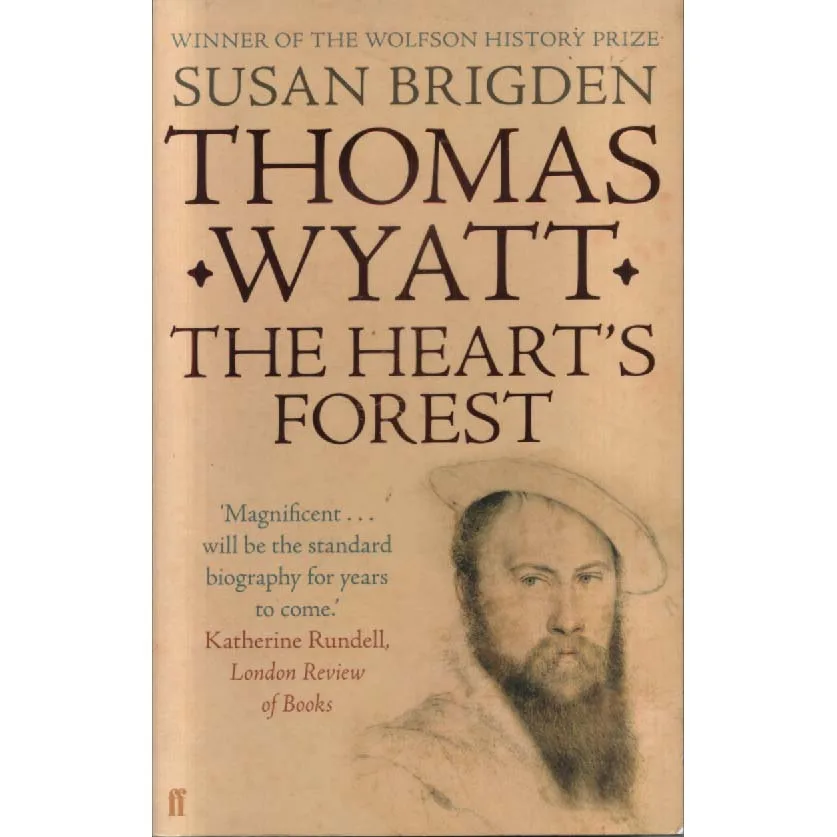
Publisher: Faber and Faber
Format: Paperback
ISBN: 9780571235858
Here is Thomas Wyatt: courtier, diplomat, poet, survivor, occasional emotional disaster in expensive Tudor clothing. A man moving through Henry VIII’s England with a pen in one hand and, metaphorically at least, his neck in the other.
Thomas Wyatt – The Heart’s Forest (2012) by Susan Brigden is not content to leave Wyatt as a few anthology pages and a vague reputation for bringing the sonnet to England. No, this book drags him gloriously back into the full Tudor weather system: a world of court intrigue, shifting favour, foreign missions, erotic peril, political theatre and the ever-present possibility that the king may wake up in a mood. Wyatt, in lesser hands, can seem like one of those literary figures who exists mainly to be praised for being “important.” Brigden restores the more useful truth that he was also a real man trying to stay alive in one of the least relaxing centuries available.
And what a setting. This is England when power is personal, religion is exploding, and a badly judged sentence could do more damage than a sword. Wyatt served Henry VIII, travelled abroad, wrote poetry of startling intimacy and intelligence, and somehow managed to navigate a court in which admiration, envy, desire and mortal danger all tended to arrive together. It was not a great age for clear boundaries. One minute you are writing a lyric of aching restraint, the next you are dodging rumours, factions and the general political consequences of being too noticeable.
The title alone gives you the flavour of it: The Heart’s Forest. Not a neat little rose garden of lyrical reflection, but a forest, dense and shadowed, full of paths that vanish and creatures that may or may not be hunting you. Wyatt’s inner life and outer life are tangled together here, which is exactly as they should be. His poetry was not composed in some serene vacuum for the benefit of future undergraduates. It came out of pressure, ambition, disappointment, longing and the extraordinary awkwardness of living in a court where love poetry and statecraft could easily become adjacent hobbies.
Naturally, Anne Boleyn hovers in the background, because no Tudor biography is allowed out without at least some charged proximity to catastrophe. Wyatt’s connection to her has fuelled endless fascination, and Brigden handles this world not as gossip in fancy dress but as a serious human and political environment in which intimacy itself could become dangerous. Tudor England had very high stakes and very poor privacy settings.
What makes this especially appealing is that Wyatt was not simply “the poet,” as though he floated around producing elegant melancholy while other people handled events. He was embedded in the machinery of his time. Diplomatic service, royal favour, factional danger, imprisonment, release, recovery: his life has all the ingredients of a thriller for readers who prefer their suspense accompanied by a lute and a fatal misunderstanding. And through it all, the poetry remains startlingly alive, not as decorative extra credit, but as evidence of a mind trying to think and feel honestly inside a system built on performance.
Susan Brigden is superb on this sort of material because she understands that the Tudors were not merely picturesque. They were stressful. Behind the portraits and tapestries were people guessing wrong, choosing sides, reading rooms badly, falling in love inconveniently and trying to survive the consequences. Wyatt becomes, in her hands, not a marble bust with excellent diction, but a vivid participant in a culture where language mattered intensely because it could seduce, conceal, flatter, wound and occasionally save.
For readers of Crappy Old Books, this is ideal: serious history with pulse, intellect and danger, wrapped around a man who helped shape English poetry while living a life that sounds suspiciously like a warning. If you enjoy your literary biography with politics, peril and a constant undertow of romantic and professional jeopardy, this is a splendid thing to take home and place where visitors can see that you are, at the very least, pretending to have deep feelings about the early sixteenth century.
Condition: As New, which is more than can be said for Wyatt’s nerves. A handsome copy of a rich, elegant and thoroughly absorbing biography of a poet who discovered that in Tudor England, having a heart was one thing, but keeping it intact was quite another.
Keep browsing: See more Biography books Other books by Susan Brigden
