


The Russian Revolution
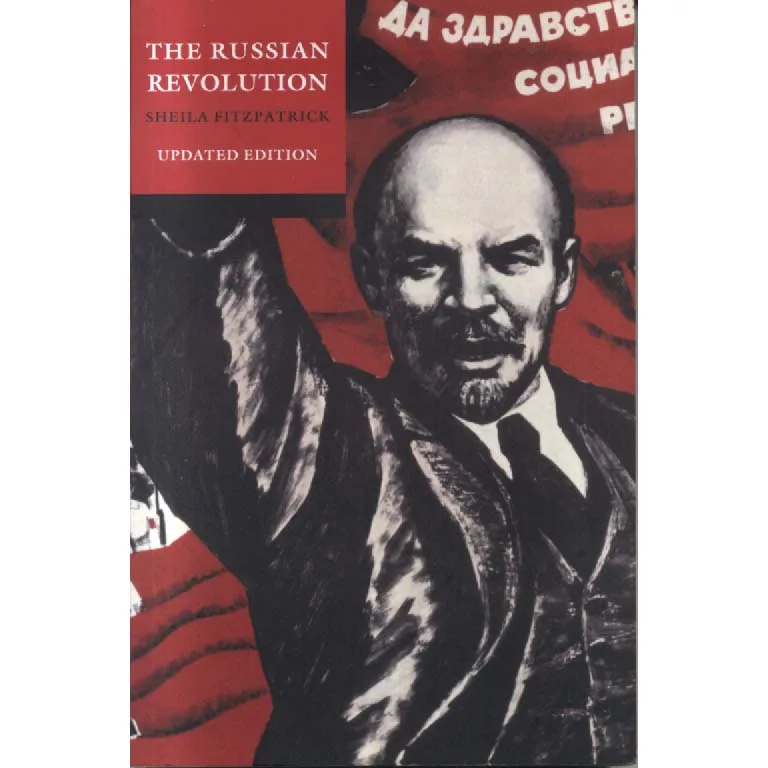
Publisher: Oxford University Press
Format: Paperback
ISBN: 9780198806707
The Russian Revolution is one of those deceptively tidy titles that conceals a vast quantity of upheaval, ideology, hunger, improvisation, gunfire, administrative collapse, utopian conviction, and people in long coats making history at uncomfortable speed. Sheila Fitzpatrick, being one of the great historians of Soviet Russia, takes this most over-explained and under-understood of subjects and does something marvellous with it: she makes it intelligible without pretending it was ever simple.
Because the Russian Revolution is rarely presented in moderation. It tends to arrive either as sacred drama or apocalyptic warning, depending on who is doing the talking. Either it is the heroic dawn of a new world, all workers and destiny and the old order crashing down at last, or it is the original political catastrophe of modernity, a blood-soaked lesson in what happens when theory acquires rifles. Fitzpatrick’s great virtue is that she sidesteps both pageants and gets on with the far more interesting business of showing how revolution actually works when it stops being a slogan and starts becoming a state.
And what a state to build. Imperial Russia collapses under the combined weight of war, inequality, incompetence and exhaustion. Out of the wreckage come revolutionaries, factions, slogans, committees, hopes, shortages, civil war, terror, and the astonishingly rapid transformation of society into something at once visionary and deeply alarming. The old hierarchy is attacked, the new order improvised, and vast ideas about class, history and human destiny are hurled into everyday life with results that are not always tidy. Which is putting it mildly. Fitzpatrick is superb at conveying that the revolution was not merely an event in Petrograd but a long and chaotic remaking of politics, institutions, habits, expectations and survival itself.
What makes the book especially good is its refusal to treat revolution as theatre performed entirely by famous men on balconies. Lenin is there, of course, glinting with purpose. Trotsky storms about with intellectual voltage. Stalin looms eventually in the background like a weather system that will become everyone’s problem. But Fitzpatrick does not let the story freeze into portrait gallery history. She is always attentive to social reality: workers, peasants, bureaucrats, shortages, education, class mobility, violence, aspiration, fear. One comes away not just with a sense of what was proclaimed, but of what it felt like to live through a system that promised a new world and then had to run one.
There is also a delicious irony in the whole subject that Fitzpatrick handles beautifully. Revolutions are so often fuelled by dreams of liberation, equality and the sweeping away of oppression; then, almost immediately, they discover paperwork, discipline, coercion, grain procurement and the awkward truth that governing is less glamorous than overthrowing. The Russian case is perhaps the grand masterpiece of this phenomenon. The future arrives in banners and ends up needing administrators. A workers’ state must somehow organise factories, food supplies, armies, ideology and dissent, all while insisting history is on schedule. It is difficult not to admire the scale of the ambition even as the consequences grow steadily more brutal.
This 2017 Oxford University Press edition is exactly the sort of serious modern history paperback one wants for such a subject: compact, authoritative, and unshowily intelligent. It has that admirable OUP quality of assuming readers are capable of handling difficult material without being bribed by gimmicks. No sensationalism required; the revolution itself is dramatic enough. A sober cover, a formidable scholar, and inside it all the collapse, fervour and re-engineering of an empire. Quite enough for one volume.
As sold by Crappy Old Books in Good condition, this copy has the right sort of practical dignity. A good history of revolution ought not to look too pampered. Good suggests it may already have done some honest service—perhaps to a student, a political enthusiast, a Soviet-history devotee, or someone trying to understand why the twentieth century turned out the way it did. Now it is ready for a new reader, whether that reader comes seeking clarity, argument, or simply the pleasure of watching one of history’s largest explosions explained by someone who actually knows where the pieces landed.
And really, that is the joy of Fitzpatrick. She is clear without being simplistic, sharp without being flashy, and alive to the strange mix of idealism, coercion, hope and catastrophe that made the Russian Revolution one of the central convulsions of the modern world. This is not just a book about 1917 in the narrow sense. It is about what happens when a regime falls, an idea seizes power, and an entire society is told that history has turned a corner whether it feels ready or not.
So The Russian Revolution is a splendid volume for anyone interested in political upheaval, Soviet history, ideology, social transformation, or the recurring human temptation to believe that a complete redesign of society can be achieved by determined people with pamphlets and momentum. Learned, brisk, penetrating and wonderfully sane amid the surrounding madness, it is exactly the kind of book Crappy Old Books is pleased to send back into circulation.
A sharp, elegant guide to one of history’s great upheavals: when an empire collapsed, a revolution advanced, and the modern world acquired one of its most consequential experiments in rebuilding everything from the ground up.
Keep browsing: See more History books Other books by Sheila Fitzpatrick
