


The Age Of Revolution - Europe 1789-1848
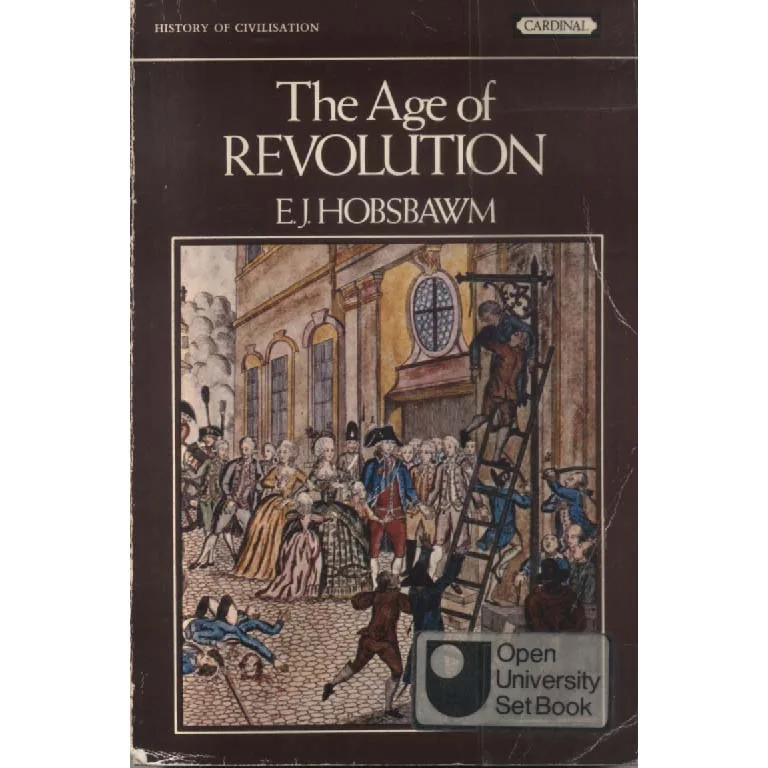
Publisher: Cardinal
Format: Paperback
ISBN: 0351167323
Here is one of those books that does not merely discuss history but strides into the room, clears its throat, and begins explaining why the modern world happened at all. The Age of Revolution: Europe 1789–1848 by E. J. Hobsbawm is not content with giving you a few dates, a handful of kings, and some decorative barricades. No, this is history with intent. History with structure. History that looks at revolution, industry, class, upheaval, ideology and the general rearrangement of European civilisation and says, quite reasonably, “let’s do the lot.”
Originally published in this 1973 Cardinal edition, Hobsbawm’s great gift is that he makes enormous historical forces feel both intellectually serious and oddly alive. This is not the sort of book that treats the French Revolution as a charming little disturbance involving wigs and principles. Nor does it reduce the Industrial Revolution to a few smoky chimneys and the invention of inconvenience. Instead, it places these convulsions where they belong: at the centre of a world being comprehensively dismantled and rebuilt, often by people who were very sure they understood liberty, progress or destiny, and only slightly less sure what would happen next.
The title itself is magnificently confident. The Age of Revolution. Not Some Revolutions, not A Few Interesting Disturbances in Europe, but the age. A whole era claimed in four words. And once you open the book, you can see why. Hobsbawm is concerned with nothing less than the transformation of European society between 1789 and 1848 — from throne-and-tithe old order to the bright and alarming modernity of factories, political agitation, nationalism, middle classes, urban misery, and the increasingly awkward discovery that once you tell people the world can be changed, they may insist on changing it.
There is something wonderfully bracing about reading a historian who assumes that economics, politics, culture and class all belong in the same conversation. This is not history as a sequence of politely separated compartments. It is all connected, because of course it is. Revolutions do not happen in a vacuum, and neither does industrial capitalism, nor do the dreams and disappointments that trail behind them. Hobsbawm writes with the air of a man who has looked at Europe in pieces and decided this will never do.
And yet for all its seriousness, there is a lurking irony in the subject matter itself. Here is Europe, declaring the rights of man, storming old regimes, inventing modern politics, mechanising labour, expanding wealth, producing misery on an industrial scale, and constantly surprising itself by how complicated liberation becomes once actual human beings are involved. It is a period rich in ideals, slogans and unintended consequences — which is to say, perfect Hobsbawm territory. The book does not sentimentalise revolution, but neither does it trivialise it. It understands that history’s great turning points tend to be equal parts brilliance, bloodshed, theory, hope and administrative confusion.
This Good condition copy has survived rather better than many of the regimes and assumptions discussed inside it. It carries the honest appeal of a serious paperback that has likely spent part of its life on the shelf of someone who intended not merely to read history but to understand it, which is a nobler and more dangerous ambition. One imagines underlining. One imagines marginal agreement or muttering dissent. One imagines someone reaching for it after deciding that the modern world had become too confusing to make sense of without first revisiting the late eighteenth century.
Sold by Crappy Old Books, where the branding remains far less elevated than the stock, this is an excellent copy for readers who enjoy history on a grand scale: ideas with consequences, revolutions with dust still in the air, and a Europe busily inventing many of the political and economic arguments we are still trapped in today. If you like your history broad, intelligent, and faintly intimidating in the best possible way, The Age of Revolution is here to remind you that modernity did not drift gently into being. It arrived shouting, marching, printing pamphlets, toppling institutions and building factories — and Hobsbawm is quite determined that you should notice.
Keep browsing: See more History books Other books by EJ Hobsbawm
