


Hertfordshire
Publisher: Methuen
Format: Hardback
ISBN: none
Some county books merely list churches, market towns and mildly improving scenery. Hertfordshire sets out to do something a little more Edwardian and a little more ambitious: to gather a whole English county into one compact volume and present it as a place of character, history, architecture, landscape and quiet significance. It belongs to that deeply civilised tradition of topographical books which assume, quite rightly, that a county is not just a patch of land on the way to somewhere else, but a complete world deserving of proper attention.
Written by Herbert W. Tompkins and published by Methuen in 1928, this is exactly the sort of interwar county book that makes second-hand shelves more interesting. There is something wonderfully confident about the idea behind it. Hertfordshire, so often treated now as a commuter belt, is here restored to fuller dignity: a county of old roads, parish churches, market centres, estates, stories, and the sort of historical layering England does so well. Before motorways flattened geography into mere travel time, books like this reminded readers that counties had identities of their own.
That is much of the charm. Hertfordshire comes from an age when local history, landscape and architecture were still treated as part of ordinary cultural life. A reader might quite naturally want to know the background of a town, the age of a church tower, the associations of a manor house, or why one stretch of countryside had taken the shape it had. The county guide was therefore not just a practical companion but a form of education, rooted in the pleasant belief that knowing more about place made one’s life richer. It is hard to argue with that.
The year 1928 gives the volume a particular flavour. This is England between the wars: not yet modern in the flattened, standardised sense, but already looking back at older worlds with some affection and concern. County books from this period often stand at a fascinating point between record and elegy. They describe places still very much alive, yet already faintly conscious that change is accelerating. In that sense, Hertfordshire is not only about the county it surveys, but also about the culture that produced such books in the first place: observant, historical, quietly patriotic, and fond of detail.
This copy has the added pleasure of photos, drawings and a map, which is exactly what one wants in a proper county volume. Text alone is admirable, but illustrations turn a guide into an invitation. Old photographs capture streets, buildings and landscapes with that particular interwar stillness which now feels almost impossibly remote. Drawings add their own interpretative charm, halfway between record and affection. And a map, naturally, is the final civilising touch: proof that one may not only read about Hertfordshire, but orient oneself within it like a serious person.
There is also something gently ironic about county books in general. They often appear so modest, so self-contained, as if merely offering local information. Yet they are really miniature acts of cultural preservation. They say: this place matters, these buildings matter, these stories matter, this arrangement of fields, roads and settlements is worth noticing before the world hurries on and forgets to look. A county guide is therefore never just a guide. It is a small argument against carelessness.
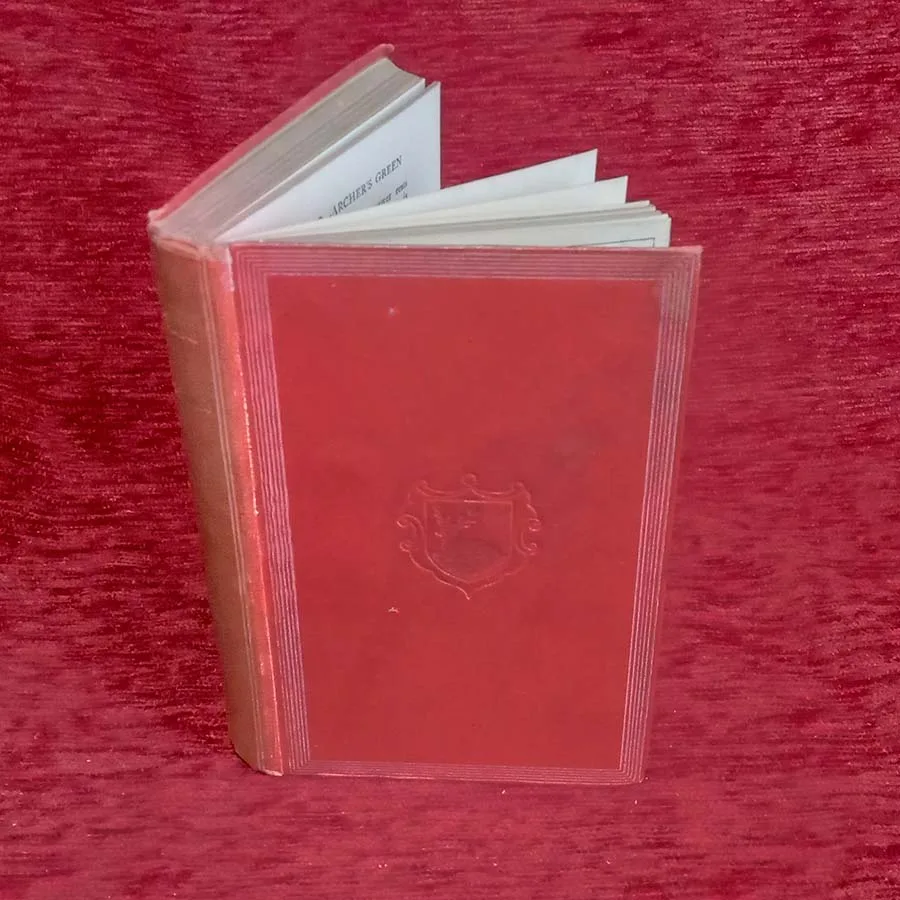
Published by Methuen, this 1928 edition has exactly the kind of restrained physical charm one hopes for in such a book. The red cloth binding visible in the image is neat, compact and properly dignified, carrying just enough decorative seriousness to suggest that the contents are respectable without being pompous. It looks like a book that would have sat comfortably in a good local library or in the hands of a walker with antiquarian instincts and a reasonable pair of shoes.
In Good condition, this copy has survived very well. It remains a tidy and attractive volume, and the inclusion of its visual material only increases its appeal. Books of this sort are often more enjoyable when they have clearly lived a little, because they were meant to be consulted, taken on journeys, opened beside roads or fireplaces, and returned to shelves richer with use. A pristine county guide is pleasant; a well-kept one with intact map and illustrations is better.
For the modern reader, Hertfordshire offers several pleasures at once. It is local history, travel writing, architectural record and cultural time capsule. It will appeal to lovers of English counties, collectors of topographical books, Hertfordshire residents with roots or curiosity, and anyone who enjoys old books that make a place feel deeper, older and more interesting than the passing glance usually allows.
In short, this 1928 Methuen edition of Hertfordshire is a delightful compact county portrait: informed, observant, well-illustrated and full of the quiet seriousness with which earlier generations approached place. In Good condition, and with photos, drawings and a map included, it is a thoroughly attractive Crappy Old Books copy — a neat little volume devoted to the proposition that Hertfordshire, properly looked at, is far more than merely somewhere north of London.
Keep browsing: See more Travel books Other books by Herbert W Tompkins
