


Sketches By Boz
Publisher: Richard Edward King
Format: Hardback
ISBN: none
Before Charles Dickens became the great Victorian institution of fog, orphans, creditors, clerks, Christmas redemption and industrial outrage, he was Boz: sharp-eyed, amused, energetic, and already wandering through London as though the entire city had been built purely to provide him with material. Sketches by Boz is where that extraordinary observational engine first properly announces itself. Here is Dickens before the full parade of his great novels, catching voices, habits, streets, small absurdities and human types with the confidence of a writer who has realised that ordinary life, looked at properly, is not ordinary at all.
This 1850 edition, published by Richard Edward King, carries all the charm one might hope for from an early Dickens volume. Sketches by Boz is not a single grand plot marching toward moral settlement, but a lively gathering of scenes, character pieces and urban glimpses: a whole cabinet of London life, opened by a young writer who already knew that the city was a theatre and that nearly everybody in it was performing, whether they meant to or not. Dickens had the rare gift of finding comedy in routine, pathos in bustle, and social meaning in the way a room was arranged or a phrase was spoken.
What makes these sketches so enjoyable is their immediacy. Later Dickens can become monumental, as though the whole Victorian age had climbed into the sentence and refused to leave. Here, by contrast, there is something quick, nimble and exploratory. He moves through streets, taverns, shops, lodging houses and public places with the alertness of a journalist and the appetite of a novelist. The result is a London that feels crowded, noisy, smoky, comic, shabby, vigorous and perpetually on the brink of revealing some new human oddity. One can see Dickens discovering not just his city, but his power over it.
And what a city it is. Sketches by Boz gives us early nineteenth-century London not in the abstract language of history, but in glimpses of movement and behaviour: the bustle of the streets, the little vanities of ordinary people, the social rituals, the local characters, the comic miseries and private dramas of everyday existence. Dickens does not merely describe urban life. He hears it, notices it, delights in it, winces at it, and then turns it into prose so animated that the people on the page seem to elbow one another for space.
There is also something wonderfully ironic about the title. “Sketches” sounds modest, almost casual, as though these were a few light pencilled observations dashed off between more serious undertakings. In fact, the book contains the beginnings of one of the most formidable literary careers in English. These little pieces are not minor in the dismissive sense at all. They are the workshop of Dickensian vision: the place where caricature, sympathy, satire, social observation and theatrical energy all begin learning to work together. One reads them partly for pleasure and partly for the thrill of seeing the machinery starting up.
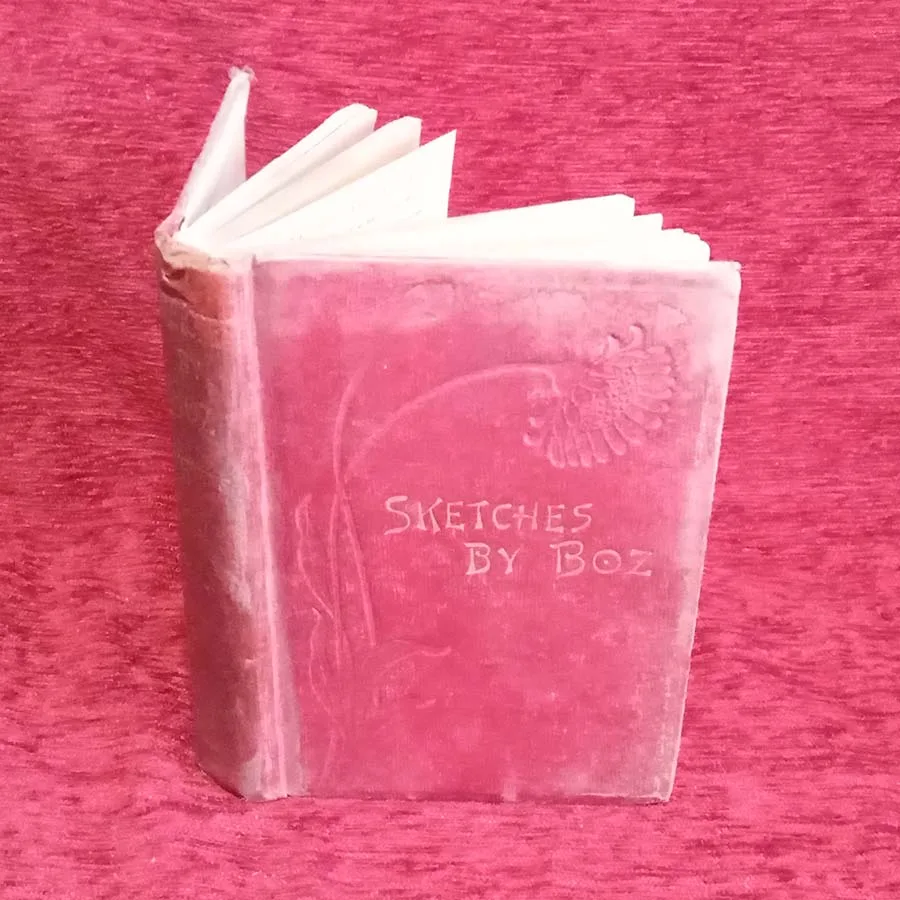
This 1850 Richard Edward King edition, in Fair condition, looks exactly like the sort of book that has earned its age honestly. The image suggests a small, worn, attractively time-softened volume with that unmistakable old-book atmosphere: a little rubbed, a little weathered, and entirely incapable of pretending to be new. Which suits Dickens perfectly. Sketches by Boz is a book about life as actually lived among the crowd, and a fair copy somehow feels truer to that spirit than anything too immaculate and museum-like. It looks like a book that has circulated, been handled, perhaps been read by gaslight, and then survived to tell the tale.
The decorative cloth binding only adds to the appeal. It has the kind of faded Victorian dignity that makes one want to place it on a shelf and feel immediately more literary. A book like this does not need to shout. It merely sits there, worn but resolute, carrying inside it the sights and voices of old London and the earliest full spark of Dickens’s genius. That is more than enough.
For the modern reader, Sketches by Boz remains one of the most rewarding ways into Dickens. It has all the wit, humanity and comic sharpness one expects, but in shorter forms that show just how quickly and instinctively he could capture a scene. It will appeal to lovers of Dickens, collectors of Victorian books, readers fascinated by London, and anyone who enjoys literature that notices people before judging them too harshly. Though, being Dickens, he does sometimes judge them quite deliciously.
In short, Sketches by Boz is Dickens in early, brilliant, bustling form: curious, funny, socially alert and already masterfully alive to the spectacle of the city. This 1850 Richard Edward King edition, in Fair condition, is a wonderfully characterful Crappy Old Books survivor — worn, atmospheric, and carrying within it the youthful, watchful eye of the writer who would go on to sketch not just London, but an entire age.
Keep browsing: See more Literary Classics books Other books by Charles Dickens
