


Peter Jackson - Cigar Merchant - A Romance Of Married Life
Publisher: Hutchinson and Co
Format: Hardback
ISBN: none
Peter Jackson – Cigar Merchant – A Romance of Married Life (1919) by Gilbert Frankau
Hutchinson and Co. — ISBN: none
Condition: Good
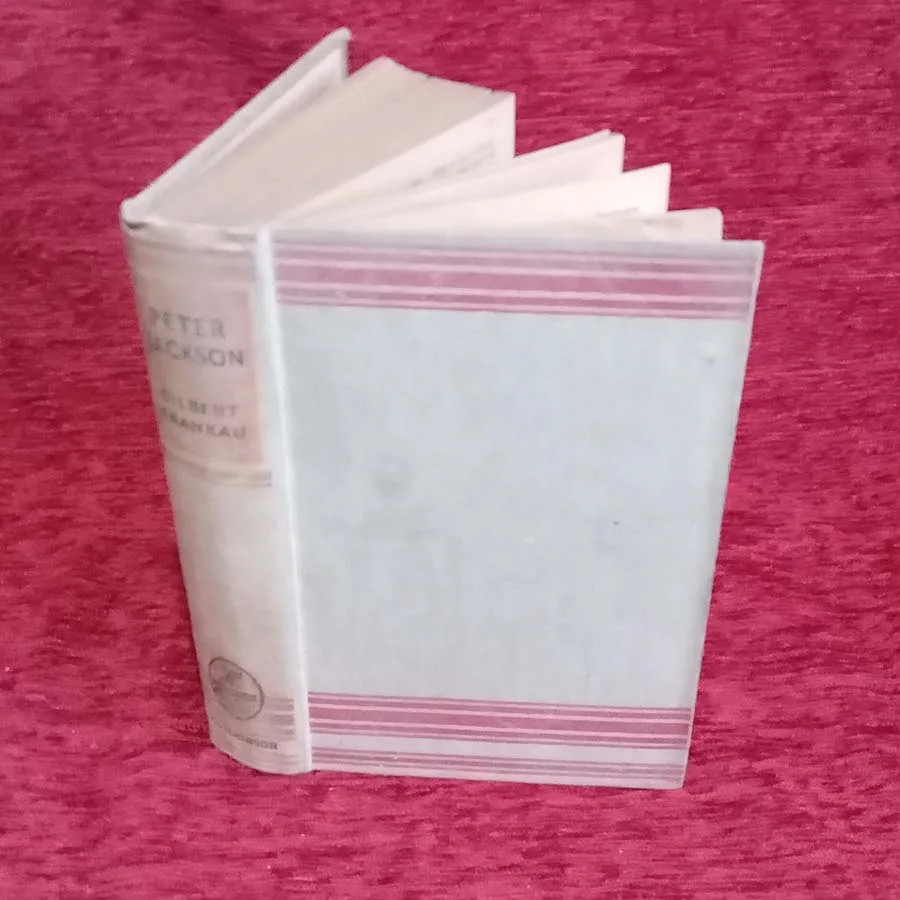
Soft cloth binding, pages good but slightly yellowed with age, spine slightly slanted.
178th Thousand
As sold by Crappy Old Books
There are love stories full of moonlight, violets, trembling declarations and ornamental misery. And then there are love stories which sensibly begin with a cigar merchant. Peter Jackson – Cigar Merchant – A Romance of Married Life belongs triumphantly to the second category: a novel that sounds, at first glance, like either a joke or a piece of highly specific Edwardian bookkeeping, but is in fact exactly the sort of title that makes old fiction so irresistible. Marriage, commerce, tobacco, and emotional entanglement — civilisation, in other words, distilled into one politely improbable volume.
Published in 1919, this novel emerges from that curious moment just after the Great War, when British life was trying to look ordinary again while quietly knowing that nothing was quite as ordinary as it had been before. Into this atmosphere steps Gilbert Frankau, a writer with a keen eye for manners, money, relationships, and the subtle mechanics of social life. The result is not romance in the sugar-spun sense, but romance in the older, more interesting sense: the drama of real human arrangements, ambitions, expectations and affections, all unfolding under the watchful eye of a novelist who plainly understands that marriage is rarely simple and never improved by sentimentality alone.
And what a title. A Romance of Married Life suggests that Frankau had no intention of wasting time on the easy part. Courtship may be decorative, but married life is where the proper drama begins: habits, loyalties, irritations, compromises, disappointments, ambitions, and the thousand unglamorous negotiations by which two people attempt to occupy the same life without entirely destroying either the furniture or one another. Add a cigar merchant to the equation, and the whole thing acquires a faint haze of commercial realism and aromatic seriousness which is immediately promising.
There is something wonderfully ironic about books like this. Modern fiction often behaves as though marriage is either an ending or a catastrophe. Older novels were often far more interested in the fact that it is, in practice, an ongoing arrangement involving personalities, economics, social standing, and daily endurance. Frankau’s title practically announces that he intends to examine domestic life not as a sentimental finish line but as a full narrative landscape in its own right. One suspects there will be emotion, certainly, but also practicalities, tempers, expectations and the occasional collision between romantic ideal and actual human conduct.
This 1919 Hutchinson and Co. edition has exactly the right physical character for such a book. The soft cloth binding visible in the image gives it that slightly genteel, slightly modest presence typical of the period: respectable, self-contained, and not at all desperate for attention. It looks like the sort of volume that might once have sat on a side table in a drawing room where someone had strong opinions about propriety, cigarettes, and whether modern marriage was going to the dogs. In other words, ideal.
The copy is in Good condition, with the pages still good though slightly yellowed from age, which seems entirely appropriate. A century has passed, and the paper has responded with the quiet golden tint of survival. That slight yellowing is not a flaw so much as an atmosphere. It reminds you that this is not merely a text but an object that has travelled through time, carrying with it the assumptions, anxieties and domestic preoccupations of another age. Books about marriage ought to show a little maturity.
There is also the inescapable pleasure of Gilbert Frankau himself, a writer now less discussed than he once was, but still possessed of that invaluable early 20th-century quality: the ability to treat social life seriously without becoming dull, and human feeling sympathetically without surrendering to mush. He belonged to a world that liked its fiction readable, observant, and properly embedded in the practical realities of class, profession and household life. The cigar trade, one suspects, is not there merely as a decorative oddity. It is part of the novel’s worldliness, its sense that people live not in abstractions but in businesses, routines, incomes and habits.
For the modern reader, that is much of the charm. Peter Jackson – Cigar Merchant sounds eccentric now, but in the best possible way. It offers a glimpse of a literary culture unafraid to ground emotional life in the material world. Love and marriage do not occur in a vacuum; they occur around work, money, domestic expectation and social performance. Frankau knew that, and the title wears its realism almost proudly. It is as though the book is saying: yes, this is romance, but let us also remember somebody must sell the cigars and pay the bills.
As a Crappy Old Books item, it is a delight: unusual, evocative, mildly comic in title, and full of period character before one has even turned a page. It will appeal to collectors of forgotten fiction, lovers of odd Edwardian and interwar titles, and anyone who enjoys novels that promise not idealised passion but the far trickier business of actual life shared with another person.
In short, Peter Jackson – Cigar Merchant – A Romance of Married Life is exactly the sort of old novel that rewards curiosity: socially observant, intriguingly titled, and rooted in the fascinating borderland between romance and reality. This 1919 Hutchinson copy, in Good condition with soft cloth binding and gently age-yellowed pages, is a wonderfully characterful survivor from a time when publishers still believed that matrimony, commerce and narrative could be packed neatly into one compact, faintly smoky volume.
Keep browsing: See more Fiction books Other books by Gilbert Frankau
