Vanity Fair
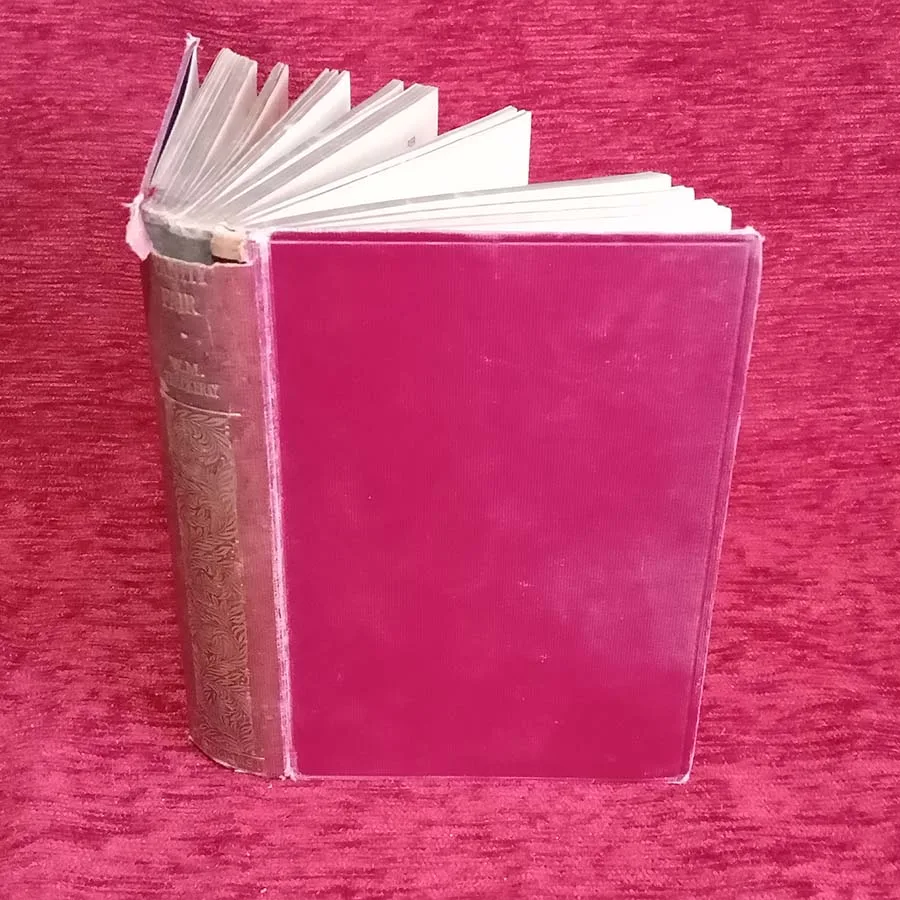
Publisher: Collins Clear-Type Press
Format: Hardback
ISBN: none
Vanity Fair (1906) by W. M. Thackeray
Collins Clear-Type Press — ISBN: none
Condition: Good
Slight damage to top of spine, as per image
As sold by Crappy Old Books
Some novels describe society. Vanity Fair strolls into it, raises an eyebrow, inventories the hypocrisies, admires the upholstery, and quietly informs you that nearly everybody is ridiculous. Thackeray’s great masterpiece remains one of the finest dismantlings of human pretension ever bound between two covers: a long, glittering, sharp-toothed parade of ambition, vanity, romance, money, disappointment, and social manoeuvring, delivered with such elegance that you hardly notice how merciless it is until several chapters later.
This 1906 Collins Clear-Type Press edition has exactly the sort of presence one wants from Vanity Fair. It looks like a proper old novel should look: compact, respectable, faintly severe, and entirely unconvinced by the moral sincerity of anyone involved. There is something deeply satisfying about encountering Thackeray in an edition from the early twentieth century, when the machinery of class, reputation, appearance and strategic marriage was still near enough to feel less like history and more like slightly improved gossip.
At the heart of the book, of course, is Becky Sharp, one of literature’s most gloriously indelicate social climbers. Becky does not so much enter the novel as begin plotting within it. Clever, resourceful, charming, ruthless, and far too entertaining to be safely respectable, she remains the bright, dangerous engine of the whole performance. Around her cluster officers, heiresses, fools, sentimentalists, snobs, and those poor creatures who imagine society rewards virtue in any reliable sense. Thackeray, being Thackeray, knows better. Society rewards performance, money, timing, and the ability to look composed while everything collapses.
What makes Vanity Fair so enduring is that its satire has not aged in the slightest. The clothes change, the transport improves, and people have fewer opportunities to faint into upholstery, but the essential human business of wanting status, admiration, security and advantageous attachment remains stubbornly intact. The novel is nominally about Regency and early nineteenth-century life, but really it is about the permanent comedy of people trying to arrange themselves favourably within a system they pretend not to worship. In that sense, it is less a historical novel than a user manual for civilisation.
The Collins Clear-Type Press imprint adds another layer of charm. These editions were made for reading rather than decorative posing, which feels entirely right for Thackeray. Vanity Fair may be a classic, but it is not a fragile shrine-piece. It is a living, bustling, ironic, socially carnivorous book, and it ought to be held, read, reopened, and consulted whenever one needs reminding that polished manners and moral worth have never been reliable companions. A clear-type edition of a novel devoted to exposing blurred ethics seems especially apt.
This particular copy is in Good condition, with slight damage to the top of the spine, just enough wear to suggest a long and honourable life without descending into melodrama. The image gives it exactly the right kind of seasoned dignity: a little rubbed, a little worn at the crown, but still very much standing. One could argue that a slightly bruised spine suits Vanity Fair better than a pristine one. A book devoted to the battering effects of social ambition should not look too untouched by the world.
There is also something wonderfully ironic in the title itself. “Vanity Fair” is not merely a place in the novel, but a whole operating system for human conduct. Everyone is displaying themselves, selling themselves, protecting themselves, or trying not to be sold off entirely. Love is tangled with advantage, virtue is frequently unrewarded, and innocence is no match for experience with a good dressmaker. Yet for all its cynicism, the novel is not cold. Thackeray sees folly clearly because he sees humanity clearly, and the result is a book that manages to be both unsparing and strangely affectionate.
For the modern reader, this is one of those classics that repays every assumption and then cheerfully overturns it. It is funny, observant, psychologically acute, and much more entertaining than those who have not yet read it sometimes fear. Yes, it is important literature. More importantly, it is full of bad decisions, strategic charm, social humiliation, and the kind of elegant narrative judgement that makes one want to underline things in approval.
In short, this 1906 edition of Vanity Fair is a wonderfully suitable survivor: a Good copy with a little spine wear, carrying one of the great English novels in a form that feels entirely at home with its wit and worldliness. A splendid piece of old-book gravity housing a novel that knew, long before the rest of us, that society is theatre, sincerity is overrated, and almost everyone is performing for the front row.
Keep browsing: See more Literary Classics books Other books by WM Thackeray