


1914 And Other Poems
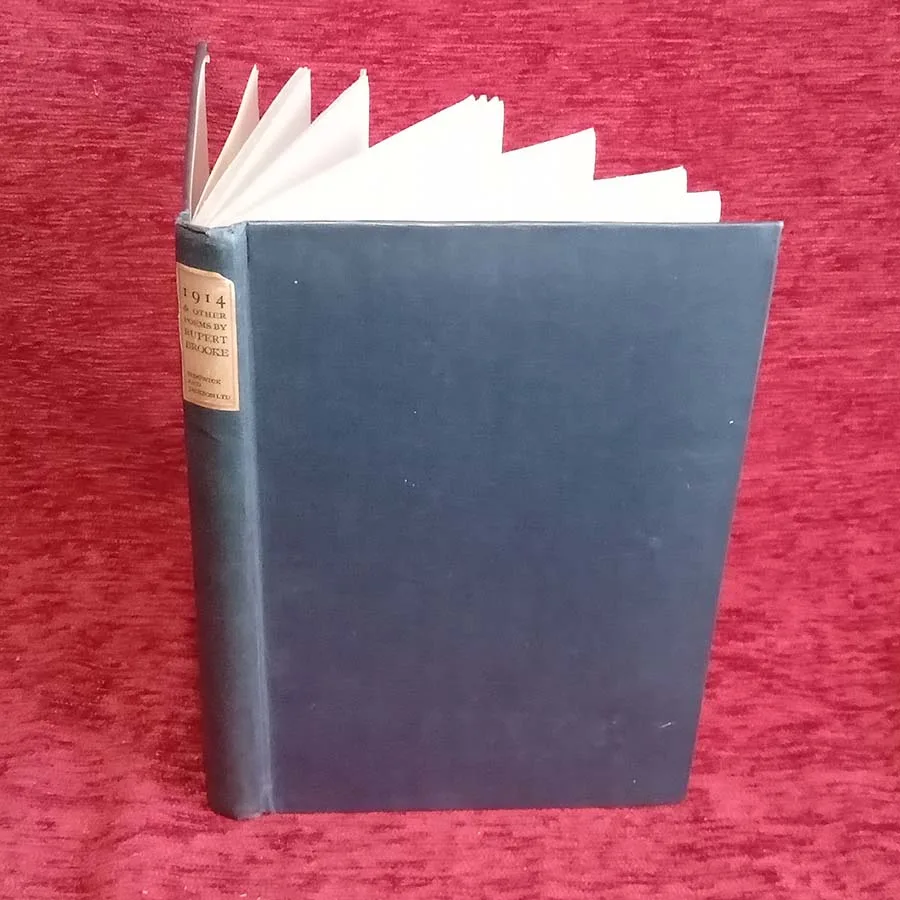
Publisher: Sidgwick and Jackson
Format: Hardback
ISBN: none
1914 and Other Poems (1915) by Rupert Brooke
Seventh Impression — ISBN: none
Condition: Good
As sold by Crappy Old Books
Some books arrive trailing history behind them. 1914 and Other Poems arrives with the full, solemn, complicated weight of a world just beginning to fall apart, wrapped in verse so polished and luminous that one almost forgets, for a moment, what it is standing beside. Rupert Brooke remains one of those peculiarly English literary figures who seem to belong equally to poetry, myth, youth, and national self-invention: handsome, gifted, prematurely mourned, and forever preserved in that strange Edwardian glow just before Europe lost its mind.
This 1915 Seventh Impression is therefore not merely an early copy of a famous poetry collection. It is an artefact from the very moment Brooke’s reputation was being sealed in real time, while the Great War was still new enough to be imagined in noble outlines rather than the mud-soaked, mechanised horror it would become. That alone gives the book a powerful atmosphere. It does not look back on 1914 with hindsight. It comes from inside the storm’s opening act, when idealism had not yet been thoroughly broken on the wire.
Brooke’s war sonnets, of course, are what most people know — especially those lines that have been quoted, memorised, anthologised, and occasionally deployed whenever England feels the urge to remember itself in elevated tones. They are graceful, musical, sincere, and laden with the kind of sacrificial patriotism that later generations have found by turns moving, poignant, and faintly unbearable. Brooke has had the odd fate of being both genuinely admired and gently distrusted: admired because he could plainly write, distrusted because history was unkind enough to expose the innocence of the world he imagined.
Yet that tension is part of what makes this book so fascinating. Read now, 1914 and Other Poems is not simply a relic of patriotic feeling, nor merely a poetic fossil from the opening months of war. It is a record of a sensibility — refined, lyrical, idealistic, and deeply rooted in a belief that beauty, sacrifice, and Englishness might all be made to march together in step. That belief would not survive the war intact, but here it still glows with undiminished confidence. There is something moving in that, even when one reads it with all the irony history has since supplied.
And Brooke was not only a “war poet” in the narrow sense. The wider contents of the volume remind the reader that he was a poet of youth, transience, longing, landscape, and self-conscious beauty. He could be tender, polished, mannered, romantic, and occasionally so very Rupert Brooke that one suspects he could not enter a meadow without becoming symbolically significant. Which, to be fair, is part of the charm. He wrote as though life were always on the verge of becoming literature, which is often insufferable in lesser hands and rather lovely in his.
This particular copy, in Good condition, has the added appeal of survival. A Seventh Impression from 1915 is precisely the kind of book that has already had a life before arriving on your shelf. It has outlived empires, fashions, certainties, school anthologies, and many stronger opinions than its own. One imagines it being bought when Brooke’s name still carried the force of fresh grief and national admiration, then kept through the decades as both poetry and memorial. Books like this do not merely age; they accumulate atmosphere.
There is also something wonderfully ironic about Brooke’s place in literary history. He became emblematic of a war he did not live long enough to see unfold fully, and of an idealism later poets would dismantle with mud, rage, and better trench detail. He is often treated as the beautiful opening note before the harsher music begins. But that should not reduce him to a preface. Brooke matters precisely because he captures that doomed early mood so perfectly: the high-minded, lyrical illusion before the disillusion. He is not the whole story of the Great War, but he is an essential part of how it first imagined itself.
For collectors, this is a deeply appealing volume: early, evocative, literary, and historically charged without needing to shout about it. It belongs to that category of old books that feel not just read but inherited from time itself. It would sit beautifully among war literature, Georgian poetry, or any shelf devoted to the long collapse of Edwardian confidence.
In short, 1914 and Other Poems is an elegant and unsettling little monument: beautiful verse standing at the edge of catastrophe, written by the poet history turned into a symbol almost before the ink was dry. This 1915 Seventh Impression, in Good condition, is a particularly attractive survivor — thoughtful, melancholy, idealistic, and impossible to read now without hearing both Brooke’s voice and the far louder century that followed.
Keep browsing: See more Poetry books Other books by Rupert Brooke
