


The Software Conspiracy - Why Companies Put Out Faulty Products How They Can Hurt You And What You Can Do About It
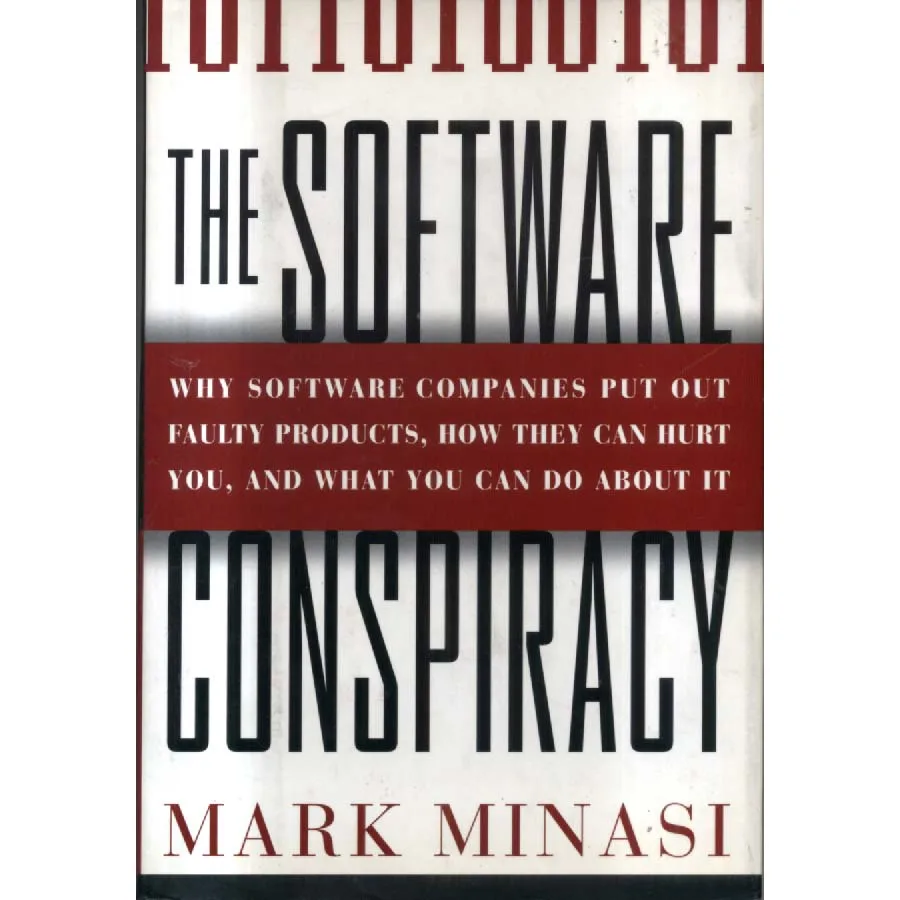
Publisher: McGraw-Hill
Format: Hardback
ISBN: 9780071348065
Some books age gently. Others age like a smirking prophecy. The Software Conspiracy (2000) by Mark Minasi is very much the second sort: a gloriously indignant, sharply observant relic from the turn of the millennium in which one man looked at the software industry, saw the bugs, crashes, patches, vague excuses and suspiciously unfinished products, and decided that perhaps this was not all an unfortunate accident.
And really, who could blame him? The subtitle alone is a thing of beauty: Why Companies Put Out Faulty Products, How They Can Hurt You and What You Can Do About It. No coyness. No soft-focus corporate optimism. No “embracing digital transformation”. Just a direct suggestion that the software on which modern life increasingly depends may be flaky, exasperating and occasionally hazardous, and that this might have something to do with the people selling it to you. Refreshing, really.
Published in 2000, this book comes from that magical era when the digital future was arriving with enormous confidence and somewhat variable reliability. Computers were no longer mysterious specialist devices, but neither were they yet the seamless, pocket-sized tyrants we carry everywhere today. Software still crashed with theatrical commitment. Installation discs lurked in plastic trays. Error messages appeared with the emotional intelligence of a dead moth. And somewhere in the middle of all this, Minasi stepped forward to say, in essence, “Hang on. Why is so much of this rubbish?”
That is the joy of this book. It channels a very particular kind of intelligent user frustration: not the vague grumbling of someone who cannot find the power button, but the properly earned rage of a person who understands enough to know that systems are being sold half-dressed and over-praised. Minasi writes for everyone who has ever stared at a frozen screen, a baffling manual, or a product update that somehow made everything worse, and wondered whether the industry’s preferred quality-control method was simply hope.
There is, too, something deeply satisfying about a title like The Software Conspiracy because it captures a suspicion many people have entertained in private. Not necessarily that there is a literal smoke-filled room where executives agree to ruin your printer driver, though one cannot entirely rule out the possibility, but that commercial incentives often reward speed, hype and market capture rather more generously than they reward “works properly.” Minasi gives that suspicion a proper airing, with the relish of a man who has met too many broken systems to remain polite about them.
From a modern perspective, of course, the book has gained an extra sheen of irony. A reader in 2000 may have imagined that this was a warning specific to the early digital age, a passing growing pain before software matured into a sleek, reliable adulthood. How adorable. Here we are, decades later, still installing updates that mysteriously move menus, still agreeing to unreadable terms, still discovering that the new version of something beloved now requires an account, a subscription, a cloud connection and perhaps part of our soul. In that sense, Minasi was not merely complaining. He was documenting a civilisational trend.
As a Crappy Old Books copy in good condition, this one has an added charm. It feels exactly right that a book about dodgy software should survive in sturdy physical form while vast numbers of the programs it complains about have long since vanished into obsolete formats, unsupported platforms and corporate amnesia. The book remains. The software is gone. There is poetry in that.
And what a splendid object it is for the shelf: a hefty slab of pre-dotcom-crash scepticism, radiating the energy of a man who has had enough of blue screens, corner-cutting and cheerful marketing lies. It belongs equally well in the hands of tech nostalgists, IT professionals, digital sceptics, collectors of millennium-era computing books, and anyone who has ever said, with total justification, “Why doesn’t this thing simply work?”
So yes, The Software Conspiracy is part tech critique, part consumer warning, part therapeutic rant, and all the better for it. It is funny, sharp, suspicious and improbably enduring. A lovely reminder that long before modern users began muttering about apps, updates and ecosystem lock-in, somebody was already standing at the keyboard, rolling up his sleeves, and asking whether the whole shiny enterprise might be just a tiny bit rotten.
Perfect for readers who enjoy computing history, righteous indignation, and the comforting knowledge that software frustration is not a personal failing but a grand, ongoing tradition.
Keep browsing: See more IT books Other books by Mark Minasi
