


Starting Flag To Chequered Flag
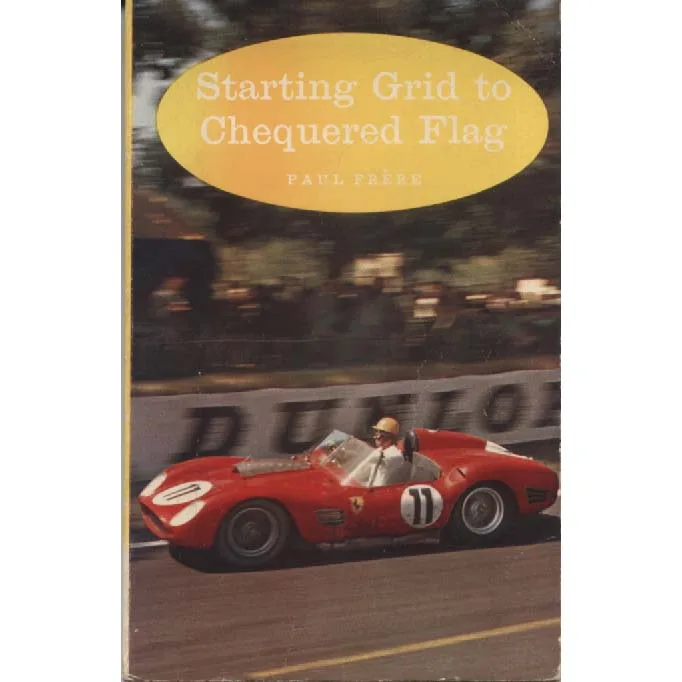
Publisher: BT Batsford Ltd
Format: Paperback
ISBN: none
There are books about motor racing that arrive drenched in glory, petrol fumes, and masculine certainty, promising speed, danger, and the sort of jaw-clenched heroism that appears to require at least three pairs of goggles. And then there is Starting Flag to Chequered Flag (1962) by Paul Frère, which offers all the excitement of racing but with the added pleasure of intelligence — always a slightly unsettling ingredient in any sport built around going very fast while sitting in an explosion.
Published by B. T. Batsford Ltd, this is the work of a man who knew motor racing from the inside. Paul Frère was not merely a commentator peering romantically at cars from behind a barrier. He was a racing driver and journalist, which gives the book that rare and wonderful quality of authority without pomposity. He understood not only what racing looked like, but what it felt like: the technical precision, the tactical calculation, the nerves, the speed, and the ever-present possibility that mechanical optimism might abruptly become mechanical disappointment.
The title itself is splendid. Starting Flag to Chequered Flag promises the whole drama in one neat line: the anticipation, the launch, the contest, the attrition, the brilliance, and finally the finish. It is the complete narrative arc of motor racing, compressed into two flags and a great deal of human ambition in between. It sounds clean and orderly, which is delightful, because racing itself is rarely either. Behind that tidy title lies a world of noise, risk, tiny margins, large egos, engineering obsession, and the continual effort to persuade man and machine to behave as a single purposeful entity.
This is exactly the sort of book that reminds you why mid-century motor racing still exerts such a hold on the imagination. It was glamorous, certainly, but also startlingly exposed. Drivers sat in machines that looked beautiful, went alarmingly fast, and offered roughly the protective reassurance of a determined biscuit tin. The circuits were dramatic, the crowds enthusiastic, and the consequences of error uncomfortably real. A modern racing book may discuss telemetry, tyre windows, and strategy models. A 1962 racing book still carries the flavour of courage, instinct, and engineering daring conducted at a speed best described as morally questionable.
Frère’s perspective is what gives the book its lasting appeal. He understood the mechanical side as well as the human one, which means the reader gets more than just a parade of names and results. There is a sense of how racing works: how cars are developed, how decisions are made, how the contest unfolds beyond the obvious spectacle. In other words, this is not merely a book about cars going round in circles very quickly, though naturally they do that too. It is about the art and logic of racing, which is far more interesting than non-believers suspect.
And there is something wonderfully ironic about racing literature from this era. It often carries itself with great composure, as though describing a refined and serious pursuit, while the underlying reality is that a number of extremely driven people were hurling exquisitely engineered machines at one another around circuits in search of fractions of seconds and eternal bragging rights. The prose says civilisation; the subject frequently says controlled lunacy. That tension is part of the charm.
This Fair copy, from the rev-happy shelves of Crappy Old Books, comes with some slight scribbled red colouring pencil marks on the first blank page and a bit more on the index page, but no other obvious red colouring pencil scribbles. Which, if anything, feels rather cheering. A motor racing book with a touch of accidental visual enthusiasm at the front is hardly disgraced by it. One likes to imagine a previous owner, perhaps young and overcome by racing zeal, briefly deciding that the book needed editorial assistance in red pencil before wisely leaving the rest untouched. Mercifully, the racing itself remains unenhanced.
That means what you have here is still a handsome, readable piece of classic motorsport writing with just enough visible life in it to prove it has been owned by actual humans rather than entombed in a sterile collector’s bunker. It has the slight wear of history about it, which suits a book concerned with machines, competition, and the noble impossibility of keeping everything pristine forever.
In short, Starting Flag to Chequered Flag is a smart, spirited, and highly appealing classic of motor racing literature: a book that captures the world of competitive driving with insight, authority, and that uniquely mid-century blend of technical seriousness and cheerful acceptance of risk. It is a reminder that racing was never just spectacle. It was craft, judgment, nerve, and mechanical faith conducted at extraordinary speed.
A fine choice for anyone who likes classic motorsport, elegant old racing books, or the idea that the quickest route to understanding human ambition may involve an engine, a track, and the sudden drop of a flag.
Keep browsing: See more Sports books Other books by Paul Frere
