


Kennedy
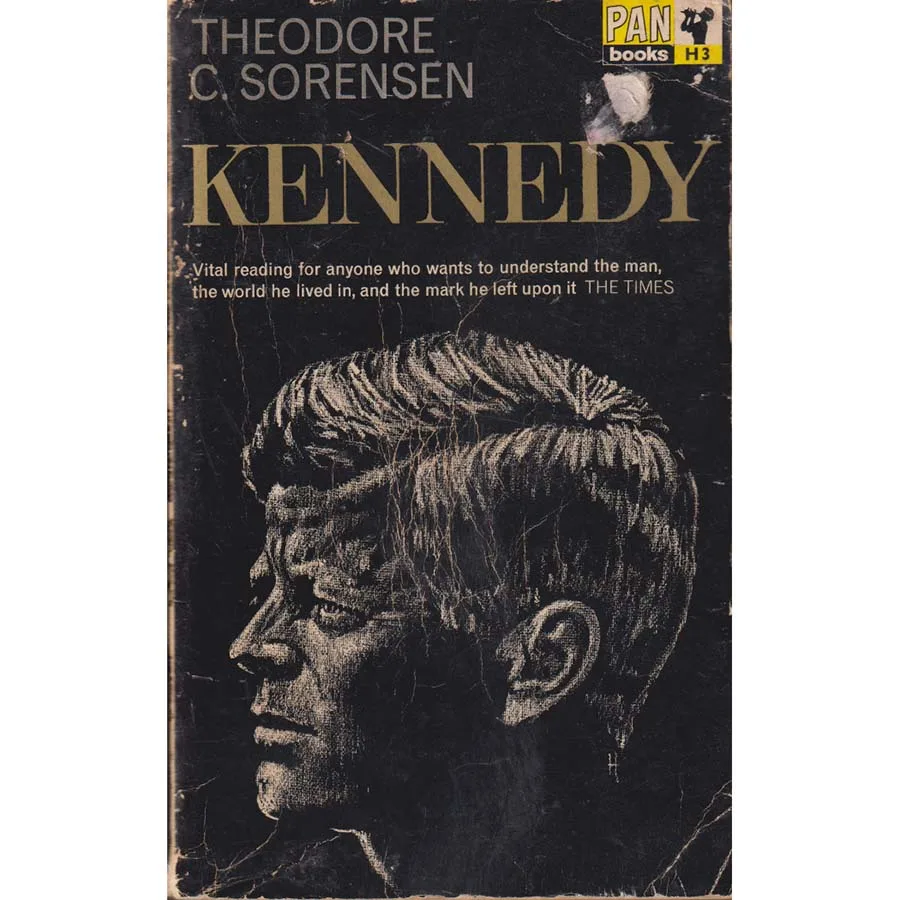
Publisher: Pan Books
Format: Paperback
ISBN: none
There are biographies, and then there are books like Kennedy by Theodore C. Sorensen, which do not merely describe history so much as stroll in wearing the aftershave of proximity to power.
Published in this 1966 Pan Books edition, Kennedy arrives with a rather unfair advantage over most political biographies: its author was not some distant trawler of archives with a sharpened pencil and a grievance, but Theodore C. Sorensen, one of John F. Kennedy’s closest advisers, speechwriters and intellectual co-pilots. In other words, this is not a man peering through the window. This is a man who was in the room, near the desk, probably carrying notes.
And that gives the whole thing a wonderful charge. A biography by an insider is never just a book. It is part portrait, part testimony, part memorial, and part exquisitely controlled act of narrative positioning. One does not open Kennedy expecting gossip in the modern tabloid sense. One expects polish, gravity, admiration, and the unmistakable tone of someone determined that history shall, at the very least, be properly briefed.
The title itself is marvellously austere. Just Kennedy. No subtitle. No “The Untold Story.” No “Camelot Reconsidered.” No “The Man, The Myth, The Missile Crisis.” Simply the surname, as though no further explanation were required. And in 1966, not long after the great public trauma of Dallas, it probably wasn’t. This was a name that had already become shorthand for youth, glamour, intellect, crisis, promise, style, and tragedy, all compressed into one compact American myth with excellent hair.
That, of course, is part of the enduring fascination. Kennedy is one of those figures who seems to belong as much to atmosphere as to history: the White House as stage set, politics as high drama, speeches as polished artefacts, and the whole enterprise bathed in that particular mid-century glow which still manages to make even governmental briefings look cinematic. A book like this does not merely revisit a presidency. It revisits an era when power itself seemed somehow better tailored.
As sold by Crappy Old Books, this copy is in good condition, which suits it admirably. A 1966 Pan edition ought to look like it has lived a little — perhaps handled by someone who took politics seriously, or by a reader who bought it while the memory of Kennedy was still fresh and the world still felt arranged around Cold War seriousness and televised poise. Good condition means it has survived the decades with its dignity intact, ready to resume its role as both historical document and cultural relic.
And what a relic it is. This is not just a book about a president. It is a book from close to the event, from a time when the image of Kennedy had not yet been processed through fifty more years of documentaries, revelations, revisionism and merchandise. It still carries the air of something immediate, composed while the shape of the legend was being fixed. There is a special thrill in books like that. They are not merely about history; they are part of the machinery by which history becomes memory.
Naturally, there is also some delicious irony in reading it now. Modern political biographies tend to arrive bloated with scandal, psychodrama, polling analysis and enough media strategy to stun an ox. Kennedy, by contrast, comes from a sterner age of public prose, when seriousness was worn like a proper suit and even the mythmaking had a certain dignity. It belongs to that vanished world in which public men were presented as if they had read books, advisers wrote in complete sentences, and politics had not yet fully surrendered to the aesthetics of panel shows and social media collapse.
For collectors, it is a lovely piece of twentieth-century political publishing: Pan Books, mid-1960s, the Kennedy aura still warm, and Sorensen’s authorship giving it genuine historical interest beyond the usual shelf of dead statesmen. For readers, it offers the pleasure of entering a version of political life that feels at once grander, more controlled, and more faintly theatrical than our own. For shelf appeal, it is excellent. A copy of Kennedy says many useful things about its owner, most of them involving seriousness, curiosity, and an appreciation for the age when politics still knew how to stage an entrance.
It is also the kind of book that makes you reflect on the strange durability of certain public names. There were many presidents. There were many political memoirs. But few surnames have travelled through history with quite this level of branded inevitability. Kennedy remains less a title than a signal: charisma, catastrophe, youth, America, television, Catholicism, speechwriting, crisis, dynasty. Sorensen knew that, and the book’s plain title lets the whole mythic cargo sit there without fuss.
So here we have a good-condition 1966 paperback by the man who helped give Kennedy much of his public voice: a compact, intelligent, historically charged volume from when the memory was still recent and the legend still under careful construction. It is political biography, yes, but also something more interesting — an artefact from inside the orbit of modern myth.
Kennedy is exactly the sort of book Crappy Old Books likes to rescue: serious but readable, historical but atmospheric, and full of the quiet confidence of a world that still believed public life could be rendered in noble prose. If you like politics, American history, Cold War atmosphere, or simply the elegant melancholy of mid-century power now bound into paperback form, this is a very fine thing to have on the shelf.
Keep browsing: See more Politics books Other books by Theodore C Sorensen
