


Practical Corporate Planning
Publisher: Unwin Hyman
Format: Paperback
ISBN: 0046582312
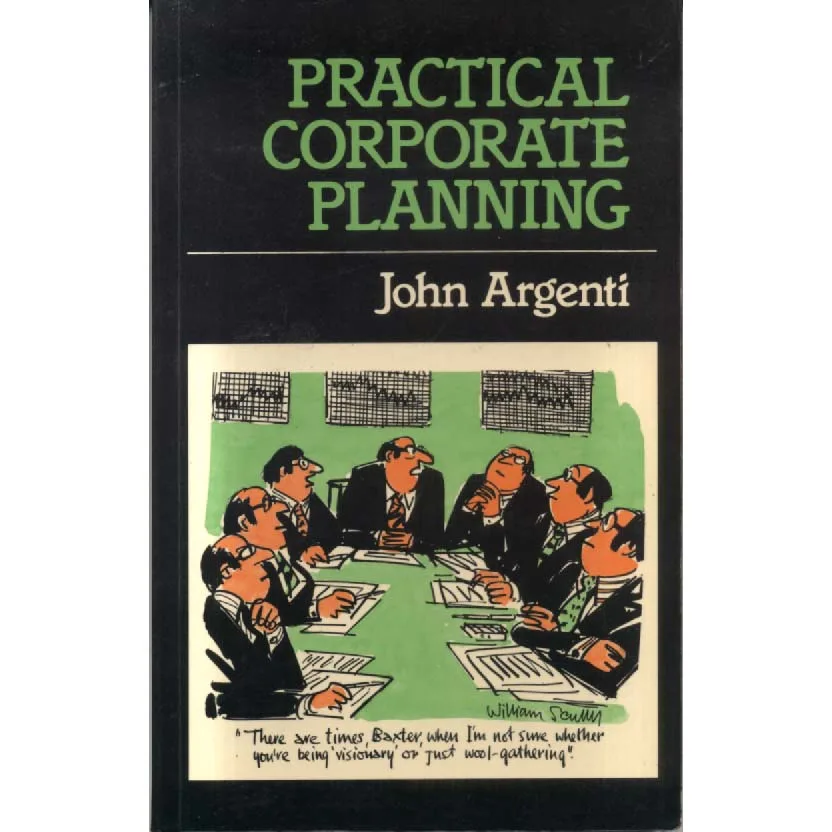
Ah, Practical Corporate Planning (1980) by John Argenti. ISBN: 0046582312. Published by Unwin Hyman. Condition: Good. As sold by Crappy Old Books — which is to say: slightly seasoned by time, faintly redolent of ambition, and still bristling with diagrams that once promised to conquer the future.
This is not just a book. It is a time capsule from an era when men in wide ties and decisive side-partings believed that with enough flow charts, scenario matrices, and strategic grids, one could tame capitalism itself. 1980: before Excel conquered the earth, before “pivot” meant a lifestyle, before “disruption” was something you inflicted on your competitors rather than your sleep schedule. Corporate planning was serious. It had weight. It had binders.
John Argenti does not merely suggest you might consider thinking about the future. He provides a framework. Several frameworks. Possibly frameworks within frameworks. If you have ever longed for the reassuring geometry of boxes connected by arrows — arrows that imply destiny — then this is your spiritual home.
But do not be fooled by the title’s quiet modesty. “Practical” here means practical in the way that building a battleship is practical: structured, methodical, faintly intimidating, and absolutely convinced of its own necessity. Argenti takes you by the lapels and whispers, “Have you considered your long-term strategic objectives?” and suddenly you have, and they are written in capital letters.
The joy of this book lies partly in its glorious pre-digital optimism. Strategy is something one prepares carefully, perhaps with a sharpened pencil and a cup of robust office coffee, rather than something one live-edits in a Slack thread while checking crypto prices. The prose carries that late-20th-century confidence that industry can be analysed, controlled, and gently shepherded toward profit with enough discipline and a well-timed board presentation.
And yet — deliciously — so much of it still applies. Markets wobble. Managers dither. Organisations drift unless someone corrals them into a coherent plan. Argenti’s insistence on clarity, structure, and foresight feels almost radical in an age of perpetual reaction. He would probably disapprove of the phrase “move fast and break things.” He would suggest perhaps planning first, then moving, and ideally breaking nothing at all.
Physically, this copy stands in Good condition: firm, readable, and ready to be deployed in a boardroom, a business school seminar, or as a very subtle warning to anyone who utters the words “We’ll just wing it.” It has the quiet authority of a book that has survived decades of management fashions and still sits there, composed, waiting to explain SWOT analysis to anyone who asks nicely.
Buy it if you are building an empire.
Buy it if you are studying corporate history.
Buy it if you simply enjoy the particular charm of late-70s business seriousness.
Because somewhere between the strategic audits and the long-range forecasts lies a comforting idea: that the future, however unruly, can at least be given a table of contents.
Keep browsing: See more Business books Other books by John Argenti
