


The Iron Bridge - Symbol Of The Industrial Revolution
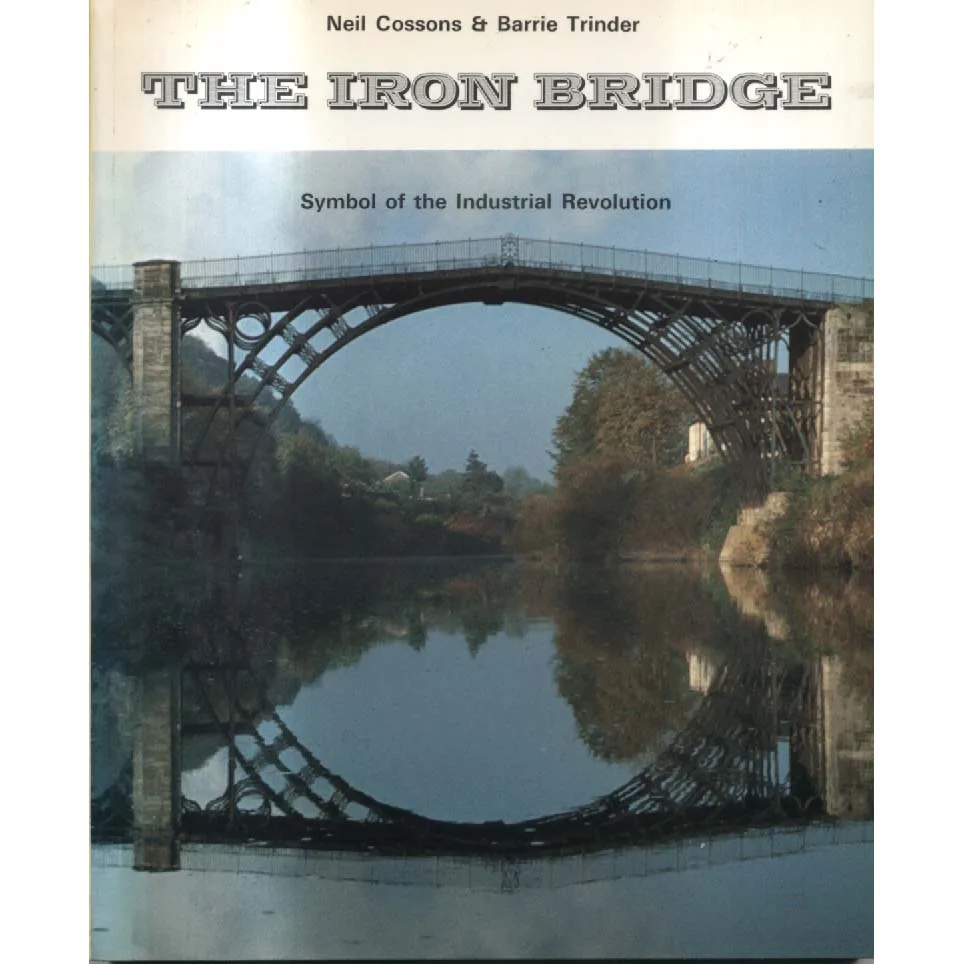
Publisher: Moonraker Press
Format: Paperback
ISBN: 0239001877
The Iron Bridge – Symbol of the Industrial Revolution (1979) by Neil Cossons & Barrie Trinder
Moonraker Press | ISBN: 0239001877
Condition: Good
As sold by Crappy Old Books
Some landmarks politely exist in the background, posing for postcards and being ignored by the people who drive past them daily. The Iron Bridge does not have that luxury. It is, quite literally, a statement in metal: the moment Britain decided that wood and stone were fine, but cast iron was the future — and then built a bridge to prove it.
This book is a love letter to that audacity.
The Iron Bridge – Symbol of the Industrial Revolution takes you into Coalbrookdale and Ironbridge Gorge, where the Industrial Revolution wasn’t an abstract textbook chapter but a place you could smell: furnaces, foundries, river transport, labour, innovation, risk, money, and the awkward birth pangs of modern industry. Neil Cossons and Barrie Trinder are exactly the right guides for this world — grounded, knowledgeable, and keen to show how a single structure can sit at the centre of a whole network of technological change.
Because the bridge isn’t just “a bridge.” It’s a proof-of-concept you can walk across. It’s engineering turned into civic theatre. It’s the point where materials science, industrial capacity, and sheer confidence in human ingenuity all decide to collaborate. You’re not just looking at something pretty spanning the Severn; you’re looking at the early blueprint of the modern built environment — the ancestor of every steel girder, rivet line, and “we can build that” instinct that followed.
And yes, it’s also a symbol in the most human sense: a monument to progress, ambition, and the slightly alarming truth that a lot of history is driven by people saying, “Let’s try it,” before anyone has properly asked, “But what if it goes wrong?”
The book digs into the story behind the structure: why it was built, how it was made, what it meant at the time, and how it became the emblem of the Industrial Revolution. You’ll get context — the industries, the landscape, the local network of production and transport — and you’ll get the bridge itself as an object of fascination: its design, its construction, its reception, its afterlife. It’s the kind of history that feels satisfyingly physical. Not just dates and names, but materials, places, forces and consequences.
And because it’s 1979, there’s an extra pleasing layer: a period when industrial archaeology and heritage were coming into their own, when people were beginning to treat industrial sites not as grubby leftovers but as important cultural treasures. This book sits right in that moment: serious enough to inform, enthusiastic enough to make you want to visit, and proud enough to insist that yes, a bridge can be as historically important as a castle.
This copy is Good, meaning it’s been read, handled, and perhaps consulted by someone who either (a) loves bridges, (b) loves the Industrial Revolution, or (c) accidentally fell down the Ironbridge Gorge rabbit hole and never fully recovered. It’s still very much ready for the next reader to admire a feat of engineering and quietly marvel at the fact that humans looked at molten iron and thought, “Let’s make something elegant.”
From Crappy Old Books: because some revolutions are fought with slogans and speeches — and some are quietly cast, bolted, and then left standing for centuries, making the point without saying a word.
Keep browsing: See more Architecture books Other books by Neil Cossons and Barrie Trinder
