


Sense And Nonsense In Psychology
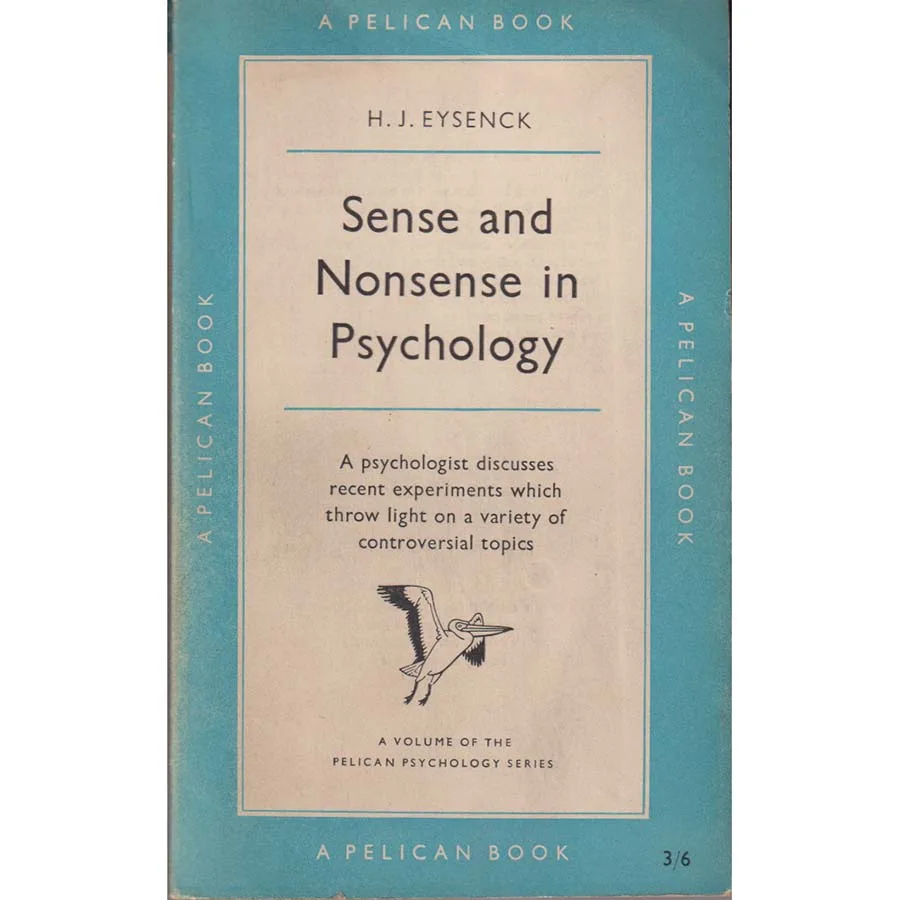
Publisher: Pelican Books
Format: Paperback
ISBN: none
Sense and Nonsense in Psychology (1958) by H. J. Eysenck (Pelican Books)
Condition: Good (as sold by Crappy Old Books)
Before psychology became a glossy TED-talk industry with mood trackers, dopamine hacks, and the occasional influencer diagnosing your ex via interpretive dance, there was H. J. Eysenck turning up in a sensible Pelican paperback to announce, in effect: “Right. Let’s have less mystical hand-waving and more evidence, shall we?” Sense and Nonsense in Psychology is a bracing mid-century slap of cold water to the face — the kind administered by a man who thinks feelings are important, but thinks data is more important.
This book is Eysenck at his most combative and clarifying: marching through big claims, fashionable theories, and cherished assumptions, and sorting them into two piles. On one side: sense (the bits that can be tested, measured, repeated). On the other: nonsense (the bits that sound marvellous at parties but collapse the moment someone asks, “Yes, but how do you know?”). It’s written with the confidence of an era that believed in progress, cigarettes, and the idea that a well-argued book could tidy up an entire discipline.
Expect sharp takes on popular psychological ideas of the day, a strong preference for rigorous methods, and a certain no-nonsense tone that is either refreshing or mildly terrifying, depending on how attached you are to your favourite theory. Eysenck has that particular kind of academic swagger where he’s not just disagreeing with you — he’s implying that you should be faintly embarrassed for having believed it in the first place. The irony, of course, is that reading older psychology is a bit like reading older medicine: half of it feels impressively modern, and half of it makes you quietly grateful for the existence of later research, better ethics, and fewer people casually defining human nature over a pipe.
But that’s the joy of Crappy Old Books finds like this: you’re not buying a flawless textbook. You’re buying a snapshot of psychology in its argumentative adolescence — a period when everyone was still building the rules of the game while also loudly declaring themselves the referee. It’s a book with a mission: to rescue psychology from becoming pure speculation dressed up as science, and to insist that if you’re going to explain the mind, you should be prepared to do the boring part too (the measuring, the testing, the admitting you might be wrong).
Condition: Good, which is perfect for a Pelican paperback that has probably lived through several intense underlining phases, one earnest student, and at least one reader who shouted “YES!” at a paragraph and then immediately used it to win an argument in a pub. The cover may be slightly scuffed — much like the human ego after Eysenck has finished with it — but it’s still standing, still opinionated, and still ready to tell you that psychology should stop being so dramatic and start behaving itself.
Ideal for readers who enjoy their non-fiction smart, punchy, historically fascinating, and just a little bit spicy — a time capsule from when the mind was being mapped with rulers, stopwatches, and a very stern eyebrow.
Keep browsing: See more Academic books Other books by HJ Eysenck
