


National Geographic 1994 February
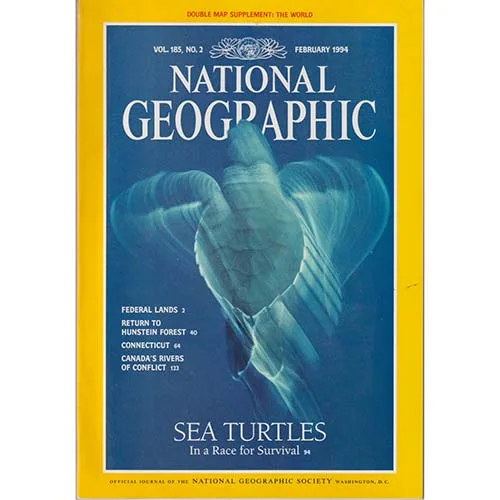
Publisher: National Geographic
Format: Paperback
ISBN: none
Welcome to National Geographic, February 1994 (Vol. 185, No. 2) — a gorgeously pre-internet slab of world knowledge from the era when “scrolling” meant unfolding a map across the entire floor and accidentally sitting on Australia.
The cover is a dreamy underwater scene: a sea turtle ghosting through blue depth like an ancient, gentle submarine with flippers. The headline is pure Nat Geo understatement: “Sea Turtles — In a Race for Survival.” Because nothing says “relaxing magazine” like being quietly informed that one of nature’s most beloved creatures is sprinting (at turtle speed) away from extinction while we all stand around like confused lifeguards.
Inside, you get that classic 1990s National Geographic vibe: earnest, well-mannered doom paired with the soothing promise that if we just look closely enough — with photography, science, and a serious font — we might actually do something sensible.
The sea turtles feature is the main event: migration, nesting beaches, predators, plastic, fishing lines, lights, luck — the whole fragile miracle of an animal that has been doing its thing for an absurd amount of time, only to find modern humanity has introduced a new obstacle course called “everything.” It’s beautiful, it’s infuriating, and it will absolutely make you stare at a crisp packet in disgust for at least a week.
But February 1994 is also one of those Nat Geo issues that refuses to stay in one biome. It’s a proper world sampler: federal lands, Huntstein Forest, Connecticut, Canada’s rivers of conflict — a spread that says, “Yes, you can have turtles, but you will also have policy, woodland, New England, and the complicated politics of water.” Balance. Range. The editorial equivalent of eating salad because you also had cake.
And then there’s the real star of your listing: the included large foldout map of the Earth, two-sided — physical and political. This is prime National Geographic behaviour. They don’t just tell you about the world, they hand you the world in poster form, like: Here. Carry this knowledge. Put it on your wall. Become the sort of person who points at places while talking. One side is the planet as it actually is — mountains, basins, ocean trenches, the physical reality of Earth doing Earth things. Flip it over and you get the political layer — borders, countries, names, the tidy human attempt to organise a spinning rock into manageable sections. It’s both practical and faintly hilarious: the physical map says “I existed before you,” the political map says “we tried our best.”
Condition: Good, meaning it’s pre-loved and perfectly readable — solid enough for a proper sit-down read, handsome enough for coffee-table display, and sturdy enough to survive at least one dramatic map-unfolding session. Expect light signs of age, but plenty of life left: the turtle still glides, the ink still holds, and the map still has the power to turn any room into a classroom.
If you want a vintage National Geographic that delivers underwater beauty, quiet environmental urgency, and a massive two-sided Earth map that instantly upgrades your wall (and your personality), February 1994 is a winner. Sold by Crappy Old Books, naturally — the unofficial rescue centre for old magazines, big maps, and small creatures just trying to make it.
Keep browsing: See more National Geographic books Other books by National Geographic
