


National Geographic 1991 July
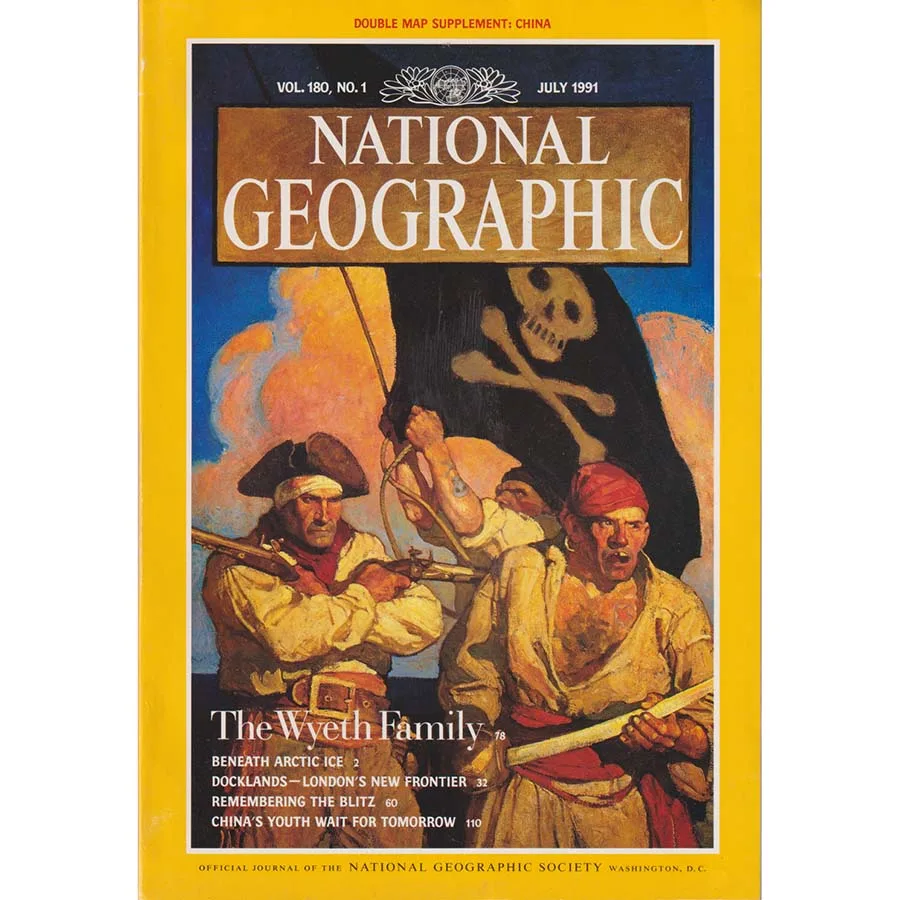
Publisher: National Geographic
Format: Paperback
ISBN: none
National Geographic, July 1991: the issue that kicks down the door, waves a pirate flag, and announces—very politely, in impeccable serif type—that it would like to educate you. And possibly board your ship. For science.
The cover art is all swagger and drama, because the headline feature is The Wyeth Family—a deep dive into the American artistic dynasty that gave us some of the most haunting, windswept, quietly intense images ever painted. Nat Geo has chosen to introduce this cultured, painterly topic with… literal pirates. Which is either genius or a reminder that the magazine’s true brand is “adventure,” even when it’s talking about brushstrokes. (To be fair, the Wyeths did paint plenty of sea-and-storm energy. This cover is basically saying: art can still punch.)
Inside, expect a big, glossy, affectionate exploration of creativity across generations: studios, landscapes, obsessions, process, and that uniquely Wyeth mood—beautiful, restrained, slightly eerie, like the countryside is keeping secrets. You’ll get the sense of how a family can become its own ecosystem: influence, rebellion, inheritance, and the odd burden of having a surname that already comes with expectations.
And because this is National Geographic, it doesn’t stop at art. It flings open four more doors and shouts, “Also, the Arctic! Also, London! Also, WWII memory! Also, China’s future!” Like a party host who can’t stop bringing out new trays.
-
Beneath Arctic Ice – the classic Nat Geo “humans go somewhere deeply unfriendly with expensive equipment and calm bravery.” Expect blue-black water, strange silence, and the kind of cold that makes you feel chilly even while holding a magazine indoors in July.
-
Docklands—London’s New Frontier – a wonderfully early-90s time capsule: London reinventing itself, cranes and glass and ambition, the Thames-side transformation while the future is still under construction. Reading it now is like seeing a familiar skyline in its awkward teenage phase.
-
Remembering the Blitz – history with a human pulse: memory, survival, the way a city carries trauma and pride in equal measure. Nat Geo does this with that respectful, reflective tone that makes you slow down.
-
China’s Youth Wait for Tomorrow – and here’s your geopolitical long-view: a snapshot of aspirations, constraints, change, and the feeling of a huge country on the edge of another chapter. In 1991, “tomorrow” feels loaded. From here, it feels like understatement.
And, crowning it all, the banner at the top: Double Map Supplement: China. Which means you’re not just reading about change—you’re getting a giant fold-out map to physically wrestle with. You will unfold it once, feel powerful, then immediately realise you have forgotten how folding works. This is the Nat Geo ritual.
Condition: Good, which is exactly what you want for a 1991 issue: sturdy, readable, and fat with that pre-internet confidence—long articles, lavish imagery, and no fear of your attention span. Sold by Crappy Old Books, naturally, because the best way to buy pirates-as-fine-art, Arctic exploration, London redevelopment, Blitz memory, a youth-on-the-cusp China feature, and a massive map is from a seller whose name suggests you found it by rummaging through a hoard.
If you want a National Geographic that feels like five documentaries, a gallery visit, and a cartography workout in one—July 1991 delivers. Come for the pirate flag. Stay for the map. Leave with opinions about art, ice, London, history, and the future.
Keep browsing: See more National Geographic books Other books by National Geographic
