


National Geographic 1991 December
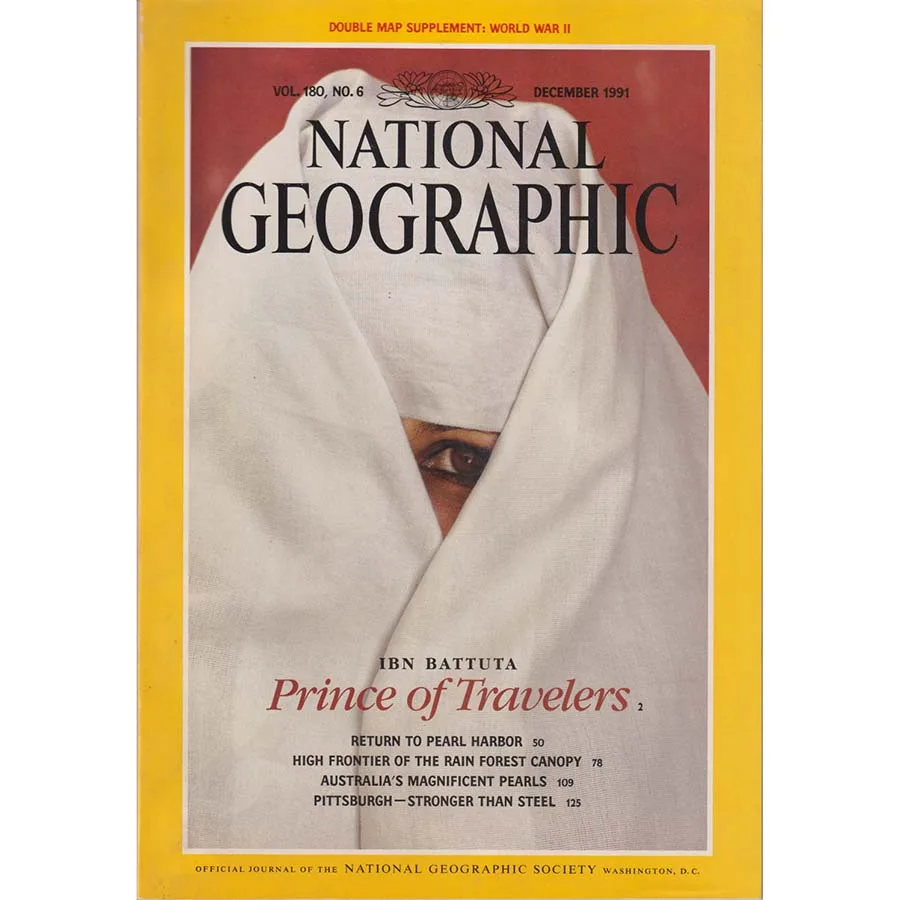
Publisher: National Geographic
Format: Paperback
ISBN: none
National Geographic, December 1991: the issue that turns up like a beautifully wrapped present, then opens itself to reveal… a 14th-century travel legend, Pearl Harbor, rainforest treetops, Australian pearls, Pittsburgh steel, and a giant World War II map. Because why choose one theme when you can have all of human civilisation in a single yellow-bordered rectangle?
The cover story is Ibn Battuta: Prince of Travelers, and the cover image is pure understated drama: a single eye framed by white cloth, quietly daring you to underestimate what’s inside. Ibn Battuta, of course, is the patron saint of “just popping out for a bit” and then accidentally travelling tens of thousands of miles across the known world. National Geographic leans into the romance of it: deserts, ports, courts, caravan routes, languages, food, rituals—travel as deep immersion rather than a weekend break with a tote bag. It’s a reminder that long before airports and loyalty points, some people were out there collecting entire continents like stamps.
And the irony is delicious: this is a magazine issue about exploration, but you’re doing it from your sofa. Ibn Battuta spent years navigating storms, politics, disease, and the occasional life-threatening misunderstanding. You’ll navigate the tricky bit where the fold-out map refuses to fold back properly.
Because yes—at the top it proudly announces: Double Map Supplement: World War II. Classic Nat Geo. Here, have a beautifully printed cartographic monster that will briefly make you feel like an admiral, a general, and a historian all at once. Then it will humble you as you attempt to refold it into its original shape, which is apparently achievable only by someone with a PhD in paper engineering and perfect moral character.
Inside, the supporting features are peak December Nat Geo: big history, big nature, big industry—like a year-end banquet where every course is in a different genre:
-
Return to Pearl Harbor – a reflective revisit rather than a headline chase. Memory, aftermath, place, and the way history sits in the landscape long after the event. Sobering, human, and quietly powerful.
-
High Frontier of the Rain Forest Canopy – that wonderful Nat Geo trick of taking something you’ve heard of (rainforests) and then moving the camera to the bit you’ve never properly imagined (the canopy). Heights, strange creatures, epiphytes, light, and a whole aerial world operating above our heads like a busy city we rarely visit.
-
Australia’s Magnificent Pearls – glamour with biology underneath. Beauty produced by irritation, industry built on tiny processes, and the reminder that luxury often begins as a stubborn little organism doing its job.
-
Pittsburgh—Stronger Than Steel – a city portrait with that classic Nat Geo fondness for human resilience: industry, reinvention, neighbourhood grit, and the civic pride of a place that refuses to be defined by one chapter.
Condition: Good, which is exactly right for a 1991 National Geographic: solid, readable, and still soaked in that pre-internet confidence—proper long-form writing, lush photography, and the assumption that you can sit still long enough to learn something. Sold by Crappy Old Books, naturally, because the best way to acquire Ibn Battuta’s globe-trotting, Pearl Harbor’s memory, rainforest treetops, Australian pearls, Pittsburgh muscle, and a massive World War II map is from a seller whose name suggests you’ll also find a random atlas and a mysterious pamphlet you didn’t know you needed.
If you want a December issue that feels like an entire education—equal parts adventure, reflection, wonder, and industrial soul—1991’s finale absolutely delivers. Just clear some space for the map. And perhaps a small prayer for your folding skills.
Keep browsing: See more National Geographic books Other books by National Geographic
