


National Geographic 1991 May
Publisher: National Geographic
Format: Paperback
ISBN: none
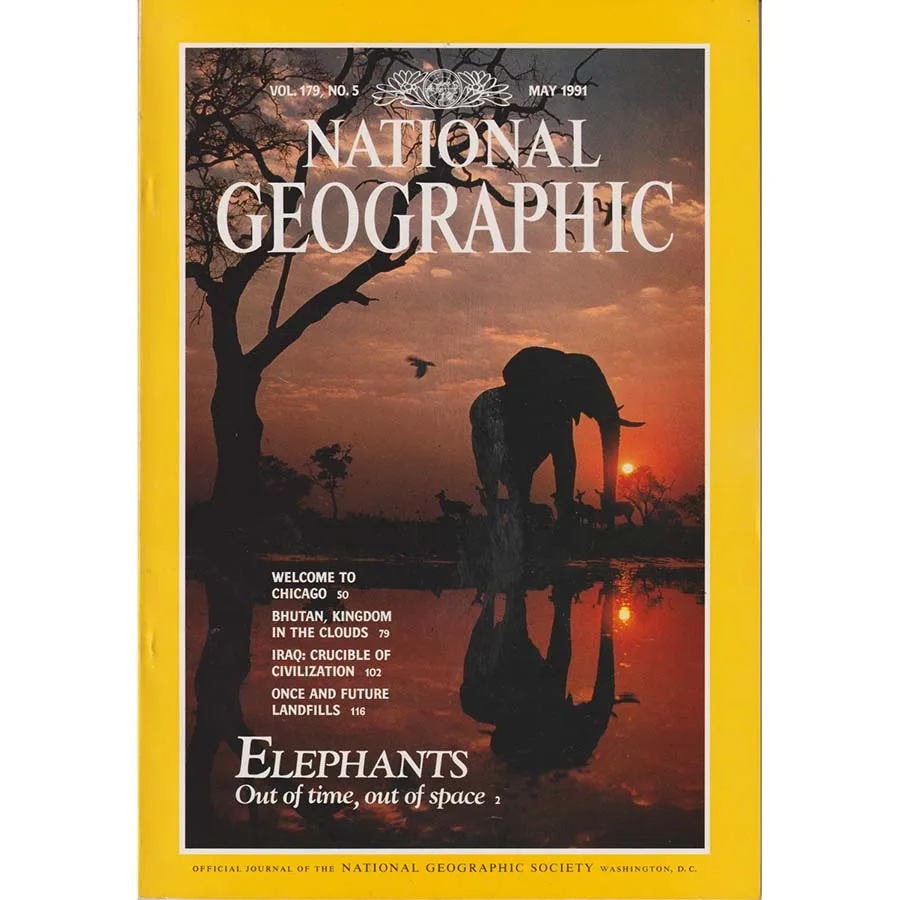
National Geographic, May 1991: the issue that arrives like a perfect postcard from the edge of the world—sunset, silhouettes, calm water, and an elephant posed like it’s modelling for “Majesty Monthly”—and then quietly informs you that this beauty is not guaranteed to last.
The cover feature is Elephants: Out of time, out of space, which is about as elegant a way as you can possibly say, “We’re running out of room and the elephants are paying for it.” The image is pure Nat Geo theatre: an elephant framed against a blood-orange sky, reflected in still water, with that timeless savannah mood that makes you want to whisper even though you’re holding a magazine. It’s breathtaking. It’s also the sort of beauty that, by 1991, already carries an undertone of urgency—habitat pressure, human expansion, conflict, poaching, and conservation that feels like a race against the calendar.
Inside, expect the full National Geographic elephant treatment: the intimacy (families, bonds, memory, grief), the scale (migrations, landscapes, sheer size), and the uncomfortable arithmetic of modern life pressing in. The phrase “out of time” isn’t melodrama; it’s a warning label. Nat Geo in this era is at its best when it’s doing exactly this: seducing you with wonder, then gently steering you toward the stakes.
And because it’s a proper early-90s issue—thick, serious, and casually globe-spanning—the supporting articles read like an entire season of television in one sitting:
-
Welcome to Chicago – because after the savannah, why not drop into a great American city and examine its guts? Expect architecture, industry, neighbourhoods, reinvention, and that old Nat Geo delight in showing that “urban” is also a landscape worth exploring.
-
Bhutan, Kingdom in the Clouds – a title so dreamy it practically floats off the page. Mountains, monasteries, mist, and the sense of a place balancing tradition and the outside world. It’s the soothing counterpoint to the harder stories.
-
Iraq: Crucible of Civilization – history on a grand scale: the deep, foundational story of Mesopotamia, culture and archaeology, the long view of a region that is far more than the news cycle’s version of it. Reading it now feels like stepping into a layered time capsule.
-
Once and Future Landfills – and there’s the Nat Geo sting in the tail: the quiet, unglamorous subject that turns out to be absolutely central to modern life. Rubbish as archaeology-in-real-time. Civilisation measured in what it throws away. It’s weirdly compelling and slightly accusatory in the way only a landfill story can be.
Condition: Good, which is exactly what you want from a 1991 National Geographic: sturdy, readable, and still drenched in that era’s confidence—long articles, lush photography, and no fear of your attention span. Sold by Crappy Old Books, naturally, because the best way to buy elephants at sunset, Chicago in detail, Bhutan in mist, Iraq in deep time, and a philosophical punch-up about landfills is from a seller whose name suggests treasure hidden in slightly chaotic stacks.
If you want one issue that captures the whole Nat Geo trick—beauty with a blade inside it—May 1991 is a belter. Come for the elephant silhouette. Stay for the uneasy feeling that “out of space” might apply to all of us.
Keep browsing: See more National Geographic books Other books by National Geographic
