


National Geographic 1992 July
Publisher: National Geographic
Format: Paperback
ISBN: none
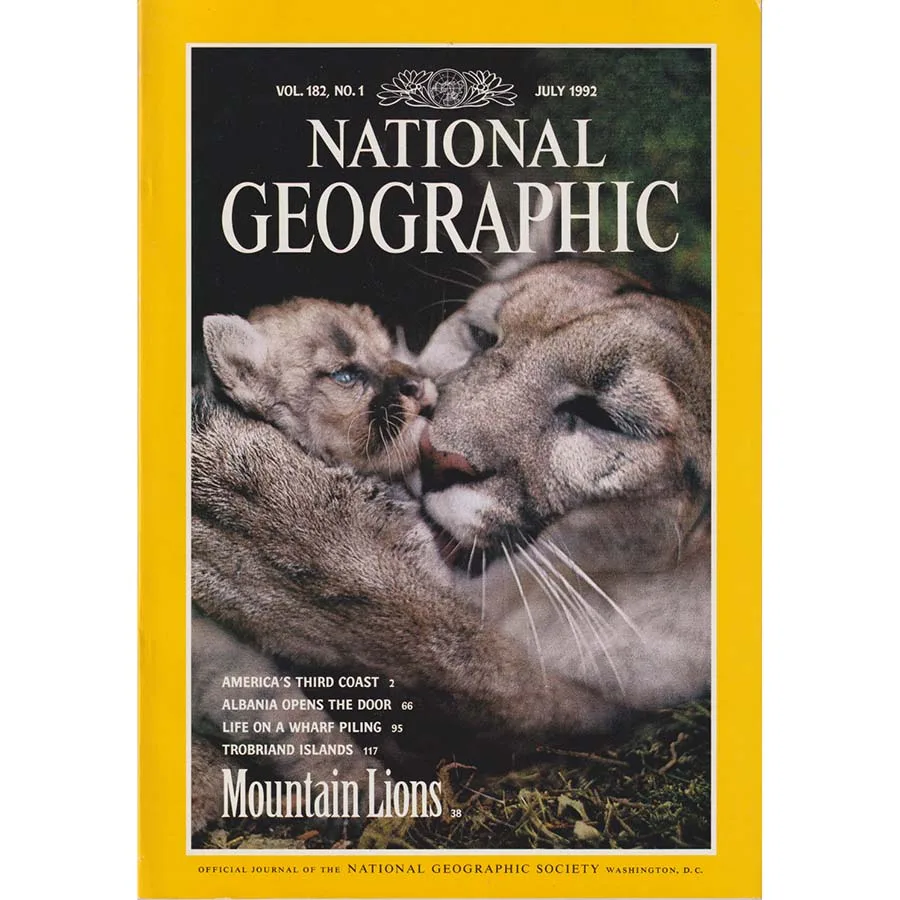
National Geographic, July 1992: the issue that lures you in with an impossibly tender close-up of a mountain lion mum cuddling her tiny, slightly grumpy kitten… and then gently reminds you that this adorable family unit belongs to an animal capable of silently deleting deer from existence.
The cover feature, Mountain Lions, is peak National Geographic emotional whiplash: soft fur, sleepy eyes, a little paw tucked in, and the quiet knowledge that you are looking at a perfectly engineered apex predator who would like you to stop calling it “kitty.” The photography here does what Nat Geo always did best in the 90s—make wildlife feel intimate and real, not just “out there,” but close enough that you can almost hear the breathing. It’s beautiful, and it also makes you respect shadows.
Inside, expect the full cougar treatment: secretive lives, enormous territories, tracking and research, human fear, human fascination, and the eternal conservation question of what happens when wild animals and expanding civilisation keep bumping into each other at the edge of a suburb. It’s one of those features that starts as “aww” and ends as “oh… we’ve built a lot of houses, haven’t we.”
And because this is a proper early-90s Nat Geo, the rest of the issue is a wonderfully chaotic world tour that reads like someone spun a globe, pointed, and said “Yes, all of it”:
-
America’s Third Coast – which sounds like a marketing slogan until you remember the U.S. has a whole other watery edge that isn’t the Atlantic or Pacific, and it comes with its own culture, ecology, and big, overlooked geography. Expect ships, commerce, weather, and the kind of landscapes people forget are doing heavy lifting for the country.
-
Albania Opens the Door – very 1992, very “the world is changing while we watch.” A country emerging from isolation into a new reality, with all the complexity, hope, and uncertainty that implies. Nat Geo does this well: human stories on the hinge of history.
-
Life on a Wharf Piling – an absurdly specific title that is also a classic Nat Geo trap. You think it’ll be niche. Then you’re 12 pages deep, fully invested in barnacles, anemones, tiny fish, and the entire bustling universe living on a bit of wood you’ve walked past your whole life without noticing.
-
Trobriand Islands – anthropology, culture, and the reminder that the world contains ways of living that aren’t just “different,” but structurally, beautifully alternative. Expect rituals, daily life, and that gentle Nat Geo tone that tries to translate without flattening.
Condition: Good, which is perfect for a 1992 issue: solid, readable, and still thick with that pre-internet confidence—long articles, lush photography, and absolutely no fear of your attention span. Sold by Crappy Old Books, naturally, because the best place to buy a mountain lion cuddle-fest plus Albanian history, American coastline geography, microscopic pier ecology, and island culture is a seller whose name suggests treasure hidden under mildly chaotic stacks.
If you like your National Geographic with a soft cover image and sharp teeth underneath—July 1992 is a cracking pick. Come for the kitten. Stay for the wharf piling. Leave with a new respect for anything that can purr and kill.
Keep browsing: See more National Geographic books Other books by National Geographic
